
Both Ukraine and Russia are stuck with either losing face or losing lives - Patrick Mercer
Rather more brinkmanship than usual is going on in Ukraine. Certainly, there’s a degree of theatre surrounding a temporary ceasefire over the May 9 period - the date in 1945 when the Soviets defeated Nazism - but both sides could find that they’ve manoeuvred themselves into a position where further, violent escalation is the only outcome.
As you read this Russians will be marking Victory Day, which is sacred to them. Since the start of the war in Ukraine parades have been under threat and have been reduced, but normally, great columns of perfectly drilled troops and tanks roll across Red Square in Moscow and other towns and cities.
Now, though, Ukraine’s drone campaign means that an attack on the spectacle is highly probable, the humiliation of which would be enormous for Russia. The Kremlin has more than grasped this so they’ve declared a short ceasefire over the period of the celebrations.
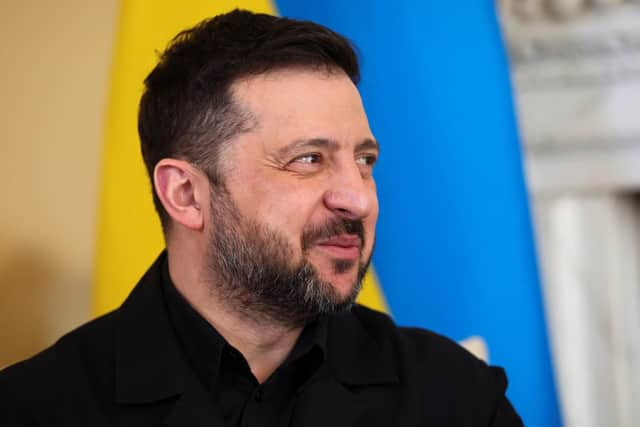
Russia hoped and expected that Kiev would be desperate for a break in hostilities, but President Zelensky reasoned that a pause in his long range drone campaign dictated by Russia would smack of weakness. So, he imposed his own ceasefire immediately after demonstrating that he could fly a drone into one of the poshest parts of the Russian capital. He then lifted his truce just as quickly as he’d declared it.

In response Moscow vowed that the instant they detected a missile or drone launch during the hours of their ceasefire they would retaliate deep into Kiev without discussion, aiming especially at ‘decision making centres’. It was also hinted that these would be the hyper fast Oreshnik ballistic missile which have only been used twice so far and against which there seems to be no defence.
The destruction would be vast; to underline their threat, Moscow warned citizens and foreign diplomatic staff to leave Kiev right now.
The problem is that both sides are stuck with either losing face or losing lives. Zelensky overplayed his cards by simply not immediately agreeing to Moscow’s ceasefire and then exploiting the lull to rest and regroup. In parallel, should Putin break his promise to retaliate massively at the first sign of even a modest assault, he’ll look panicky. What should have been a period of calm now promises bloody escalation.
As if this wasn’t enough of a drama, Friedrich Merz, Germany’s Chancellor, has provoked the most serious diplomatic crisis of his leadership by picking a fight with Donald Trump. This usually sober suit can normally be relied upon to weigh his words carefully, but not last week.
Whether Merz said what he said deliberately or by error is impossible to know. Perhaps he thought that his audience of youngsters at a school in his constituency were the only people listening when he said that the Iranian government, “…are obviously very skilled at negotiating, or rather, very skilful at not negotiating, letting the Americans travel to Islamabad and then leave again without any result” he continued, “An entire nation is being humiliated by the Iranian leadership.”
Herr Merz was quite wrong, though, for his words travelled across the Atlantic almost instantly.
The riposte was equally blunt from the US President, “(The Chancellor) doesn’t know what he is talking about”, he’s “totally ineffective”, is presiding over a “broken country” and presumably “thinks it’s OK for Iran to have a nuclear weapon”.
Germany - perhaps self interestedly - has been at the forefront of support for Ukraine and is not just talking about re-arming, she’s actually doing it. Yet, when President Trump asked for naval support to help open the Straits of Hormuz, Berlin swerved.
Then came angry words followed by Washington’s punishment: extra tariffs, a promise to station long range US missiles in Germany cancelled and an immediate threat to withdraw 5,000 troops with, in The Donald’s words, “plenty more to come”.
This is not just another political spat, it’s a serious misjudgment especially when it’s remembered that Friedrich Merz has always been a leading Trump-whisperer. Appease, schmooze, placate have been Merz’s creed until the mask suddenly slipped and Germany's chief rake-stepper scuppered his own careful efforts to build a relationship with the mercurial US president.
And now the NATO schism manifests itself with an unspoken race for leadership of whatever remains once The Donald takes his tanks home. Logically, that role should fall to the head of government of western Europe’s largest country who speaks for a large part of the EU and NATO too. Yet, there’s another candidate.
Some suggested that Boris Johnson’s uncharacteristic focus that he displayed over Ukraine was inspired simply by a chance to lead a new sub-set of NATO. With unusual prescience he saw the possibility of a new role for Britain - a vision that our current government has eagerly pirated.
Now a pitch to lead ‘NATO lite’ would suit Labour’s obvious wish to reintegrate with the EU whilst simultaneously pretending that Britain’s still militarily relevant.
Patrick Mercer is a former MP for Newark and Army Colonel.