
Bradford 2025: The year has come for the city to take control of its own narrative and destiny - Toby Howarth, Bishop of Bradford
Happy New Year and welcome to Bradford 2025: UK City of Culture. We’ve finally arrived. First it was the months of pulling together our bid. Then that riotously joyful moment in City Park I remember so well when we heard that Bradford had been crowned UK City of Culture 2025.
Then came the hard work of putting together a team, a programme, finding partners and fundraising. And all this while the city centre was being transformed with new pedestrian walk-ways, green spaces and the redevelopment of spaces such as the National Media Museum.
Bradford 2025 kicks off with ‘Rise’, a spectacular opening event with Steven Frayne, formerly known as Dynamo, on January 10 and 11. It continues through the year and across the district. ‘Earth and Sky’, for example, invites us to walk with Opera North’s immersive music on Haworth’s Pennistone Hill; ‘Draw’ invites us to pick up our pencils with David Hockney, and ‘Sing, Dance, Leap’ invites school children to do just that in a major programme with the Royal Ballet and other national partners.
At the heart of Bradford’s year as UK City of Culture is stories: individual stories, community stories and something even bigger. Bradford 2025 is that rare thing: an opportunity for a whole city and district to re-tell its story to the nation and the world.
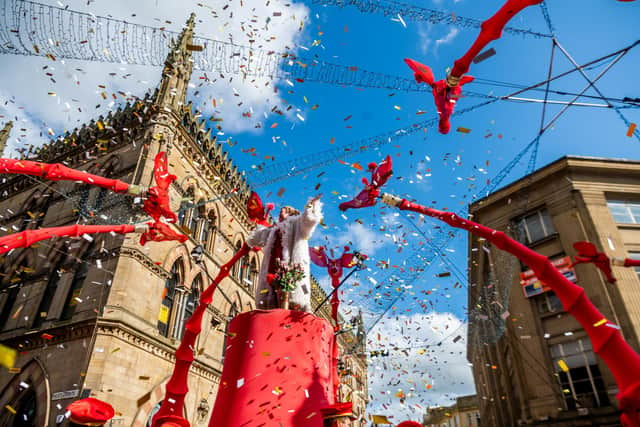

We will be in the national spotlight, where we and others can examine the narratives that have shaped us with honesty, humour and love. This is about how others outside of Bradford see us, and it is about how we see ourselves. It is about honouring our stories of the past while opening up the possibility of new stories for our future.
Take, for example, the story of the Bradford Fire. On May 11 this year, we will be commemorating the 40th anniversary of the dreadful inferno at Bradford City Football’s Valley Parade which took the lives of 56 spectators and left hundreds more with horrific burns.
But as terrible as that fire was, the re-telling of the story of the fire has taken on new, positive layers as the years have gone by.
There was of course the extraordinary bravery and resilience shown on the day. In the immediate aftermath, Prof David Sharpe set up the renowned Bradford Burns Unit, developing the ‘Bradford Sling’ in his treatment of victims, which is still used internationally, often on patients who have never otherwise heard of the city.
Later, more was told about the local Bangladeshi community living around Valley Parade. Parents used to warn their children to stay indoors on match days for fear of racism. Nevertheless, on the day of the fire, many local residents opened their homes for survivors to receive care and to telephone loved-ones. Still later, leaders in that community developed a supporters club, the Bangla Bantams, who have since won awards and whose story was told nationally in a BBC Radio 4 play in 2023.
Some of Bradford’s stories have deep roots and long tails. Take, for example, the story of the city’s most famous ghost. In June 1643, Bradford was on the front lines of the English Civil War. Oliver Cromwell’s forces were in control, but the Earl of Newcastle, William Cavendish was besieging it with the King’s forces.
Cavendish stayed at Bolling Hall with his Royalist supporters, and that night, just before dawn, he was visited by a ghost, an apparition of a lady dressed in white who pleaded with the Earl over and over again to “pity poor Bradford”.
That phrase was one that I heard long before I knew where it originated and it still captures a sense of Bradford as a victim. Maybe 2025 can be a year in which we put that ghost to rest.
Re-framing our narrative as a city and district is not just about the arts and ‘high culture’. It is about economics and investment, about development and jobs. National and international businesses will want to come to Bradford if the narrative they hear about the place is one of confidence, youth, creativity and entrepreneurial energy.
If we are not careful, the stories we tell about ourselves can become prisons. We can find ourselves locked up in places of victimhood or feel that privileges we hold are ours by right. The story of God’s people in the Bible is, rather, told as a story of grace. We learn that our real value lies not in our achievements or the suffering that we have endured, but simply in the fact that we are loved by God and called to follow in the way of love shown to us in Jesus Christ.
Such knowledge then gives us the deep confidence to create new stories and new futures for ourselves, our families and our communities. I hear these stories often as I travel around the Bradford district as bishop.
So, here’s an invitation for the New Year, whether you’re reading this in Bradford or further afield. Come and take part in our UK City of Culture and join in with this year’s opportunity to re-frame Bradford’s narrative. What about “Bradford: heaven on earth”?
Toby Howarth is the Bishop of Bradford.