
Bridges loom large in war and peace as Trump cosies up to Putin and Xi: Patrick Mercer
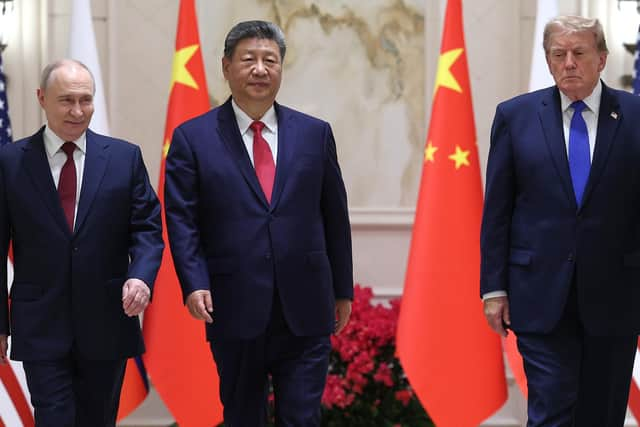
Bridges seem to be central to everything at the moment. Donald Trump, Xi Jinping and Vladimir Putin met at the sidelines of the Asia-Pacific Economic Cooperation (APEC) summit in an unprecedented three-way bridge-building meeting of the three leaders.
At the same time – and certainly designed to focus the minds of the three premiers – Ukraine and Russia have been hammering away at each other’s physical bridges. Most eye-catching has been the serious damage inflicted on Russia’s Kerch Bridge, a target that Ukraine and her allies have struck several times, but never conclusively.
Historically, the Crimean peninsula could only be approached by road from the north. To great fanfares that changed in 2018 when President Putin opened the Kerch Bridge at Crimea’s eastern point creating another route to the Russian mainland.
What’s often ignored is Moscow’s tactical success in March 2022 when her troops seized another ‘bridge’ – a sleeve of land along the coast of the Sea of Azov towards Crimea, opening a main artery – the M14 highway – for military operation. So vital was this corridor that Ukraine mounted a summer offensive in 2023 to sever it. That failed bloodily and the destruction of the Kerch bridge became a point of principle for Kyiv.

The Kremlin soon realised the emotional as well as practical importance of this bridge especially after the leak of a meeting of some of Nato’s German generals where a plan to destroy it was discussed. In view of this Moscow ordered all military convoys to use the land route. So, the tactical importance of the Kerch bridge has been drastically reduced, but that really isn’t the point. Russia has invested so much national pride in physically linking their mainland with the Crimea that protecting the bridge has become a matter of honour.
Meanwhile, Russian Intelligence claims that UK officers designed the attack, British Storm Shadow cruise missiles did the bulk of the damage and 24 hours before Kyiv’s operations began a RAF ‘Rivet Joint’ reconnaissance aircraft was seen to be especially interested in Kerch. Defence Secretary Wes Streeting’s clumsy speech in the wake of the attack has turned Britain’s central involvement into a fact for the Kremlin rather than just a rumour.
Yet, after intense drone and missile attacks over the last week the bridge still stood yesterday, although a great chunk in the middle has collapsed leaving only the railway line working.
Moscow believed that the damage wasn’t fatal until it was discovered that debris has blocked the deep water shipping channel, effectively closing the Black Sea route to the vital ports on the Sea of Azov. The operation was carefully planned and it’s not certain that Russia will be able clear the underwater barrier unless the whole area can be protected from further attacks.
In parallel, Moscow has been bombarding Ukraine’s strategically important bridges across the Dnieper river. Especially in Zaporizhzhia city and Kyiv, the main crossings have been so badly damaged that resupply of the front lines in the Donbas and the southern front has become critical.
There may be more to this than meets the eye, though. Once it became clear that Ukraine was not going to be a push over and supplies from Nato began to flow, Russian hawks heavily criticised the Kremlin for not destroying the Dnieper bridges. But this is always a dilemma for soldiers who see that a damaged bridge can be captured, repaired and used for their own counter attacks whilst a ruined one can’t.
And the fact that Moscow’s strikes penetrate Kyiv’s air defences and make the bridges unusable but repairable suggests that Mr Putin’s generals expect to cross over them sometime soon. Now, the brass hats may just be over-ambitious, but this tells me that Russia’s high command is confident enough to plan advances much deeper into Ukraine.
Similarly, the first impression is that both sides have been determined to bust a bridge or two right under the noses of Trump, Putin and Xi, but that’s not the case. Certainly, Ukraine’s assault has literally made more of a splash, but both Moscow and Kyiv have delayed their knock-out blows for fear of seizing media headlines whilst the three most powerful leaders in the world plot and scheme.
It’s possible that by the time you read this several bridges will have dropped into the rivers they span, but so long as nothing detracted from what could develop into a fundamental shift in global power blocs, The Big Three will be content.
So, the meetings might well be the first steps towards a new alliance which few would have predicted even a short time ago. To their dismay, Ukraine and Britain weren’t invited, nor were any of the European allies, but what seems to be evolving between Russia and China and Mr Trump hasn’t been seen since the cards were reshuffled at the end of the Cold War.
There’s an important caveat, though. What Donald Trump puts in place is wholly the initiative of the US Republican Party and is unlikely to survive without major renegotiations should the Democrats win the next election.
Whilst new alliances take time to evolve, one immediate result of Ukraine’s operation in Kerch was a grant of more money for drones, air defence weapons and ammunition from Europe and Britain. Ukraine needed this win to bolster morale and reassure their European allies – and that’s just what’s happened.
Patrick Mercer is a former Conservative MP for Newark and Army Colonel.