
Britain’s ability to help Ukraine could be limited further by the gutting of our armed forces - Patrick Mercer
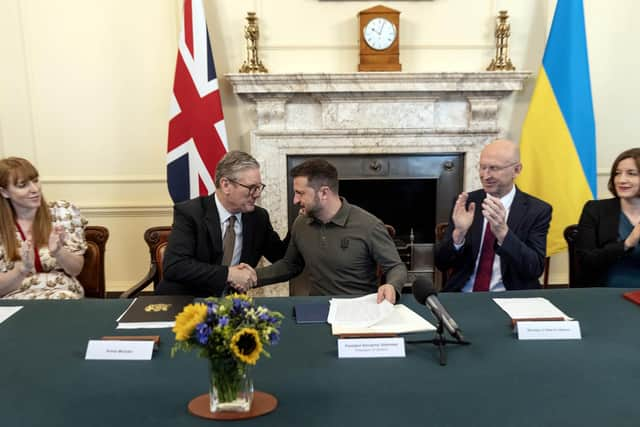
“Be in no doubt: Britain stands with Ukraine for as long as it takes”, said Sir Keir Starmer back in July. Now, those were pretty well the same words that the Conservatives used, but a closer look about how our new government really intends to support Kiev reveals some stark differences.
The PM’s early policy on Ukraine was distinctly hawkish. Within days of being elected he visited Kiev and immediately parroted Lord Cameron’s line permitting British missiles to be fired ‘deep into Russia’. He ignored the fact that the noble lord’s rashness had been quashed after Britain’s ambassador to Moscow was firmly but quietly saying that there would be severe consequences if Britain followed such a unilateral course.
The novelty of a new PM allowed a quick u-turn by Sir Keir without too much press embarrassment: British missiles were suddenly unavailable without US and French (yes, French) permission.
Kiev was left dangling, especially when they launched their ill-starred incursion to Kursk. They desperately needed to be able to attack Russian logistics with long range weapons, but they weren’t allowed to.

Now, in my last column I predicted that the Kursk offensive was a huge mistake and, sadly, I believe that’s proving to be true. It’s as if Ukraine was in the ring with a stronger opponent who was pummelling him right in his tactical vitals (the Donbas) and threatening to knock him out.
Rather than dancing away or fending off the punches, weaker Ukraine chose to tread on the bruiser’s toe. It was never going to work and now, with Moscow on the verge of piercing Kiev’s centre and the Kursk offensive all but spent, the situation is dire.
Whilst they’ll never say it in public, I’m sure our new government has grasped this. They’ve also realised that neither Trump nor Harris is going to support Ukraine with President Biden’s vigour and there’s no point in pursuing an aggressive foreign policy alongside a threadbare NATO which lacks wholehearted US backing.
Now, there’s some practical issues over the missile question as well as political ones. Primarily, all types of Western long range projectiles are running out: the remaining, slender stocks are needed for NATO’s own reserves and it takes time to build new ones. Meanwhile, the expensive air defence and long range missiles systems donated by the West are being comprehensively destroyed on the battlefield.
Then there’s Moscow’s stance. Once attacks by Western weapons became feasible, President Putin riposted, “…we reserve the right to act in the same way. In general, this is a path to very serious problems”.
Underlying this statement is the vexed question of Russia’s ‘red lines’, of course, although President Putin has already allowed many of these supposed barriers to be crossed without noticeable response (eg, British and German tanks are now on Russian soil). But, the missile question is uncomfortably close to the use of nuclear warheads and Russia has hinted that retaliation might be aimed directly at Allied bases worldwide; think of Cyprus being attacked with hypersonic weapons.
There’s also the issue of NATO missile crews being killed on Ukrainian soil. Most fascinatingly, though, it’s been suggested that a new US regime would see any escalation that followed a deep missile strike - even if it didn’t result in all-out war - as a major hindrance in any rapprochement with Russia once the shooting ceased. Bluntly, all the horrors of a smashed Ukraine could be forgotten so long as there’s a route to profitable friendship between Russia and America in the near future.
That’s realpolitik, I suppose, but I do find our new government’s homespun version deeply cynical. Simply put, protecting ourselves from aggressors means that our armed forces, whom the Tories have wantonly neglected, need to be rebuilt - and that means more money. Clearly, part of this is helping Ukraine and you can’t shout reassuring slogans whilst cutting your defence budget.
Mr Sunak promised to increase spending from 2.3 per cent to 2.5 per cent of GDP, but Labour will not commit to that. There are some weasel words about a reconsideration after yet another defence review has been conducted, but it all means further cuts.
The detail, though, is illuminating. Should the government really have to put its money where its mouth is and get directly involved in a war, our air force will be at the forefront. Ships take a long time to get anywhere, we’ve got vanishingly few soldiers, yet aircraft are fast and lethal. Despite this, it seems likely that the Tempest fighter programme will be cut first.
Then there’s training. Army pay, we’re told, will be increased: hurrah! But, the money will be found by axed exercises, ammunition and the like. Training, though, is the most immediately useful thing that we’ve been able to do for the Ukrainians (especially within the UK as it provides some rest from the real battlefield) and now its provision has been instantly slashed.
Undoubtedly, ‘foreign adventures’ frequently threaten the very survival of democratic governments - look no further than the effect of the Iraq debacle upon Tony Blair’s regime. Successive governments have taken a brutally pragmatic approach by talking big yet ripping the guts out of our forces to such an extent that they’re incapable of taking the field, the heavens or the oceans in any meaningful way.
That’s where we are today and whilst this might have been tenable when we could shelter behind America’s shield, that shield is now tarnished and may be effectively withdrawn by either Democrats or Republicans. The first casualty will be Ukraine, of course. Ask yourself, didn’t Britain and the rest of NATO also promise to stand with Iraq and Afghanistan ‘for as long as it takes’?
Patrick Mercer is a former MP for Newark and Army colonel.