
Buy Christmas gifts over the counter instead of online - Andrew Vine
A few years ago, I made a decision not to do any Christmas shopping online, for the simple reason that struggling high streets need my money more than the likes of Amazon.

A number of friends have done likewise, because we’re all keen to do our bit to keep shops in business. It’s the principle of use it or lose it. If Yorkshire wants to see its shopping streets thrive and be bustling places to visit, then more of us need to turn the computer off and go out to do our spending in person.
And it’s a far better experience. I’d much rather browse in a shop where customer service matters and deal with a knowledgeable member of staff than stare at a screen and be pushed around by an algorithm.
Unfortunately, the number of vans delivering online packages that have been a daily presence on my street for the past month indicate that nowhere near enough people are doing their Christmas shopping in person.
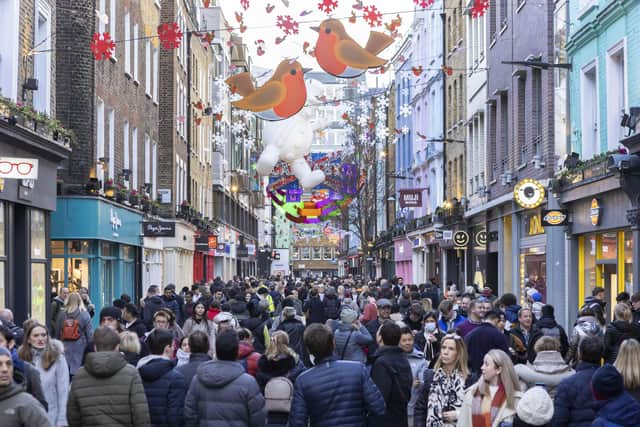

So do the latest set of dispiriting figures from the British Retail Consortium (BRC) that about 850 shops have shut so far this year, with the loss of thousands of jobs, a large proportion of which will be directly attributable to online competition.
With just today and tomorrow left for last-minute shopping, let’s hope for a late rush that makes this Christmas a good one for Yorkshire’s retailers.
We’ll know if that is the case within a few weeks when sales figures are released, but nobody should be surprised if they tell a story of shops’ trade being further undermined by the internet.
Its share of the market continues to grow relentlessly, and now stands at 28 per cent according to the BRC, which is potentially bad news for the more than 16,000 retail businesses in our region and the 200,000 people they employ.
Yet successive governments have stood by and done next to nothing to give bricks-and-mortar retailers a fighting chance of staying in business against an onslaught that has gathered pace for the past two decades.
A tax regime that disadvantages high streets attempting to compete with internet retailers remains in place.
While shops pay high levels of business rates, out-of-town warehouses dispatching vanloads of packages face far lower costs.
And while the shops that keep our high streets alive have been hit with higher bills as a result of last year’s increases in employer national insurance and the minimum wage, online businesses which employ far fewer people have weathered the changes much better.
It all adds up to both the former Conservative government and the current Labour one being complicit in the slow death of traditional retailing because of timidity about taking on online giants.
The damage already done is apparent on virtually every high street in Yorkshire, with their empty shops. Talk to any independent trader who clings on, and it’s more than likely they’ll tell you of an uphill struggle to stay open in the face of online competition able to undercut prices because of lower fixed costs such as rent and rates.
If the trend of shops and livelihoods being lost is to be reversed, there has to be a much more level playing field.
And one way to give shops a better deal would be to introduce a sales tax on online purchases, using the proceeds to reduce the burden of business rates on traditional retailers.
The idea has been floated before, by the last Conservative government in 2022, but it shied away from introducing a new tax after lobbying from online sellers and retailers trying to catch up with Amazon by launching their own internet offering.
So much has changed since then that the time is right for a fresh look at the concept. Shop closures have accelerated as the online share of consumer spending has increased.
Without realising it, the previous government rejected a sales tax just at the moment the threat to shopping streets became especially dangerous because of two giant Chinese sellers, Temu, launched in 2022 and Shein, which became the world’s biggest clothes retailer that same year.
A modest tax of one or two per cent on every purchase would in itself help to level the playing field, by bringing prices closer to those offered by shops.
Given the volume of online sales, it would also generate a huge amount to support both retailers and the efforts of local authorities to keep town and city centres full of shops and attractive destinations for their customers to visit.
Consumers still have their part to play by making the choice to buy their Christmas gifts – and the rest of the year’s purchases - over the counter instead of over the internet.
But the government needs to weigh in too, if we are not to witness the loss of the traditional high street.