
Case for closer UK–EU security and defence cooperation is more compelling than ever: Timothy Kirkhope
The UK has long played a leading role in European security – whether through NATO, bilateral cooperation, or past contributions within the EU framework. But in today’s rapidly shifting geopolitical landscape, that leadership is fading.
As conflict rages in Ukraine, threats to critical infrastructure mount, and alliances evolve, we must ask: where does Britain now stand in shaping Europe’s defence future?
The European Union is deepening security collaboration in ways that would have been unthinkable just a decade ago. The United Kingdom, once a principal architect of Europe’s security strategy, now risks becoming a bystander. That cannot continue.
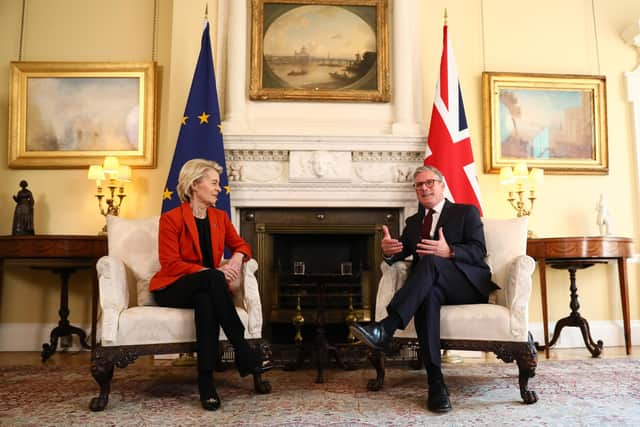
Later this month, when UK and EU leaders meet in London for the May 19 Summit, a new Security and Defence Partnership may finally come into view. Though neither side is speaking publicly in detail, it is clear that discussions are progressing. Officials suggest the EU’s recent agreement with Norway could offer a blueprint – albeit one that must be significantly expanded to reflect the UK’s unique defence footprint and diplomatic reach.

Earlier this month, as Co-Chair of the All-Party Parliamentary Group (APPG) on Europe, I led an evidence session that brought together leading think tanks, defence experts, and industry voices. What we heard was unequivocal: the threats Europe faces today demand a closer, not looser, partnership between Britain and our closest allies.
As a former Member of the European Parliament and Leader of the Conservative delegation in Brussels, I know first-hand how vital structured cooperation is to European security and the case for a formal agreement is more compelling now than ever before.
A Security and Defence Partnership based on the EU-Norway agreement would be a meaningful step forward. That deal created structured political dialogue, joint strategic planning, and deeper operational coordination. A similar UK agreement would allow British representatives to engage in EU high-level forums and relevant Council meetings, while establishing a formal dialogue process backed by regular working-level contact.
But given that the UK currently has no formal security and defence partnership with the EU, any new agreement must go further. It should enable British participation in Common Security and Defence Policy (CSDP) missions through a Framework Participation Agreement – something already open to many non-EU NATO allies. Before leaving the EU, the UK led several CSDP operations, including Operation Atalanta, headquartered in the UK and crucial to tackling piracy off the Horn of Africa. We should not exclude ourselves from missions where British know-how and capacity can make a real difference to our collective security.
It should also formalise UK engagement with Permanent Structured Cooperation (PESCO) – the EU’s flagship framework for defence collaboration – through an agreement with the European Defence Agency. From military mobility to cyber resilience and intelligence systems, PESCO represents the future of coordinated European defence. Britain’s absence from these initiatives not only weakens our own strategic positioning but leaves gaps in Europe’s collective capabilities that we are well placed to fill.
Crucially, a formal partnership would unlock access to EU defence initiatives such as the European Defence Fund, the Act in Support of Ammunition Production, and the €150 billion ReArm Europe package. These aren’t bureaucratic luxuries – they’re vital vehicles for capability development, joint procurement, and competitiveness. Without a seat at the table, UK firms risk being cut out of the emerging European defence market at precisely the moment it is expanding.
Since leaving the EU, the UK has lost many of the institutional links that once underpinned its understanding of European policymaking. Foreign Office staff rotate regularly, and with each passing year, institutional memory of how the EU operates is fading. This erosion of expertise hampers our ability to engage effectively with European partners.
To rebuild that capability, we must restore structured links, promote knowledge exchange, and invest in people-to-people connections. A formal secondment programme between UK departments and EU institutions, including the EEAS, would be a practical and cost-effective way to rebuild trust, understanding, and influence where it is urgently needed.
This is not about reversing Brexit - though it is now widely recognised that Brexit has been a disaster. It is about responding to the world as it is. The threats we face are complex, cross-border, and fast-moving. The EU and UK share values, geography, and vital interests. The lack of a formal security architecture is an increasingly dangerous omission and Europe’s collective security requires full-spectrum cooperation, from intelligence sharing to industrial collaboration to crisis response.
Whatever disputes remain must not be allowed to obstruct a deal on defence. The threats we face are too urgent, the stakes too high, and the costs of disunity too great. A forward-looking, mutually beneficial Security and Defence Partnership is in the interest of both sides and long overdue.
As Europe redefines its defence priorities, the UK must be part of that conversation; not outside the room, but at the table. The London Summit provides a critical opportunity to chart that course. We should not waste it.
Lord Kirkhope of Harrogate is the Co-Chair of the All-Party Parliamentary Group on Europe