
Disaster relief needs to be decentralised and Mayors given control - Carl Les
The matter of the moment this week must be the wildfire on Langdale Moor, above Fylingdales and leading towards Whitby and Robin Hood’s Bay. I was up there last week, initially to observe one of our councillors completing the Coast to Coast Walk.
Just as well he did it when he did, as the walk was closed this week past because of the fire. Indeed the owners of the campsite where he stayed for the last night were interviewed on regional television, commenting on their situation and how they were preparing for a possible evacuation.
That decision would be taken by the Chief Fire Officer, as incident commander, but much of the management of such an evacuation, where people would go, what support they would need, would fall to the council, our staff, many drawn from other disciplines and other day jobs and our teams of volunteers notably in the MIRT – the Major Incident Response Team. Fortunately as I write this, the risk is lessening and as yet no evacuation has been necessary.
The challenge of writing these articles, if I try to be topical and timely, is that I start and finish at the very end of one week and before the start of another, with a gap between completion and publication. There is always a chance that events overtake me.
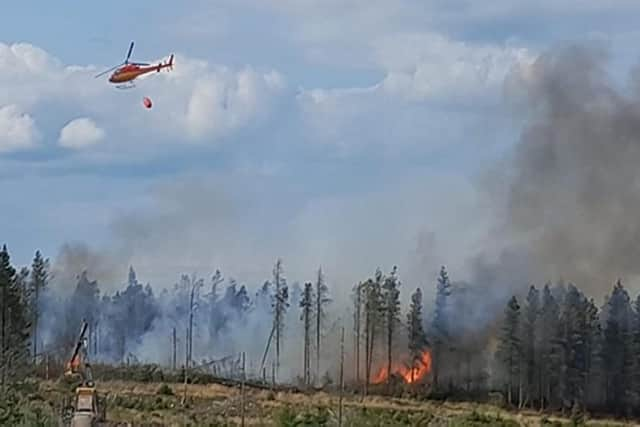

The Chief Fire Officer says that the wildfire is now contained i.e. no longer spreading, but recently on one weekend it was dying down and overnight the wind gained strength and on Monday it was travelling rapidly again. The difference this weekend is that heavier rainfalls are predicted, which if they come will be the most effective firefighters of all. Not only extinguishing the visible surface fires that spread over the moorland, sometimes jumping and then travelling along small hedgerows and clumps of vegetation, but also dampening down the underlying peat below ground that can burn for many weeks, if not months.
Containment has been the activity of this last week, North Yorkshire Fire & Rescue backed up by mutual aid from local and forces wider afield and that huge and very welcome local volunteer force of farmers, gamekeepers and other land managers, now popularly referred to in the media as the ‘Farmy Army’.
Whatever lessons are learnt from this major incident, and there will no doubt be many, as part of the debrief as well as the blue light service considering how it must prepare for such an incident reoccurring, I’m sure generous reference will be made to the volunteers who came forward to make firebreaks, beat out fires, fetch water to the front line and many other activities I don’t know about.
At the start of the incident, as plans were being drawn up and mitigations put into place, inevitably concerns about costs were considered. North Yorkshire Fire & Rescue is a small force with a large footprint, and with limited reserves. A major incident can eat into those reserves rapidly, as indeed it can with even the largest forces in the land.
To help with this the government has a contingency scheme that allows public services to seek additional financial support, known as the Bellwin scheme. Akin to a bidding process it takes time for local government to convince central government to open up its coffers. There has to be a better way.
FRS needed an early decision to allow it to charter a water carrying helicopter for more than the first week, for instance. In the United States if the President declares that a local incident of scale is a disaster, then the full capacity of the federal government, including cash resources, are allocatable to that incident.
In this country the direction of travel is that all geographies will have an elected Mayor. If the government in Whitehall had a notional fund for disaster containment, then working alongside the leaders of the councils and other bodies acting locally, the Mayors should be able to call on that fund with immediate effect.
Accountability can be provided by the fact that the elected Mayor is just that, elected to serve and if negligent or profligate in the application of the disaster relief, then their chances of being re-elected would be diminished.
The United Kingdom is still one of the most centralised systems of government in Europe, if not the world and this would be a further step on the welcome road of devolution.
Domestically, two Poles have come for a short holiday and it will be useful to catch up on what is happening much closer to the Ukrainian border and the Russian missile strikes that are now only 50 miles away from Nato territory.
As both parties had got up very early to catch the flight from Krakow and meet it at Leeds Bradford Airport, we called at Weetons on Leeds Road in Harrogate for breakfast.
First time I’d visited but it's easy to see why this, and other superfarmshops are becoming destination shopping. Another visit beckons next week on our return run to LBA.
Carl Les is the Leader of North Yorkshire Council.