
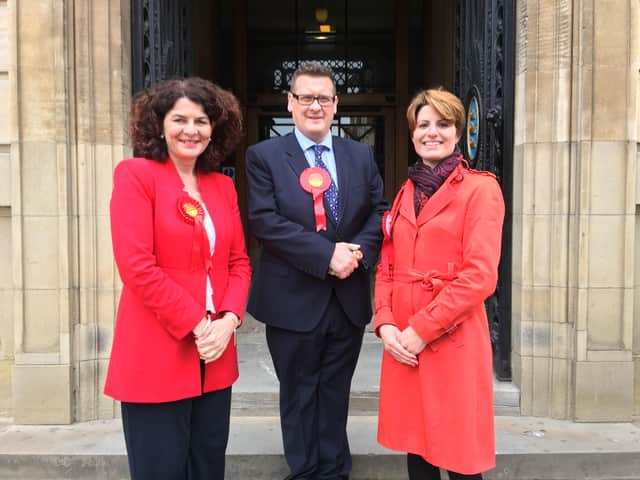
It's time to ditch the diesel on the rail line to Hull - Diana Johnson, Karl Turner and Emma Hardy
This year train fares were frozen for the first time in 30 years, but East Yorkshire’s rail passengers still pay top whack for rail services long beset by sluggishness, inadequate capacity and poor reliability.
Businesses around the Humber have been clear for many years that our creaking transport infrastructure is a drag on our sub-region’s economic potential – and therefore on the UK’s.
Despite the Humber’s renaissance as the renewable Energy Estuary and our Freeport status, we remain a poor relation in recent decades compared to, for example, the £18.9bn spent on the South East’s fully electric Elizabeth Line.
That’s why Humber MPs have worked cross-party over the years, alongside our business community, to secure the electrification of rail lines to Hull that currently operate on diesel. This has been part of promoting a wider vision of faster, cleaner electric rail travel across the North from Hull to Liverpool.
In November 2016, a privately financed rail electrification scheme for Hull was blocked by Theresa May’s Government. This was followed by a series of on-off promises under three further Tory Prime Ministers.

The Hull and East Yorkshire Devolution Deal, committed to by the outgoing and incoming governments in 2024, declared that: “The Government will bring Hull into Northern Powerhouse Rail, electrifying and improving the line speed between Hull to Leeds and Hull to Sheffield”.
This January, the Government’s Northern Growth Strategy: Case for change said that Hull will be served by Northern Powerhouse Rail, but running on “existing infrastructure” into East Yorkshire – meaning the apparent continuation of diesel.
It was welcome that the Department of Transport then told The Yorkshire Post that “electrification of the lines to Hull remains under consideration”.
What’s changed over the past decade that merits this consideration?
In short, battery technology for trains has moved on and is cheaper to run than diesel – ultimately saving the Government money. Its charging infrastructure is also more economic and less disruptive to install than an electric network based solely on overhead cables.
Alongside this, many rail routes in the North will require new fleets of trains in coming years.
This adds up to an opportunity to end the use of diesel trains through a cost-effective scheme of discontinuous overhead cable-based electrification, alongside new battery bi-modal trains.
If the North wants to achieve rail electrification in the foreseeable future, we need to avoid being lumbered with diesel-powered trains for decades to come.
There are other good reasons for ditching diesel – not just for Hull, but for the whole of Yorkshire, the North and beyond. Polluting diesel emissions from the rail industry are bad for air quality, especially in enclosed areas such as stations. Consequently, they are also harmful to our health.
At the end of February, the Department of Transport’s own Rail air quality policy statement was clear: “Improving air quality across the passenger network requires reducing pollution from train operations. The most significant long-term benefits will come from decarbonising the railway by phasing out diesel traction, supporting the UK’s legal commitment to reach net zero by 2050”.
Elsewhere in public transport we are already seeing more electric buses, for similar reasons.
Modernising the North’s rail infrastructure is not just about fairness. It’s about national economic self-interest too.
The Government clearly understands the potential of Northern England for achieving UK energy self-sufficiency and for boosting productivity and national economic growth.
In contrast, Reform’s national leadership wants to axe North Powerhouse Rail, drive private investors away from it and from the Humber’s green energy sector.
We prefer a brighter future that builds further on the Northern Powerhouse Rail vision, advances Lord Blunkett’s Yorkshire Plan for Rail and honours Hull and East Yorkshire’s Devolution Deal. Siding with the builders - not the blockers.
Rt Hon Dame Diana Johnson DBE, Labour MP for Kingston upon Hull North and Cottingham
Emma Hardy, Labour MP for Kingston upon Hull West and Haltemprice
Karl Turner, Labour MP for Kingston upon Hull East