
Education divide shows why language matters, woke policymakers need to start telling people what they need to hear - David Behrens
Unless you have in mind the past participle of stirring from sleep, ‘woke’ is a dreadful word. It should in any case be ‘woken’ but that’s not the sort of thing they teach you in schools these days, apparently.

They do, however, keenly enforce the more recent American definition of the word. You shouldn’t do, say or think anything that might offend someone, that’s the gist of it.
It’s a good rule to live by, so long as you don’t overdo it. Otherwise you lapse into the sanitised vernacular of people who think it’s more than their job’s worth to express any emotion in writing, except with imbecilic ‘sad face’ symbols.
It was a thought articulated this week by Kirstie Allsopp, the TV presenter beloved of Middle England (which is itself a euphemism for the Home Counties). Why, she wondered, do people who write public statements go out of their way to avoid direct words like ‘death’ even in the act of eulogising someone? Is anyone other than the most monomaniacal outrage-seeker really going to take offence?

She had noticed that in its appreciation of Dame Penelope Keith, the British Academy of Film and Television Arts wrote only that she had ‘passed’, because presumably to have ‘died’ would have sounded too final. The same sensibility infects police statements and online reports of fatalities. No-one has ever just ‘died’; the safe phrase is always ‘sadly died’.
In Whitehall the flight from plain English is even more comprehensive. ‘Unlocking potential’, ‘centring marginalised voices’ and ‘protecting the most vulnerable in our society’; these and other off-the-peg phrases are reeled off to promote every new initiative and then re-used a week later to justify doing the opposite.
Writing by rote betrays more than just a lack of imagination; it’s an unconscious dilution of emotions into a meaningless word-salad designed to offend no-one, for the sake of inclusivity. It’s supposed to signal action and project authority but instead it fuels scepticism and suspicion.
It’s a wokeist philosophy that must have driven, at least partly, the conclusion this week by Estelle Morris that our education system had become biased against white working class children and their families.
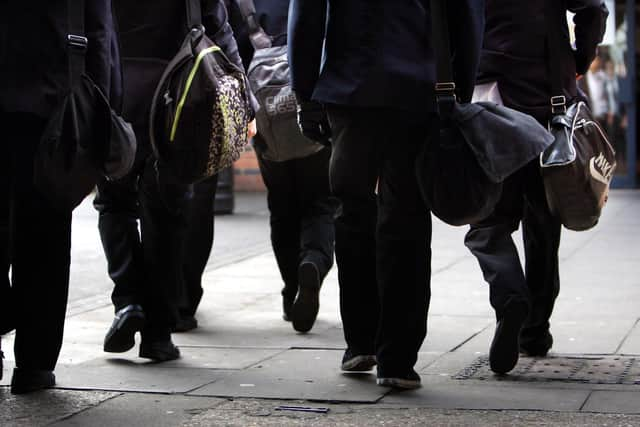
The former Education Secretary, who resigned in 2002 because she thought she was not up to the job, had been put in charge of the Independent Inquiry into White Working Class Educational Outcomes, a loaded title which suggests its mind was made up before it started. Sure enough, it reported what we already knew: the demographic in question was the worst-performing in the English school system.
But is that the fault of children, their families or their schools? Surely it is no-one’s policy to actively discriminate against white children in the classroom – but have managers allowed themselves to sleepwalk into prioritising certain demographic groups over others?
Or, more likely, have some parents simply chosen to assume so, from the alien-sounding ‘identity-focused’ discourse that is now the lingua franca of the education sector?
Baroness Morris was adamant that doing badly “cannot be explained away by low aspiration or lack of effort” on the part of families. I think she’s dead wrong: those are exactly the attitudes that undermine efforts to teach working-class kids. The question is why they have taken root and why it’s a mindset that appears to be gaining momentum.
The lockdown months of learning from home didn’t help. They reinforced the belief among some parents that attending class was an optional extra; that the prospects of finding a job were slight and that knowledge and qualifications were unnecessary for an inevitable lifetime on benefits. That had been their experience, and their expectations had rubbed off on their children.
The emphasis on baccalaureates that defined Michael Gove’s years of education policymaking further widened the classroom divide. That was something Andy Burnham, in his years as Mayor of Manchester, fought with Whitehall to reverse.
But this perception of a schism between educators and parents, fuelled by a supposed avoidance of straight-talking and therefore truth-telling, cannot easily be dismissed. We are seeing families on the fringes of society cutting themselves even further adrift because they are not being engaged with on terms they can understand.
The requirement for a free state education for every child was made precisely for the benefit of working-class families, and we are beyond redemption if we genuinely don’t still see the value of it. It’s up to woke policymakers to literally wake up and start telling people what they need to hear, whether it offends their sensibilities or not.