
Factionalists need to be careful, changing the voting system could backfire - David Blunkett
Recently, I've come across a new phenomenon in British politics. The enthusiasts for the fracturing - some might say shattering - of the tradition, which has seen two main parties dominating British politics over the last 100 years, with the exceptions of the Second World War and the 2010 general election.
The narrative now goes that there are two “blocs" rather than two main parties. The enthusiasts for this point to the rump of the Conservative Party and Reform UK to the right and far right; and Labour, the Greens and the Liberal Democrats battling it out for the left of centre vote, together with Plaid Cymru in Wales and the Scottish Nationalists north of the border.
It’s easy to see why some people would love to embrace this new form of political representation and, in some cases, use it as a battering ram to get the campaign for Proportional Representation (PR) back up and running. Supporters of PR have always wanted a system where much smaller, tightly knit and cohesive groups campaign to win their particular niche of the electorate, with coalitions being negotiated between parties after the election to provide a majority in the House of Commons. Taking the power out of the hands of the electorate, and into the hands of the Parliamentarians.
Leave aside that this almost inevitably must lead to a disconnect between the individual MP and a defined geographic constituency (because either a list system or multi member, larger geographic areas are required) and reflect instead on the impact on public dialogue and the maintenance of a cohesive and tolerant society. With all its faults, the single-member, first past the post system, requires the MP to respond to and engage with their constituents.

There appears to be an assumption on some of the left of politics that replacing ‘coalitions’, made up within political parties with those arising from a fractured electoral landscape, would be a positive answer to the lack of trust and the demise of democracy as we know it. Those thinking like this have very rarely read - or if they have, understood - history.
In his seminal book, The Strange Death of Liberal England, George Dangerfield spelt out what happened to the Liberal party over 100 years ago. Then it was Labour who was the challenger and giving Ramsey Macdonald a clear run in one of the Leicester constituencies, seen at the time as a benign act by the Liberal leadership but had profound consequences. Macdonald later became the first Labour Prime Minister.
In 1910, the Liberals won a landslide. But by the 1920s they had started the inexorable slide to third party status.
Don't get me wrong, I'm in favour of shaking up the system and getting people to recognise that decisive action and delivery on the ground is fundamental to rebuilding trust in politics generally, and the protection of major democratic institutions. I'm not in favour of the “business as usual" approach, or a nostalgia for a bygone era. Rather, that we address the implications of what would happen if the ‘two bloc’ advocates get their way.
Too much momentum for a particular outcome can sometimes lead to it becoming inevitable. After all, the failure - long before the 2016 referendum - to make the case as to why the UK should stay in Europe was central to losing the argument and the consequent outcome.
Let us examine this enthusiasm for the awful ‘in-crowd’ term of a ‘smorgasbord’. Small political parties taking a proportion of the electorate with them, but with no one having the chance to reach a sufficient density and popularity to provide a majority government, and the ability to remove that government at the subsequent general election.
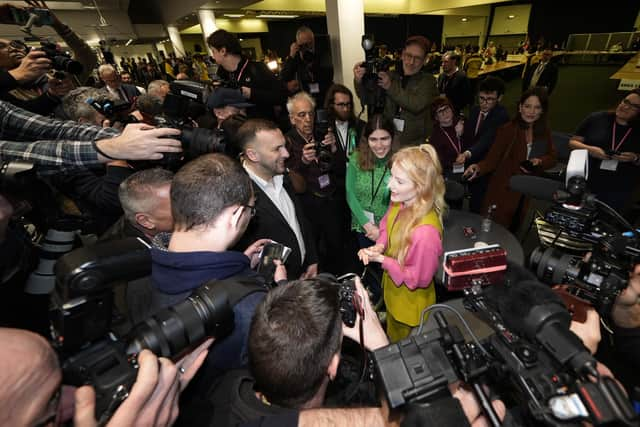
As we saw in the Gorton and Denton by-election, appealing to the lowest common denominator – to a very narrow niche of electoral support – coupled with just one or two controversial and divisive issues, can get you elected.
Such simple dividing lines can be seen in the reaction to the US-Israeli bombing campaign against the regime in Iran. Are you ‘for or against’; despite no one being clear about the intended outcome, or, for that matter, considering the incredible damage to the living standards and well-being of billions of people for whom simplistic political sloganising or grandstanding is a total irrelevance.
The obvious consequence of all this is that instead of political parties having to appeal to the widest possible electorate, reaching out and trying to win people who previously would never have voted for them, the campaign focuses instead on narrowly defined, touchstone questions with the battleground within the ‘bloc’ rather than between competing sets of values and ideology. In England, this would result in the Green party, Labour and the Liberal Democrats fighting it out to a standstill, sufficiently disabling each other from being able to command a workable majority.
It is not quite so cut and dry in relation to the right of centre. Reform UK doesn't just take Tory votes, but former Labour working class votes and young men as well. This, surely, must give the factionalists pause for thought?
But if the centre ground is no longer the battleground for our democratic politics, then division and sectarianism will sweep aside the appeal to the shared values which the late Jo Cox – murdered almost 10 years ago – pronounced in her maiden speech to the House of Commons that “we are far more united and have far more in common with each other than things that divide us".
Lord Blunkett is giving the Harold Wilson Memorial lecture at Huddersfield University on the evening of March 26. Tickets are available at: https://www.eventbrite.co.uk/e/the-annual-harold-wilson lecture-2026-tickets-1982185572406
David Blunkett is a Labour Party politician, and served as the MP for Sheffield Brightside and Hillsborough.