
Good to see female role models in football but do we really need wall-to-wall coverage of Women’s Euro? - Sarah Todd
Coming from the tail end of an era when schoolboys were sent one way down a corridor for woodwork and girls the other for needlecraft the subsequent opening up of opportunities for all is to be celebrated.

At the end of the first term at secondary school this pupil still couldn’t master threading the sewing machine while all around had finished the required task of making a pencil case. Next academic year, thanks to the utter exasperation of the sewing teacher, these failings opened up a whole new world of dovetail joints.
News that Olympic champion diver and jumper-maker extraordinaire Tom Daley is going to be hosting a new Channel 4 knitting competition series titled The Game of Wool brought reflections about how hard it would have been, back in the day, for one of the boys to do the opposite of yours truly and turn their backs on carpentry and get stuck in with the girls grafting away at blanket stitch.
Traditional is this correspondent’s middle name, so best make it clear that she’s not gone soft and still finds most modern gender debate an unfathomable testament to bonkers Britain.

However, it seems so wrong reflecting on our modern times, that every thought and deed now needs a label. To be a syndrome or cause of anxiety.
This little lass found wielding a tenon saw easier than a needle; there was no underlying urge to become a boy. Being a tomboy was a passing phase. She just couldn’t fathom sewing and preferred, if truth be known, the company of the lads to the girls. A wife of over 25 years and mother of grown-up children, there has been no hidden urge to change gender. Frightening to wonder where one could have been pushed today, at a time when so many children are packed off for counselling and gender identity consultations. As a youngster, The Husband took great pride in sewing scout badges on his uniform and is a dab hand at mending holes in socks. However, it would be hard to meet more of a man’s man.
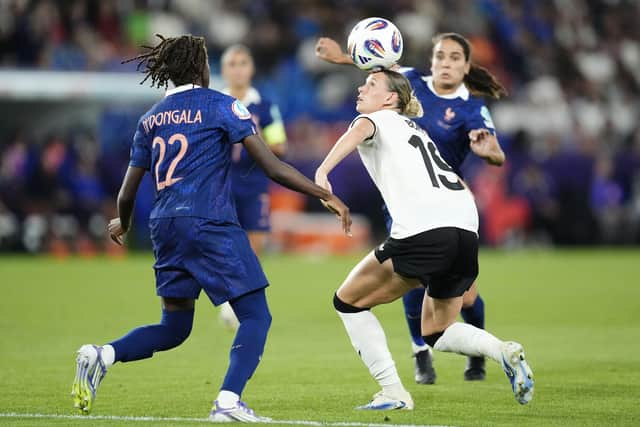
To coincide with the current UEFA Women's EURO 2025 football tournament being hosted in Switzerland there was some old footage, from 1972, shown on the news of Southampton Women's FC players. The presenter asked who their footballing heroes were and with no female role models they all gave the names of men, the likes of Goerge Best and Emlyn Hughes.
It would have taken a heart of stone not to have been moved by the answers given to the same question 52 years later; with the girls listing their favourite players and them all being women. Real-life female soccer stars inspiring the next generation to set aside their mobile phones and worrying what they look like and get out onto the pitch for fresh air and exercise.
Having said all this, did we really have to show seemingly every single women’s football match on prime-time television? Fair enough maybe the quarters, semis and the final - but every cough and splutter seems to have been broadcast for weeks.
It just seems over-the-top - a bit politically correct - when sports like cricket, Premier League football and Formula One are so rarely seen on mainstream television. There was a point needed making with equality in sport for women but three weeks of teatime television seems a bit much. Surely it could simply have been switched over onto one of ITV’s sister channels, like ITV4 where they sometimes have the racing. Or is that just being middle-aged and grumpy?
Moving on from the battle of the sexes, actor and comedian Steve Coogan has suggested that working class people are being 'ethnically cleansed' amid the redevelopment of northern cities.
Speaking on BBC Breakfast, the Alan Partridge creator argued that investment in sophisticated developments only benefits those able to live in such places – pushing people further away from where they were born. The same could very easily be said of our countryside communities, where it is becoming beyond the realms of possibility for young people to stay living in the rural areas where they have been brought up.
Government statistics show around 10 million people live in rural areas and since mid-2020 - otherwise known as the covid pandemic - the population has been growing faster than in urban areas.
For both sectors of society life’s gone higgledy-piggledy, with properties now gentrified beyond recognition.
Thinking again about football, while there can be no doubt it’s a good thing that both boys and girls can get stuck in, the loss of muddy fields, back ginnels and - yes, you’ve guessed – hand-knitted jumpers for goalposts seems somehow sad.