
Historic buildings are not relics of the past – they are foundations for the future - Simon Baker
If we want to understand the future of our town centres, we should look not to the newest buildings, but to the oldest. Politicians of all parties speak of the importance of our high streets and town centres. The Government's new Pride in Place programme rightly recognises that successful places are not created through capital investment alone, but through long-term stewardship and the things people value most.
Yorkshire is fortunate to possess an extraordinary collection of market halls, town halls, civic buildings and industrial heritage. From Doncaster to Goole, Scarborough to Wakefield, these buildings sit at the heart of their communities and remain among the most recognisable landmarks in our towns and cities.
Having spent more than a decade working with local authorities, communities and cultural organisations across Yorkshire and the North, we have repeatedly encountered the same challenge: how do we breathe new life into historic buildings that have become underused or compromised by changing economic circumstances? Whether at Scarborough Market Hall, Goole Market Hall, Middlesbrough Old Town Hall or Wakefield Courthouse, the lesson is consistent: historic buildings endure because communities continually find new value in them.
There is a tendency to see heritage as something to be preserved exactly as it was. But historic buildings have survived precisely because successive generations have found new uses for them. Their value lies not only in the stories they tell about the past, but in their capacity to support new memories and new forms of civic life.

Throughout their history, these buildings have adapted to changing needs and patterns of use. Great civic buildings are resilient precisely because they can accommodate new activities, new communities and new ways of living.
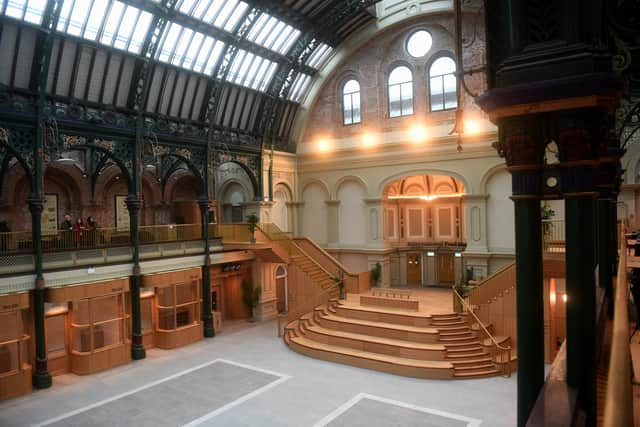
Doncaster Corn Exchange is a powerful example. Constructed in 1873, the Grade II* listed building was originally built to serve the region's agricultural economy. Yet over time it became much more than a trading place, hosting political speeches, concerts, markets and boxing matches, embedding itself in the collective memory of generations of local people.
When Group Ginger began work on the building, the challenge was not simply to restore an important heritage asset, but to ensure it remained useful and relevant to the people of Doncaster for generations to come.
Rather than maximising commercial floorspace, the project prioritised flexibility, accessibility and public life. The removal of a later mezzanine floor reopened the dramatic volume beneath the glazed roof, creating a space capable of supporting markets, performances and everyday encounters.
Boxing has returned for the first time in decades, reviving not only a sporting tradition but also a shared civic memory. On one evening, visitors might be eating oysters from a local trader while watching boxing beneath a Victorian roof. You do not encounter oyster-eating boxers in every town, but you can in Doncaster. This is precisely what makes great towns distinctive.
Places derive their identity not from buildings alone, but from the people who use them. Architects can create spaces, but people make a place.
Historic buildings matter not simply because of their age or architectural merit, but because they provide the setting for everyday life: meeting friends, trading, debating, celebrating and creating memories. Heritage is not only inherited from the past; it is continually made in the present through participation and shared experience.
Historic buildings resist homogenisation precisely because they force us to think and act differently. Unlike standardised development, they demand adaptation, creativity and local responses rooted in place. In doing so, they create the conditions for independent enterprise, community activity and the unexpected encounters that give towns their distinctiveness.
Historic buildings that fall out of use rarely survive through repair and restoration alone. They endure when people continue to use them: as places to work, meet, trade, learn and socialise. An occupied building is almost always more resilient than an empty one.
In times of constrained public funding, architects and local authorities have a responsibility to maximise public value through careful intervention: spending as little as possible, but as much as is needed. Our role is not simply to conserve buildings, but to create the conditions in which communities can occupy them, adapt them and make them their own. Sometimes the most sustainable act is not to build more, but to unlock the potential of what already exists.
The Government's Pride in Place programme presents an opportunity to recognise this. Pride cannot simply be designed or funded into existence. It grows from participation, stewardship and the sense that communities have shaped the places where they live.
Yorkshire's market halls, town halls and civic buildings have survived because successive generations found new ways to use them. They remind us that heritage is not a constraint on renewal, but one of its greatest assets.
The question is not whether our historic buildings should change, but whether we can create the conditions for future generations to inhabit them, adapt them and make memories of their own.
Simon Baker is founder of architects Group Ginger.