
How Nick Clegg is as much a part of the class that he condemns - David Behrens
It must be a peculiarly American trait – the richer you are, the more self-pitying you become. Sir Nick Clegg diagnosed the condition in these terms: if you’re accustomed to privilege, equality feels like oppression.

He could have been talking about Donald Trump or even Meghan Markle but it was America’s so-called tech brotherhood he had in mind this week.
Clegg, you’ll remember, was the Liberal Democrat leader who found himself Deputy Prime Minister in an unholy coalition with David Cameron’s Tories 15 years ago.
He was voted out of Westminster when his broken promises came home to haunt him. Instead of phasing out university tuition fees, he had conspired to raise them three-fold. That went down badly in the academic-minded Sheffield constituency he represented.
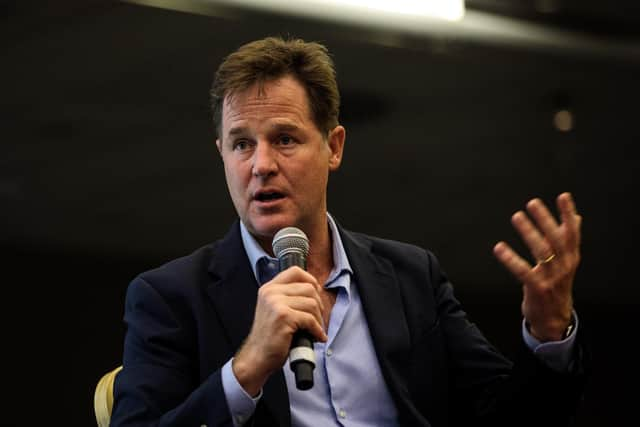

Since then he has been mostly in California as chief spin doctor for Facebook and its robotic and ridiculous boss, Mark Zuckerberg. He has written a book about his time in Silicon Valley and will shortly return to Yorkshire to promote it, as the opening attraction at the literature festival in Ilkley – another cultivated town short-changed by the Faustian pact he made with Cameron.
His departure from Facebook was almost as sudden as from Westminster. He expected a Trump victory, he says, but did not foresee how quickly supposedly liberal tech lords would fall in behind him. He should have known from experience; wasn’t it exactly what he’d done himself in 2010?
In the circumstances, his book How To Save The Internet could be seen as sour grapes. But he has little to be bitter about: he was wealthy already and made another fortune selling his shares in Facebook. So he is irrefutably part of the privileged class of which he speaks.
“They think they’re hard done by,” he says of his former colleagues; a “deeply unattractive combination of machismo and self-pity.”
The thing is, does anyone still care what Nick Clegg says? Here is someone who flip-flops more than an old pair of beach shoes and has spent the last seven years defending the propagation of misinformation, alleged tax evasion, data theft and, most insidiously, wanton social harm inflicted on young, exploitable users. How can he talk about saving the internet when he has done so much to break it?
All the same, his insight into the culture that drives the technology is grimly fascinating. In his estimation Silicon Valley has embraced the mores of corporate America that computer geeks used to rail against. “Everyone dresses the same, they drive the same cars, they listen to the same podcasts, they claim to read the same books,” he says.
More worrying is his depiction of the toxic masculinity promoted by Facebook – not just towards impressionable users but also its own executives. On one occasion, Zuckerberg actually made his team wrestle each other in his personal gym. It makes the world’s most powerful communications hub look like a Church of England summer camp.
Unfortunately, Clegg pulls his punches. He is in a unique position to expose his former employer’s excesses but, like the liberal he is, he stops short of direct criticism. He is still Zuckerberg’s shill, an Americanism for someone who promotes a product regardless of morality. It’s a bit like pimping, except that pimps deal in flesh; shills in souls.
“Anything that empowers people to express themselves, I have a very visceral liberal view that is a good thing,” Clegg told The Guardian in an interview brokered by his publisher. It may be liberal but it is hopelessly naive. Facebook is not about free expression; it’s a cynical exercise in giving people a mouthpiece and then manipulating how they use it, by way of algorithms that amplify only what their audience wants to hear. By lending it the respectability of his former office, Nick Clegg has legitimised that.
So much has changed in British politics since he was a part of it that it’s easy to file him away with Liz Truss as an irrelevance and a diversion, but his story stands as a portent for what may be to come.
In 2010 Clegg was a political outsider whose path to power was opened up by an electorate disenfranchised with the main parties. Who does that remind you of today?
When he lost his formerly safe seat it was to a wholly unsuitable Labour candidate who rarely turned up at Westminster and eventually went to prison for fraud. That will be the calibre of contender 650 times over when Reform floods the field in 2029 with knuckle-draggers who sign their names by painting red crosses on roundabouts.
Clegg’s term as Facebook’s apologist-in-chief is over, but he has a lot more than that to be sorry about.