
How Phillips 66’s Humber Refinery is playing important part in UK's renewable fuels story: Paul Fursey
With energy security high on the political and economic agenda, the importance of reliable, affordable domestic fuel production is becoming increasingly clear. Energy is the foundation that allows people, communities and industries to function, prosper and adapt.
That is certainly true in the Humber region. Phillips 66’s Humber Refinery is one of the UK’s four remaining refineries and one of the region’s largest industrial employers, supporting more than 1,000 jobs. The Humber Refinery produced approximately 21 per cent of the UK’s demand for liquid fuels used for transport and heating in 2025.
We have strengthened our position in the UK this year, through our acquisition of the former Lindsey Oil Refinery assets and associated infrastructure, alongside key fuel terminals across the country. This reflects our commitment to domestic energy infrastructure at a time when resilience, capacity and industrial competitiveness are under increasing scrutiny.
At the Humber Refinery, we’re also investing in a multi-year petrol quality improvement project that will enable production of higher-quality petrol, facilitating greater access to higher-value global markets. For the UK, this means making more of the refinery’s petrol suitable for domestic supply.
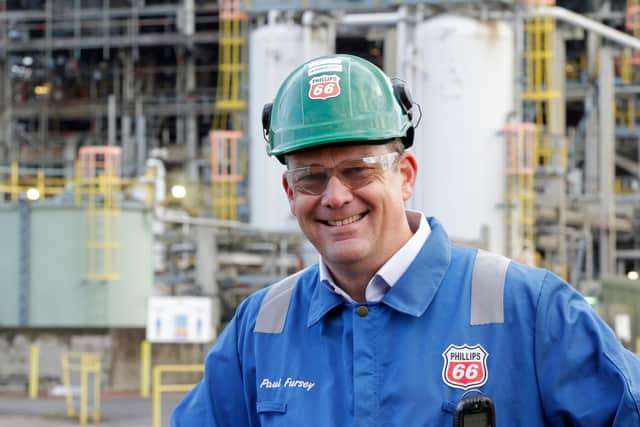

The petrol quality project brings our output more closely in line with UK market requirements, while the newly-acquired assets and infrastructure enhance our ability to move, store and supply products to customers across the country. Together, they strengthen UK supply and extend our reach into the domestic market, while creating a foundation for the broader range of fuels customers will need in the future.
Supported by Phillips 66’s specialist Energy Research and Innovation team in the US, the site has become an important part of the UK’s renewable fuels story.
Since 2017, we have been processing used cooking oil (UCO) to produce lower-carbon road fuels and sustainable aviation fuel (SAF), a lower-carbon alternative to traditional jet fuel. Our teams are also exploring other waste-based materials that could further help to reduce the amount of fossil-based inputs we use.
This work matters even more as the UK Government’s SAF Mandate reshapes the aviation sector. Under current plans, the proportion of SAF that must be supplied in the UK is set to rise from two per cent in 2025 to 22 per cent by 2040.
As the UK’s only commercial-scale producer of SAF, we’re supporting the industry’s transition while contributing to a more resilient energy future.
By transforming waste-based materials into valuable transport fuels, we’re widening the range of resources available to meet growing energy demands. At a time of geopolitical uncertainty and volatile global fuel markets, diversification is not only practical, but increasingly important to long-term energy security.
At the Humber Refinery, we also produce speciality coke, a high-purity carbon material that undergoes further processing into synthetic graphite for lithium-ion battery anodes, supporting electric vehicles and consumer electronics. Our speciality coke is also used to manufacture graphite electrodes for electric arc furnaces, enabling steel recycling and supporting a lower-carbon route to steel production.
More broadly, fossil-based materials, refined products and petrochemicals continue to underpin modern life. They remain part of the supply chains behind many everyday products, from clothing, footwear and home furnishings to food packaging, household cleaning and personal care products, and medicines.
Any serious discussion about the future of energy therefore needs to weigh both costs and benefits, including the role reliable energy plays in living standards, industrial resilience and national security.
That is why the focus cannot simply be to eliminate fossil-based materials altogether. The task is to reduce emissions in ways that are technically feasible, safe and economically viable, while continuing to provide the energy and products society depends on.
In practice, that means investing in lower-carbon alternatives, improving the carbon intensity of existing fuels and operations, and recognising that transition will succeed only if it is grounded in reliability and affordability, as well as ambition.
Refining has an important role to play in that process. Existing infrastructure can help make the transition practical and scalable, allowing new lower-carbon fuels to be developed alongside the products that people and businesses still rely on, often at a significantly lower cost than building new facilities.
Phillips 66 is a founding member of the Humber Energy Board. The Board brings together global energy companies with a local presence to provide a collective industrial voice for the Humber, working to strengthen energy and manufacturing security, prevent deindustrialisation, and secure investment, growth and jobs across the region, with decarbonisation integrated throughout that agenda.
The Humber’s contribution is clear: supplying the energy and everyday materials society needs now, while investing in the capabilities needed for tomorrow.
Sustaining that contribution means protecting industrial competitiveness, attracting investment and supporting skilled jobs as we reduce emissions. The region is not simply part of the UK’s energy story – it is helping to shape what comes next.
Paul Fursey is UK Lead Executive at Phillips 66 and a Director of the Humber Energy Board.