
How the Selby & Ainsty by-election in 2023 went wrong for the Tories - Edward Young
The summer sunshine gave no hint of the thunderstorms to come. At the end of a narrow lane, in a hot, airless regeneration centre, in a hall which looked like a school classroom longing for a quiet weekend, Selby Conservatives were meeting to select a parliamentary candidate.
Nothing about that night of Friday, June 9, 2023, seemed rushed or extraordinary. There was plenty of time before a general election in 2024. But as the meeting went on, the mood changed.
Shortly after 8 pm the news broke that Boris Johnson would be resigning as an MP. Earlier that day, Nadine Dorries had also announced she was resigning. The details were unclear, but there were rumours of a row with the new Prime Minister, Rishi Sunak, over peerages.
The focus fell back onto Selby & Ainsty. For 13 years, the seat had been held by a popular local Conservative, Nigel Adams. In recent years, Nigel had become a strong supporter of Boris Johnson. The expectation was that if Boris resigned, Nigel would be next.

The meeting in Riccall gained fresh urgency. At 9 pm, a winner emerged. Michael Naughton won the vote by a healthy majority. The next day, Nigel Adams announced his decision on social media: ‘I’ve today informed the chief whip that I will be standing down…with immediate effect.’
Five days later, the Conservatives faced fresh catastrophe. Michael Naughton found himself in a family medical crisis. He had little choice but to withdraw. The Conservatives were back at the starting line.
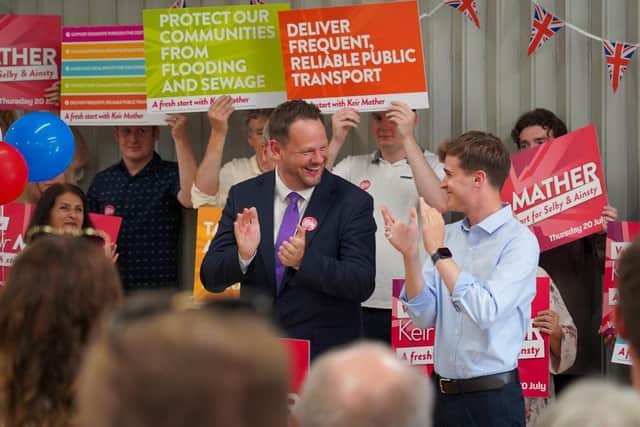
Meanwhile, a new protagonist appeared. Keir Mather had grown up in East Yorkshire. After studying at Oxford, he had gone to work for Wes Streeting. But he had kept his hand in with the local Labour Party. At the time of Nigel Adams’s resignation, Keir Mather was 25.
Around 70 Labour members gathered in Selby Town Hall for the selection meeting. Keir Mather’s pitch was personal as well as political. If elected, he would be the first Labour MP who had been born after Tony Blair’s victory in 1997. The selection result was not even close.
The main campaign commenced that weekend. The Conservatives were still short of a candidate and hurriedly organised a new selection meeting. The victor this time was a barrister from East Yorkshire.
Claire Holmes came from a family of miners. The weekend of the selection she was meant to be at Scout camp with her children, but she told them she had a job interview. As she put it later: ‘I just had to do this. It felt like the stars had aligned’.
The frantic start now gave way to a traditional campaign. From his family home in Brough, Keir Mather threw himself into the contest. However, there was a problem: Keir Mather had broken his hand playing rugby and was unable to shake anyone’s hand.
A bigger challenge was Keir Mather’s age. ‘I can’t count the number of times we got jip on the doorstep,’ one campaigner admitted. Being young also created other challenges: Keir had not learned to drive.
At the start of the campaign, Keir Mather only owned one jacket. This oversized grey blazer became his campaign uniform. When he took it off, some Labour activists did not recognise their candidate and asked if he had turned up to volunteer.
On the final weekend of the campaign, I spent a day in Whixley with three fellow Conservatives and a dalmatian called Hugo. That day can be taken as a proxy for the entire campaign. Tropical downpours were followed by hours of sunshine.
The four of us spent several hours searching for hidden voters scattered through the village. Eventually we found a shop and stocked up on fizzy drinks. As we paid for our supplies, a schoolgirl came in from Queen Ethelburga’s, having spent the morning horse-riding. She told us this would be the first time she voted. She hadn’t decided who to vote for, but thought she would probably vote Green.
On polling day, the fates of the candidates diverged forever. Labour gained over 16,456 votes, compared to 12,295 for the Conservatives.
There are two ways of looking at the result. On the one hand, it was one of the biggest majorities overturned in history. On the other, Labour gained 2,700 fewer votes than they had received in the 2017 General Election. The Conservative vote simply collapsed.
There is another moral to the story. Three by-elections took place on July 20, 2023: Uxbridge, Selby & Ainsty, and Somerset & Frome. Of the three, Uxbridge had the smallest Conservative majority – but it was the only one the Conservatives held. The reason for this was not resources, candidates or strategy. It was that in Uxbridge there was a powerful reason to vote Conservative: to stop the Mayor of London’s anti-car crusade. In Selby & Ainsty, that reason was missing.
It was many weeks before Keir Mather could take his seat in Parliament. When he finally gave his maiden speech, he told the story of another by-election in Selby.
In 1905, the Conservative candidate was defeated by a Liberal opponent, Joseph Andrews. But the victory was short-lived. Three months later, Andrews lost at the general election and never took his seat in Parliament. He died three years later from appendicitis. By contrast, at the time of writing, Keir Mather remains in good health and is still very much the Member of Parliament for Selby.
Edward Young is a former Conservative Candidate for York Central. He lives in Nether Poppleton with his family. This essay is an extract from British By-Elections 1769–2025: The 88 By-Election Campaigns That Shaped Our Politics, edited by Iain Dale, which went on sale this week (Biteback: £30).