
How think tanks have shifted power away from Downing Street and are calling the shots - David Behrens
This little stream of commentary, the one you’re reading now, is what’s known in the newspaper business as a think piece – an item of personal opinion rather than just the bare facts. But the practice of tossing brickbats over the toast and marmalade at your breakfast table is light work compared to the wholesale thinking that goes on elsewhere.

Because, honestly, it doesn’t really matter what my thoughts are about anything; nor, I’m afraid, yours. If you want to really wield influence you need something bigger than a stream to swim in. You need a tank.
The phenomenon of organisations that seek to ‘educate’ the rest of us along lines of their choosing is ingrained in British politics. The phrase ‘think tank’ is now sprinkled so liberally over the news that it barely even registers. Yet the persuasiveness of these shadowy outfits has shifted the balance of power from Downing Street. It’s now to be found half a mile away, in Tufton Street.
That’s where these think tanks draw their oxygen, in expensive offices gifted them by wealthy benefactors: industrialists, despots and plutocrats who pollute public discourse as reliably as sewage into a river. They’ve been doing it for decades but in the last few years their influence has grown out of all proportion to their substance.
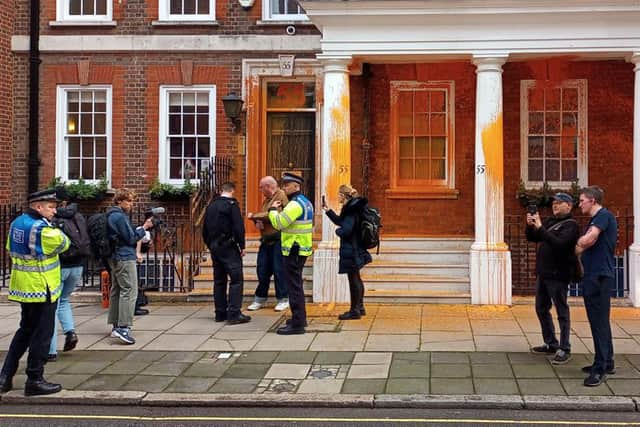

The network of corridors concealed behind the elegant Georgian frontage at Number 55 is the beating heart of Tufton Street. There and in the neighbouring buildings the arguments of scepticism towards Europe, climate change and public spending were fermented. If Brexit had its own address, this would be it.
Shortly before the referendum, Number 55 was home to no fewer than eight right-leaning organisations campaigning to take Britain out of Europe and fighting efforts to address global warming. The thinkers in that building outnumbered those at Number 10 by some margin.
A decade after the vote, with the sores of Brexit still festering, the thought processing goes on unabated. Whenever you read some nonsense about what an unqualified success it all was, this is where it most likely came from.
I counted around 30 stories on the national news wires last week alone that were sourced from think tanks. Their spheres of attempted influence encompassed human rights, Ukraine, the environment, social media and military spending. If you want a quote for tomorrow’s paper or an interview for the six o’clock news they’ll come running like a dog with a stick. There’s nothing on which they don’t have an opinion.
But it’s unclear whose opinions they are because many of these organisations are deeply secretive about where their money comes from. The Adam Smith Institute, for example, claims to seek “freedom from poverty through markets and economic growth”, whatever that means, but when it reported a “crisis of confidence” among business leaders it offered not a word of context about who was funding its research.
Another inscrutable organisation, the Taxpayers’ Alliance, has been loudly attacking the Government for tipping the country into recession and public sector staff for continuing to work from home four years after it stopped being necessary.
Some lobbyists are more candid. The late Nigel Lawson, Margaret Thatcher’s chancellor until he left in acrimony, was quite open about the climate change denialist think tank he founded in Tufton Street.
And these organisations are not necessarily antisocial or mendacious; they’re just partisan. Think tanks are propagandists by any other name and if all their stories came with health warnings like packs of cigarettes you wouldn’t give them a second glance. But because they don’t, they seep by stealth into the public consciousness.
More insidious still is the revolving door that operates between Tufton Street and Downing Street, making government officers of pollsters and vice versa. Dominic Cummings was a Eurosceptic lobbyist before entering Number 10. And the entire Liz Truss administration was one giant think tank; a Frankenstein’s monster brought to life. Truss went so far as to elevate Matthew Elliott of the Taxpayers’ Alliance to the House of Lords.
Money is at the root of it. Political donors fund think tanks to secure and shape the kind of government they want, not what the politicians are offering. When a compliant party leader bends in their direction, ideas that would have been outlandish a few years before become suddenly part of the national debate.
Lobbyists do rely on one thing though and that’s the credulity of the rest of us – and unfortunately for them, Liz Truss and Boris Johnson emptied that particular tank. Brickbats are all we have left.