
I found my way in the world despite being blind, the challenge now is to help others do the same - David Blunkett
It's August so I thought I would give readers a break from talking about politics. Well, not quite. Because four weeks ago, a long-standing acquaintance of mine, BBC Chief Correspondent in the US, Gary O’Donoghue, cornered an interview with Donald Trump.
The relevance is that Gary and I have two things in common. Neither of us can see and we both live in Yorkshire.
I rarely write about the challenges of being blind.
In fact, I rarely speak about it because I have never sought to be defined by the barriers I have had to overcome, but rather by what I've managed to achieve.
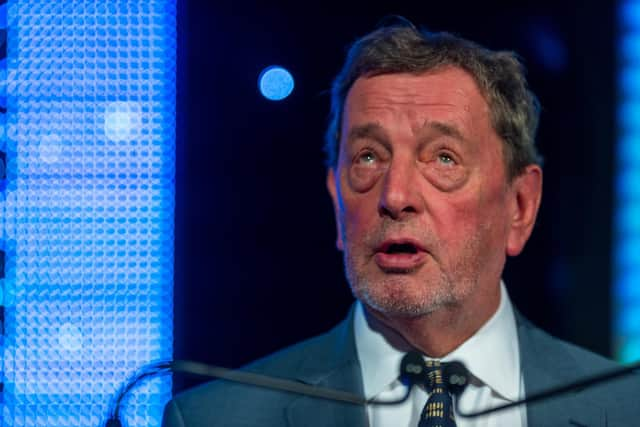

But sometimes it's worth reflecting on how the world has changed since I was a child and the difference that has made for blind and partially sighted people today and, for that matter, for those with a variety of other disabilities.
My lack of sight, diagnosed when I was a baby, was as a result of my optic nerve failing to develop.
I tell my grandchildren that it's a bit like having a bulb in the light fitting but when you flick the switch the light doesn't come on because the circuit isn’t complete.
The real challenge was to set aside what my parents (perfectly reasonably) understood to be a major tragedy.
In fact, my mum’s hair turned white when she was informed that there was absolutely no chance of restoring my vision.
Nowadays, the RNIB have workers embedded in the ophthalmic units of most major hospitals to talk with parents of newborn babies; or, where through accident or disease, young or old have lost their sight.
Talking with parents of youngsters is crucial and certainly would have benefited my mum and dad.
The famous poet, William Blake, in his Ode to London, writes about “mind forged manacles".
I like that phrase, because I think it sums up one of the biggest problems that all people with defined disabilities experience: the perception of others about what they can and can't do, and therefore what their likely success and achievements are going to be.
The biggest obstacle to working on equal terms with others, certainly in the kind of jobs I've done, is reading – and the availability of material in either braille or audio.
Over the years I've schooled myself in being able – mostly at least – to cut through the verbiage, understand the facts and then put them in context.
But it still takes time. You can only move at the speed you can listen and that is, by definition, massively slower than anyone with any proficiency can read print.
You can't skip reading and skim. You have to absorb what's really important, make notes and above all, try and develop your memory.
When a student in Sheffield, I used to work with my peer group to persuade them to read the particular chapters of books or publications (which weren’t, then, available in braille) I had twisted the arms of lecturers to identify specifically for me.
An overlong reading list (no longer the case these days), made it impossible to simply access everything.
Of course, the students learned exactly what material mattered, so they got something out of it as well.
Yet, in the political arena, this was going to be the dragon to slay. Working late into the night – literally, night after night, when I was in Tony Blair's Cabinet for eight years – took its toll.
Firstly, on my sleep patterns, but secondly my social life.
People, including in the Palace of Westminster, used to see me as somewhat aloof. I think I only went to the bars five or six times in the 28 years I was in the Commons.
I was rarely seen in the tearoom. The alternative to not working all the hours that God sends was to lose the very precious time on a Sunday when I would walk in Derbyshire, commune with nature and get back some of my inner-self.
But those quid pro quos are things that all of us do at some point in our lives. I used to think of this when I was in evening class and slogging my guts out, over six years, to get to university.
The prize, however, was one worth fighting for. To have had independence and dignity, the opportunity to serve others and get great satisfaction out of seeing things change for the better.
The relief when people stopped being nice to me because I couldn't see, and started to treat me as they would anyone else, good or ill.
The chance not just to prove to myself that I could do it, but perhaps also to encourage others facing similar obstacles to think; “Well, this youngster deserves a chance. David Blunkett can do it, perhaps they can.”
The tragedy of the moment is that only one in every four blind people of working age is in full-time employment.
This is a terrible waste of talent as well as a tragedy for the individuals concerned and the funding programme run by the Department for Work and Pensions, Access to Work – which provides money for workplace adjustments for those with disabilities – could do so much more.
This could open up the kinds of employment that were closed to me all those years ago.
I found my niche, my voice and my way in the world. The task now is to help others to do so.
David Blunkett is a former Labour cabinet minister. He he served as MP for Sheffield Brightside and Hillsborough (formerly Sheffield Brightside) from 1987 to 2015. Lord Blunkett recently led the Yorkshire’s Plan for Rail review.