
I grew up in the 1980s North like Andy Burnham - it's not true people like him had no opportunities: Jayne Dowle
Andy Burnham, so-called King of the North and putative PM, has described his past self as a “mid-Eighties scally who evolved into a “late-Eighties student”.

This transformation happened with the help of Morrissey and The Smiths. The teenage Burnham has written that the frontman and songwriter, “seemed to be saying to us that we could be something. We could dare to aim higher. Yes, we may be hidden by rags, but we have something they'll never have.”
Quite what this “something” is we’re now finding out. However, for this “something” - now as Brand Burnham, his easy man-of-the-people charm, cool clobber and understanding of how important buses are to ordinary people - to stick, it must have substantial roots. These are inevitably being called into question.
Burnham, running for the vacated seat in Ashton-in-Makerfield, a town at the heart of the former Lancashire coalfield, has made much of coming from a working-class background. His father, Ken, was a telephone engineer and his mother, Eileen, worked as a GP receptionist.
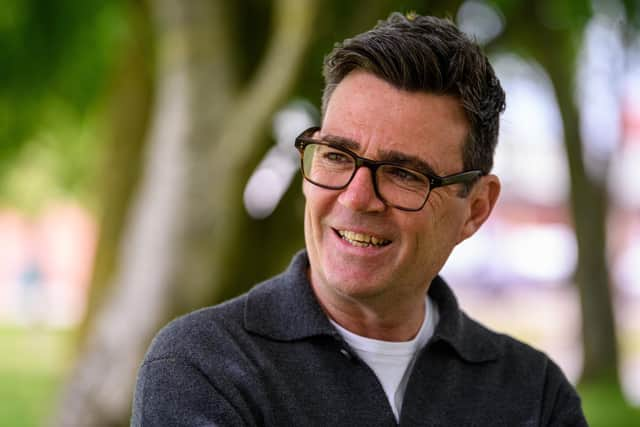

Born in 1970 in Old Roan, near Aintree in Liverpool, Burnham moved to Culcheth, just six miles from Makerfield, when he was young, and grew up, as he seems fond of saying, between Liverpool and Manchester. He now lives 10 miles away from Makerfield with his family, a son and two daughters, in Leigh.
There is no denying Burnham is a Northerner through and through, but it would seem that “our Andy” isn’t quite as working class as he would like people to believe. Sure, he grew up between Liverpool and Manchester’ sure, but in a substantial bungalow - one newspaper went poking around and found it’s now worth around £1.3m, extended and improved and behind electric gates - and Culcheth is leafy Cheshire commuter belt rather than urban sprawl.
From here, Burnham attended the local Catholic high school before going on to Fitzwilliam College, Cambridge, to study English. His two brothers are both teachers.
Whilst undoubtedly a clever man and a gifted politician, he is no one-off or freak of nature who has escaped the clutches of poverty through politics. Like millions of others in the Seventies and Eighties, his parents were clearly aspirational and supported their sons to do well in life. It’s been reported that Burnham’s father encouraged him to apply to Cambridge because it would “open doors”.
Over the years Burnham has said that suffered from imposter syndrome at Cambridge and questioned himself over his right to be there. He’s also shared that he was once forced to cut short a three-month work experience stint because he couldn't afford the bus fare.
None of this should matter of course, but this is England and class and all its signifiers is inescapable, especially in politics. Burnham needs to tread carefully here. Our antennas are up. Just like ‘son of a toolmaker’ Starmer, Labour politicians undermine trust when they try to convince us they’re made of humble stuff.
If one thing can be said in defence of former Cabinet minister Angela Rayner it is that she really is the genuine working-class article; a teenage mother, who ended up working in care and becoming a trade union organiser, she doesn’t need to turn up the notch on her own humble roots.
Whilst Burnham was mooning around listening to Morrissey, at a decade younger, Rayner would have been looking after her own mother, who was bipolar and couldn’t read or write, shuttling between her own home and her grandmother’s house, where she went for a bath on Sundays.
Taking all of this to extremes runs the risk of turning the subtle class-based differences between senior Labour politicians into a reductive version of Monty Python’s Four Yorkshiremen sketch, in which each one vies to outdo the other when it comes to growing up poor. Amusing, but not helpful when we’re considering who might be leading the country soon.
More seriously, Burnham, has said that growing up in the northwest in the Eighties meant “it was hard not to pick up the subliminal message that we couldn’t aspire to be very much”.
I don’t know what was happening in Cheshire back then, but certainly in my corner of South Yorkshire, the opposite for people like him was true. Not for the lads who worked in the pits and the steelworks, or the lasses who sewed in factories, all of whom saw their jobs and secure futures evaporating before their eyes.
But for clever kids like Burnham, the world was out there. I’m three years older than him, and yes, back then I was a Morrissey fan too.
At my sixth form college, which drew in students from across the entire borough of Barnsley, the farms, the pit villages, town centre and quiet hamlets, we knew we had no choice but to aspire. Three A Levels and we were out of there, scattering to universities from Aberdeen to Exeter, rarely a backwards glance or an existential crisis.
And this was in the middle of the 1984-5 miners’ strike and the aftermath. We learned our politics at first-hand, not through watching Boys From The Black Stuff. Burnham should remind himself that we all have long memories.