
Important for us to learn from the past in order to move forward - Carl Les
I think it was Winston Churchill who said that “to know where you are going, you need first to know where you have come from”. It certainly sounds Churchillian. He was a great historian, both of international and national history, and I remember my father buying and then wading through Churchill`s ‘History of the Second World War’ as a way of both learning and improving his use of the English language by reading about a subject that he knew something about.
Much the same way that he took The Yorkshire Post as its stories related to events and happenings around him, so it was easier to follow.
My comments in these pages often relate more to local history. Last week it was to do with Healam Bridge and the Leyland clock, and it left some unanswered questions.
I’m grateful to Peter Sowray, a past Chairman of North Yorkshire County Council and a former colleague County Councillor over many years, and members of his family, for sending me some information together with a copy of a painting and a photograph.
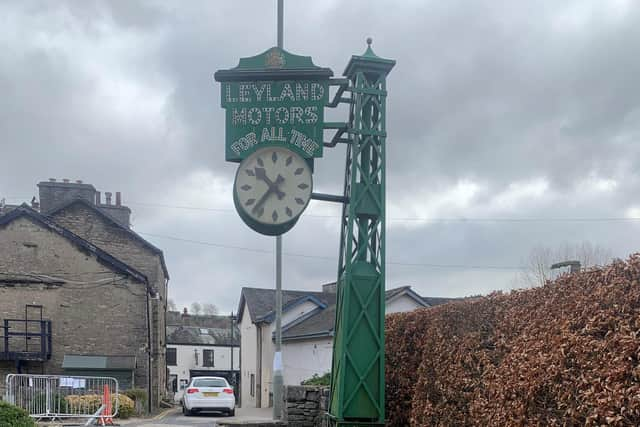

The photograph shows a Leyland clock in situ in a yard in Kendal. Is this the Healam clock, via Plawsworth, Co. Durham, which didn’t go to Australia as supposed? There is a plaque beside it, unfortunately not in shot, so the next time I travel to The Lakes I will find it and find out.
The clock is very clearly shown, rugged iron work reminiscent a little of the Forth Rail Bridge, but very much of the old railway bridge over the Swale at Catterick Bridge.
Typical of industrial design of the early 1930s it is one of those pieces that the planners would resist as a new application today on aesthetic grounds and the conservationists would insist must be kept for all time.
Why did Leyland install the seven or eleven around the country? Clearly this was early corporate branding, the name Leyland standing proud, and the neat logo “For All Time” carrying an early subliminal message that lasted at least until the 1980s.
Why Healam Bridge? It’s obvious really. Just as between York and Northallerton on the East Coast Main Line there is a large sign with arrows pointing, Janus-like, to both London and Edinburgh, equidistant, so Healam was half way between the two capital cities if travelling on The Great North Road.
Wherever it has ended up, the clock started life in a field beside the bridge. The Sowray family tell me it is still known locally as Clock Field in the way that many fields have local names to identify them.
A field which I bought some years ago next to the motel at Leeming Bar was called Fiddler’s Field; we presumed it was likely owned at some time by a Mr Fiddler rather than any musical or nefarious connection.
They were also able to inform me that the clockmaster, charged with the simple maintenance tasks of cleaning and winding, was originally Arthur Bowe, of Hope Town (house or farm). He was paid the rate of £2 per year. The Bowes are a long-standing and widespread family in the Bedale area and somebody may know more.
We know that the clock moved on to the parapet of the bridge at some time because of the copy of the painting I was sent. This was commissioned by Bryan Lye of Quernhow Café, mentioned last week, who started this whole enquiry off. It shows an ERF flatbed truck, registration CUB 99, driving over Healam Bridge, owned and driven by William Lye, his father, haulage contractor of Leeds.
Very few articulated lorries in those days, often driven with a driver’s mate in the cab, restricted to 20 mph, these general purpose, multi-load flatbeds were the backbone of the haulage industry of the day. They were capable of adapting to palletisation, the next revolution in logistics and its implication of change.
The major change we have reflected on this week has been the passing of five years since the start of Covid. We have planted a tree at County Hall to remember in sadness all those who lost their lives in the pandemic, both patients and front-line staff.
Our Chief Executive Richard Flinton wielded the spade to place the tree, but symbolically it was in the company of, and in celebration of, all NHS colleagues, blue light service personnel, care assistants, council staff of all tiers, the military, volunteers, all who came together to cope with the threat.
I remember how fearful we were at the time, a real fear of the unknown and what would happen next. Locked down, looking out from my home office onto our wide village green, it was difficult to comprehend that only 30 miles away people had no such space, they were catching it, they were dying from it.
We should include the scientists who worked tirelessly to develop the vaccinations that give us hope for the future and the tree in the grounds will be both a tree of remembrance but also a symbol of growth for the future.
Carl Les is the Leader of North Yorkshire Council.