
Increase opportunities for young people from all backgrounds to boost the economy - Dr Mohammed Ali
A couple of weeks ago, more than 350 of the great and good gathered in Bradford for the Yorkshire Asian Young Achiever Awards 2025, or the YAYAs as they’re more commonly known.
I started the YAYAs, with York St John University as headline sponsors, five years ago to mark the 30th anniversary of QED Foundation – the national charity I set up in 1990 to support new and settled migrant communities – and to recognise the achievements of young people from the South Asian community who had overcome adversity in one way or another. I felt if we could put a spotlight on these success stories it would inspire others to bigger and better things.
Since starting the awards, we’ve had people from all kinds of backgrounds including Indian, Afghan, Pakistani, Bangladeshi and Sri Lankan, taking part – each with their own inspiring story. At the gala dinner a short video of each shortlisted nominee is shown, and I’ve lost count of the time I’ve seen members of the audience with tears in their eyes listening to some of these stories.
Stories like that of Dr Madiah Mahmood, the 2025 overall winner of Yorkshire Asian Young Achiever of the Year award. Madiah is a resident doctor at Bradford Teaching Hospitals NHS Trust who survived life-threatening autoimmune encephalitis in 2016 before graduating six years later and now raises awareness of the condition for the Encephalitis Society.
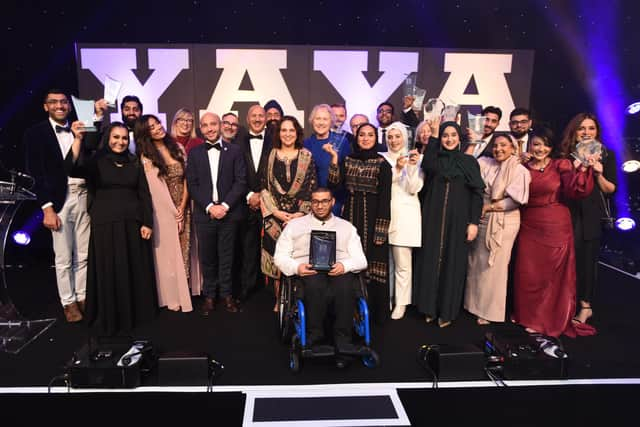

Then there’s fellow YAYA winner, 19-year-old Mohammed Ali Adnan – a wheelchair user living with Spina Bifida, who is studying at Bradford College and hopes to go to university and embark on a career in air traffic control.
Another of this year’s winners is a name many of you will be familiar with – Musharaf Asghar. Musharaf captured the nation’s heart when he appeared in Channel 4’s hit TV series Educating Yorkshire having lived with a stammer since childhood. Now a motivational speaker, he develops workshops on leadership and social anxiety, supports children with special needs, and shows that a stammer doesn’t define a person’s potential.
I could go on, because all of the 26 shortlisted candidates deserved an accolade. The YAYAs are a reminder of just how much young talent there is in our communities. As someone who grew up in this country without having any role models to guide me, I know the impact their absence can have and why it is so important that young people today can see people who look and sound like them being successful.
This is something we need to harness because too many of our young adults are struggling to get a foot on the jobs ladder. New data published last month, shows that almost a million young people are still out of work, education or training. According to the Office for National Statistics (ONS), the number of so-called Neets – those aged 16-24 who are unemployed or economically inactive in the UK – stands at 946,000. This equates to one in eight young people, up by around a third in four years.
The government has recently announced a scheme to help them get access to paid work, education and apprenticeships, and while this is welcome news much more needs to be done.
Having a university degree was once seen as a passport to a successful career, but now that certainty is ebbing away with ethnic minority graduates, in particular, finding it increasingly difficult to get jobs.
A report published earlier this year by the Nuffield Foundation and led by researchers at UCL, found that ethnic minority graduates from a low socio-economic background are 45 per cent less likely to be offered entry-level professional roles compared to more advantaged white applicants.
This is a big challenge and one that must be addressed if we want to create a level playing field. That’s why we are working in partnership with Morrisons which is funding a training programme for 60 recent graduates in West Yorkshire with one-to-one support from professional mentors in the corporate sector to build their confidence, offer advice and help them launch their careers. It's something we would like to expand because there are thousands of ethnic minority graduates here in Yorkshire.
But it’s not just graduates who need support. Marginalised groups of young people face more barriers than others, and there are stark regional disparities with the North East and Yorkshire and the Humber home to the highest proportion of Neets in the country.
It’s something we are looking to tackle through our Youth Employment Mentoring Project (YEMP), a pilot one-year programme funded by the Department for Work and Pensions, aimed at unemployed people aged between 18 and 30 living in Bradford. This provides six months of training and mentoring – including help with writing a good CV and workshops on everything from mental health to managing budgets – at the end of which those taking part will have a better chance of getting a job.
We hear a lot these days about the need to boost productivity and increase growth. Well, one of the ways we can do this is by increasing the number of opportunities for all young people, irrespective of their socioeconomic background or ethnicity. Their future, and indeed ours, depends on it.
Dr Mohammed Ali OBE is the founder and CEO of QED Foundation, a Bradford-based national charity.