
Ministers need to kick away the crutches and get the idle back to work - David Behrens
Idle is the name of a district in Bradford and the social club on High Street which bears its name was a running joke for years. The Idle Working Men’s Club sounded like a hangout for people who turned up for work but didn’t do much of it once they got there.

It struck a chord in the 1970s, when idleness came to define the British work ethic. People weren’t shirkers exactly; they just played the system. The idle rich did it, so they did too.
But if the bar for what constituted hard work was low then, today it has disappeared entirely. Idleness is now a career in itself, though of course no-one calls it that. A lexicon of pseudoscientific terms – some valid, others conveniently elastic – has encouraged people to believe they are not simply loafers but ‘victims’ with clinical conditions.
The result has been to normalise not going to work. Not for everyone, of course, but for more people than is justifiable or sustainable.

This is unfair on two levels. It stigmatises those with real conditions which make it impossible for them to hold a job. It also makes mugs of the rest of us for whom earning a living was never a lifestyle choice; it was the foundation of life itself.
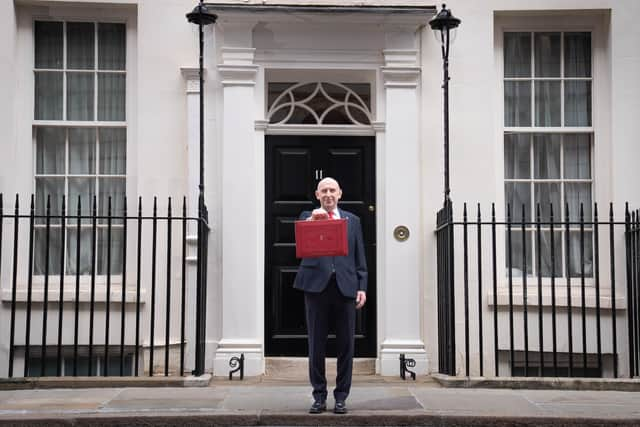
That’s why it was disappointing that the Chancellor chose not to address it on Wednesday. Not even a hint of changes to come.
But change there must be, no matter how big the inevitable pushback from Red Wall backbenchers who fear offending people they naively believe to be Labour voters.
The extent to which not working is ingrained in our society – especially in the North – was laid bare during the run-up to the budget in a report from the Centre for Social Justice, the think tank founded by Iain Duncan Smith, who as a Tory minister created the system of universal credit that was supposed to always make work pay. Instead it has become a crutch.
The report found that in 3,000 neighbourhoods across England and Wales, more than half of adults are receiving out-of-work benefits. On some streets, the figure is as high as 80 per cent.
If you include another 17,000 areas in which a third or more are claiming those benefits, you have a total of nearly six million, which is equivalent to the entire population of Yorkshire.
These people, says Duncan Smith, have fallen back into a welfare trap supercharged by health-related benefits that give them no incentive to find work. Yet because much of this worklessness is recorded as ‘incapacity’ rather than conventional unemployment, it has gradually become accepted as a fact of life.
In Yorkshire, Bradford emerges as the district with the highest proportion of out-of-work benefits claimants: 24 per cent overall, across 81 neighbourhood ‘hotspots’. Idle, ironically, is not one of them.
Fuelling the figures is the apparent collapse in the nation’s psychological wellbeing. Reported mental health issues have risen by 3.2m in the last four years alone.
It’s an indigenous problem, not the inevitability of too much immigration. White people on benefits, who trundle through the courts for shoplifting and taking drugs, far outnumber anyone else. These are families in which children are brought up to believe the state owes them a living; all they need to do is shake the money tree.
The proof of this is already apparent. Teens and young adults make up nearly a third of recent claimants for anxiety disorders. Nearly a million of them are neither earning nor learning and only last week, Andy Burnham was calling it a “moral failure” on the part of the state.
Yet at the same time the statutory minimum wage policy is backfiring on young people who are making an effort to find work. By removing the ‘training discount’ that once encouraged employers to take a punt on raw talent, the youngest recruits are being priced out of the market. We’re talking here about the bottom rung of the work ladder: remove that and you risk taking away the chance to ever climb higher.
In any case, it’s not just about economics, it’s about the independence that comes from going out to work and the despair of not doing.
I’ve seldom heard this put better than by the comedian Chris McCausland, whose loss of sight as a young man made him more deserving of help than any of us. But, as he recalls in his autobiography, that wasn’t the point. The job he took in a call centre paid less than the DHSS but did more for his sense of self-worth than anything else he’s done.
That seems too hard a concept for today’s idlers to grasp. So it’s up to ministers to finally kick away their crutches by making credit less universal – and more sensitive to the difference between medical affliction and personal inertia.