
Mission to the moon shows how we can change the world - Christa Ackroyd
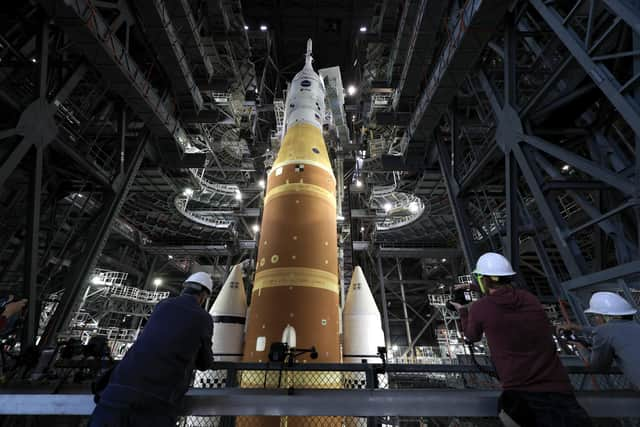
Hopefully by the time you read this the latest space mission around the moon will have touched down safely.

It is strange to think that somewhere overhead nearer to the moon than to us here on earth three men and one woman have been floating around in space this week, 200,000 miles away from the chaos of what is happening down below.
And for the first time with a toilet. Who knew?
But then I always was one for detail, just as I know that before every mission a special cake is made.

Space, the final frontier, as I remember the StarTrek catchphrase of my youth, has always held a fascination for me.
It reminds me how small we are individually, globally and universally. And I like that.
When we get het up or angry over the little things, for me it always helps to see the bigger picture.
And you don’t get any bigger than space, which so far we haven’t even literally touched the surface of, other than the moon of course.
We can argue about the cost when so much is needed here.
We can discuss why science has spent billions on getting us there when there are people struggling without food, clean water and with untreated disease across our world.
Or we can remind ourselves that those who would use conflict to divide rather than man’s scientific know how to heal and tend those here on earth, are equally insignificant in the grand scheme of things.
I like to think that the greatest thing about missions to the moon are that they symbolise anything is possible.
That is why our family catchphrase has always been: “love you up to the sky, down to the ground, as wide as the world and as big as the universe”.
And that’s a lot of love to teach those younger than we, less able to comprehend the mammoth achievements in science and technology they take for granted, which have taken place in our life time, that flying to the moon is a symbol of the infinite possibilities for them and for mankind.
I remember my cousin Paul and I, in the early hours of the morning that day in July 1969, poised to press record on his little reel to reel tape recorder all those years ago when man first walked upon the moon.
And yes they did. Of all the conspiracy theories that abound this one I have no doubts about.
It wasn’t just me and Paul who got up in the early hours of the morning in this country to watch the moonwalk live.
Around the world it is estimated that one fifth of the global population did the same….650 million people, an incredible number when you consider both the time of day and the fact many people didn’t even own a telly back then.
Yes you can tell me it wasn’t live. Yes you can ask how the world’s first overnight broadcast for the BBC was possible, but then how was it possible to even get there might be a more significant question.
Of course Neil Armstrong’s ‘small step..giant leap’ was technically not live because of the transmission time delay and for the first few minutes the grainy images were broadcast upside down. But it was as it happened here on earth and it was momentous.
It was, even though I was so very young, part of a shared moment in history and proof now that if you watched like me you are getting on in years.
Space is frightening in its vastness and the dangers of trying to get there.
I remember the ill fated Challenger mission of 1986 which I watched live again from the newsroom of Radio Aire when Christa McCauliffe one of so few female astronauts lost her life along with six colleagues as the whole thing exploded on take off.
A disaster, a tragedy and still the scientists and those who believed in at least finding out if there is life out there, tried again.
Which is why three years later I found myself on the banks of the Banana River at Cape Canaveral waiting for the launch of the Shuttle Atlantis, this time with astronauts wearing seven stars on their uniform in memory of those who died.
But it is why we were there I remember more.
We were in Florida for the first ever live broadcast from Disneyland, where we had taken a group of youngsters all with their special stories, made possible by the satellites we were then broadcasting and which we now take for granted for our every day communication.
But also possible because of the generosity of the people back home. Radio Aire won a major broadcasting award for that programme. But that wasn’t why we went.
We went because down to earth people were generous with their time, ingenious with their fundraising and wanted to help make a difference in their own backyard, a million miles away from where science would take us in the future.
That is the reason for writing this column this week. I often think how insignificant we all are individually but how strong we are collectively.
We can change the world, if not for everyone, for someone. Maybe that is our mission here on earth. This Easter many of you may have gone to church to celebrate the Easter story.
I didn’t, not because I don’t believe, but actually I believe so wholly in the teachings of Christ who made his church here on earth not within four walls but among those who needed it most, and for whom reaching for the stars seemed impossible.
Simple folk. And yes women too. Christ had little to do with powerful men.
He taught, he healed and he fed, which is why this week and not for the first time after a fun morning riding their ponies the two grand daughters who live close enough came with me to cook for the homeless.
They worked so hard ladling the food into containers, writing what was on the lids and packing them away to be delivered to those they now understand have nothing, when they have so much.
They did it willingly and with a smile, hardly falling out (which like all sisters is a rare occurrence) and for no reward.
Though they will wear their Homeless Street Angels T-shirts with pride and no doubt enjoyed the Easter eggs they were given as a thank you, part of a huge haul of donations for the Easter Sunday outreach of cooked breakfast served with a smile and a hug, which to me is far more akin to the teachings of all religions than formal worship.
I know that churches and places of other religions do so much good. I know many are open for more than just a day a week so this is not a criticism of those who use them for contemplation and devotion.
It is just that for me I prefer to contemplate on the power of the universe, when I think of God, all our gods, on what we can do in our towns and cities and among our neighbours here on earth to make it a better place.
It is strange to think of mankind being up beyond the sky while my two grandchildren cooked and cleaned in a small kitchen, of human beings circling the moon that shone as the food they had prepared was given out to those who can no more imagine flying to the moon as they can see a better life ahead.
But it is also strangely comforting to think that we can achieve something just as powerful, just as impossible, if we are prepared to look to the stars rather than down at our feet and believe nothing will change.
The power of the brain is an incredible energy.
The universe is made up of that same energy and if a man or women can fly to the moon, just imagine what we can do here on earth, if we believe it.