
Nigel Farage’s tough talk on Russia masks a hollow defence policy - David Stuart
In an interview published by Bloomberg on October 16, 2025, Nigel Farage said he would “shoot down Russian jets if they enter NATO airspace”. His delivery sounded decisive – the posture of a man who wants to appear strong in a dangerous world. Yet the remark exposes something deeper and more troubling about Reform UK’s defence politics: a talent for noise without strategy.
Tough language has its uses; it reassures the anxious and flatters national pride. But when Reform UK talks about Britain’s security, it offers a sequence of statements designed for applause rather than implementation. Its latest promise to raise defence spending to three per cent of GDP within five years looks bold on a banner but collapses under the weight of basic questions: against whom, delivered how?
Reform has never defined which countries or actors it considers threats to Britain’s security. Russia’s aggression is discussed as if it were distant and abstract. China is mentioned only as a trading partner. Hybrid warfare, disinformation and energy coercion scarcely appear in its public materials. A defence policy that cannot even name the threats it seeks to deter is not a policy at all – it is an attitude in search of substance.
Numbers are easy; defence planning is not. Three per cent of GDP tells us nothing about what ships, aircraft or brigades that money would produce. Reform UK offers no timeline or mechanism for turning that spending into deployable, trained forces able to respond to real threats. It omits any link between Britain’s defence industry capacity, supply chains, or procurement reforms and the forces it claims it would expand.
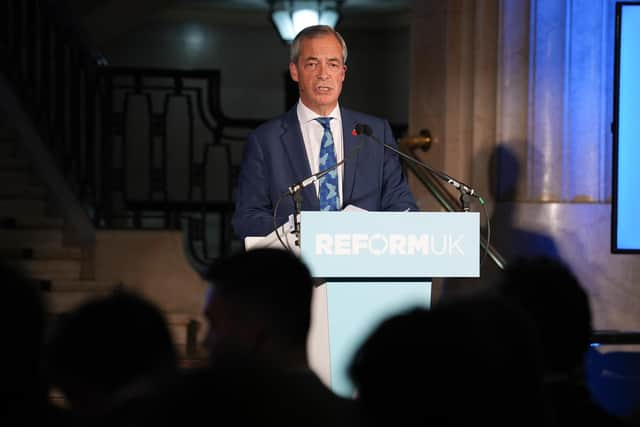

Alongside the three per cent promise sits an older claim from Farage – that NATO expansion provoked Vladimir Putin’s invasion of Ukraine. That argument is not only false; it is morally poisonous.
NATO is a defensive alliance. It has never invaded, annexed or coerced a neighbour. Every state that joined - Poland, the Baltic nations, Romania, the Balkans - did so by democratic choice, precisely because they feared Moscow’s return. When Russia attacked in 2022, Ukraine was nowhere near qualifying for membership. There was no invitation, no timetable, no consensus. The real reasons for the war were imperial ambition and envy: envy of a democratic, prosperous Ukraine and ambition to rebuild a Russian empire. Putin struck not from fear but from greed - for land, power and control over free nations.
No serious defender of national sovereignty bargains away another nation’s. Farage’s so‑called realpolitik of conceding another sovereign country’s territory for 'peace' is surrender in instalments – if invaded, what would Britain give up under the same logic: Cornwall for peace, the Shetlands for stability? Real sovereignty, whether Ukraine’s or Britain’s, rests on the principle that borders are not negotiable under threat of force.
When a British political leader repeats Moscow’s excuses, he sends the worst possible signal: that Britain’s resolve can be shaken and that tyranny might be tolerated if it stays far enough away. It tells allies that our commitment wavers and adversaries that our memory fades.
Supporting Ukraine is not charity; it is forward defence. By helping Ukraine to resist, we defend the front line of freedom so we do not have to defend it on our own soil. Reform UK’s vagueness about continued support – its refusal to state whether that help would endure – emboldens Moscow.
Reform UK likes to speak of ‘taking back control.’ But sovereignty today is not measured by isolation; it is measured by capability and credibility. A sovereign Britain is one that can act effectively with its allies, shaping events rather than hiding from them. Our security depends on the depth of alliance, not the distance from it. The RAF’s operations in Poland, the Royal Navy’s patrols in the Baltic, our shared radar networks and nuclear cooperation with the United States – these are not concessions of independence but expressions of strength.
Farage’s latest outburst, dressed up as toughness, exposes what Reform UK’s defence politics truly are: bravado without backbone. Britain has never defended its sovereignty by pretending threats do not exist. Our national story is one of standing up to bullies – from Napoleon to Hitler and now Putin. British soldiers died for the principle that nations should be free. Real patriotism is not waving a flag while looking away; it is defending the values that flag represents – courage, loyalty and honour in the face of aggression.
My grandfather fought at the Somme and Passchendaele. I wonder what he would have made of Farage’s brand of patriotism — a flag draped over fear? Britain’s security requires a lot more than flags, slogans and a GDP per cent number — it needs the difficult substance of intelligence, deterrence, alliance, a defined force structure, a readiness pathway, an industrial delivery plan and potentially sacrifice.
David Stuart is a retired senior civil servant with a background in industrial psychology, based in Sheffield, and an active interest in military history and national defence.