
Nigel Farage’s visit to Barnsley shows Reform has its eyes on gains but what can the party deliver on a local level? - Jayne Dowle
Like most of the rest of Barnsley, I woke up last Thursday morning to learn that Nigel Farage has been in town again. He’s identified us as a “key battleground” in the local elections on May 7 and his party is gunning for control of our longstanding Labour-controlled council.

Yes, the same council which has done so much to transform Barnsley from a struggling ex-mining town to a nationally-recognised beacon of pride, progress and innovation.
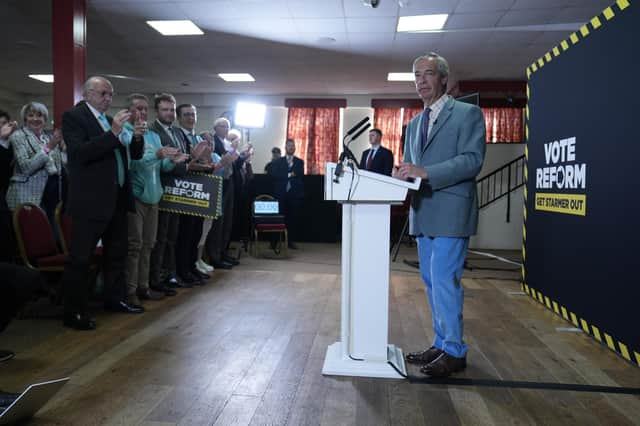
Farage slinks in without warning, seemingly even to party members, many of whom expressed outrage on social media that they had not been invited to meet him for a pint at Dodworth Central Social Club.
He also somehow forgot to invite Labour’s Marie Tidball, whose parliamentary constituency covers Dodworth, overlooking the convention and etiquette that if one MP makes a visit to another’s patch, they should inform their Westminster colleague.

She’s not happy either; Tidball grew up in Dodworth, where her dad was a local councillor.
The speech, we learn, was only for an invited audience of local election candidates. Reform UK is fielding a representative for every single seat.
We have 21 council wards in Barnsley, each represented by three councillors. By my maths, that’s 63 individuals in total. I’m sure Dodworth club holds more than 63 people, and from visual evidence, it looked packed. Who were all the others in the audience?
Who knows? Reform UK supporters, not just in Barnsley, but across the UK, are blindly, even dangerously, convinced that Nigel Farage only has their interests at heart.
Like any senior national politician, of whatever party, he puts his own interests first.
He’s had to fight to get to the top, fight to keep his place and fight to reinvent his party from UKIP, with its agenda to leave the European Union, to Reform UK, which puts ‘Stop the Boats’, ‘Secure and Defend Our Borders’ and ‘Deport Illegal Immigrants’ at the top of its policy list.
Sadly, there are too many people, and not just here in Barnsley, who think this multi-millionaire, reported to live in a big house with a swimming pool in Frinton-on-Sea, a genteel resort in his Clacton constituency in Essex, really is their ‘mate’, a pint-supping, cig-smoking man of the people who will save them from Sir Keir Starmer.
And sadly, what many of them also fail to understand is that what Reform UK promises to do nationally - should Farage ever step into Downing Street - is not what they can do locally.
If you’re going to vote Reform UK, at least take the time to understand how British politics works. We all know that the upcoming polls, as Farage outlined in his speech, are “not a normal set of local elections”. Much of England, Scotland, Wales and all 32 London boroughs will be voting.
It’s widely accepted that as well as delivering local councillors to sort out local issues – bin collections, potholes, along with economic regeneration, inward investment, social care, housing, planning, education – these elections are going to be a de facto national referendum, delivering a verdict not just on the Labour government but also on the leadership of Starmer.
The calculation is that should Labour be trounced, not just by Reform UK, but a resurgent Green Party, nationalists in Scotland and Wales and in some areas, strong Conservative and Liberal Democrat candidates, Starmer will be forced to step down.
That is the big picture many Reform UK-leaning voters have in their minds, who imagine that into the breach will step a triumphant Nigel Farage to be anointed PM.
I know this because I have plenty of friends who support Reform UK; some are more politically savvy than others and understand that it doesn’t happen like that. That they could be in for a long wait.
Starmer going is one thing. Labour leaving Downing Street is quite another. If he went, another leader would be elected and the Labour government could conceivably soldier on until August 2029, when by law, the next General Election must be held.
Or, we could have a General Election at any point before. Labour could win again. Or a diminished Labour could join a rainbow array of Reform UK, Greens, nationalists, Uncle Tom Cobley and all in a coalition government. Or Reform UK could win.
Anything could happen. However, what should be absolutely clear to anyone considering voting Reform UK on May 7 is that local politics and national politics are very different beasts.
Whilst there is crossover in terms of roles – about one in 10 current MPs also serve as councillors, with others having local government backgrounds – what your vote will actually lead to really is quite different.
Instead of being held spellbound by a showboating Farage, I’d advise anyone considering voting for a Reform UK candidate in any council seat should seriously ask them exactly what they plan to do locally.