
Reform is not really a party at all but Nigel Farage’s personal fan club - David Behrens
I don’t wish to sound unnecessarily lavatorial about this, but sometimes it is necessary to flush several times before the most malodorous contents of the bowl can finally be rinsed away. That is pretty much what’s going on in the Conservative Party right now.

Robert Jenrick’s emergence from the Westminster soil pipe into the gutter of Reform UK has been the most visible example of a very public Tory excretion. Sacked for treachery before he could resign, his public sluicing exposed him as the stupidest of all its former leadership contenders – and in a field that once included Liz Truss, that’s quite an achievement.
Jenrick had apparently left the details of his planned defection next to the photocopier. Colleagues found it and amused themselves by reading of his reinvention as “the new sheriff in town” and the politician most able to give Reform “political heft”.
A few hours later, he washed up at a Reform press conference where Nigel Farage did his best to make him look welcome. He did the same for two other Tory defectors including the former Chancellor Nadhim Zahawi, smarting after an investigation by the taxman, being refused a peerage and getting sacked as party chairman.
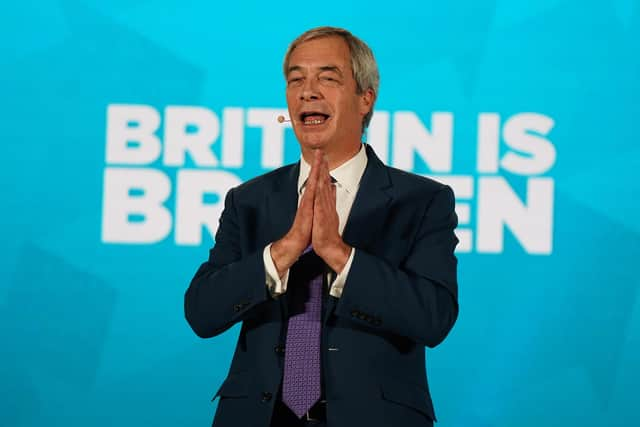

But behind the bonhomie, the air was thick with betrayal. Jenrick and Zahawi were liabilities to Kemi Badenoch; now they are threats to Farage. Jenrick in particular was open about how badly he wanted the Conservative leadership; he won’t be content for long to play second fiddle at Reform.
He and Farage are not natural bedfellows. Jenrick was originally a creature of the Tory centre – his creep towards the right has been in pursuit of popularity more than principles – and he and his new boss have locked horns frequently.
Last August Farage was tweeting: “Jenrick is a fraud. I’ve always thought so”, claiming that as immigration minister he exponentially increased the number of illegal migrants in free hotels.
Three months earlier Jenrick had accused Farage of competing with Labour to splash out ever more cash on what he called “workless families with 10 or more children living on state benefits”.
That’s an aspersion that will come back to haunt him, for what differentiates his new party from the Tories is the profile of their supporters: a far higher proportion of Reform voters are members of those benefits-reliant families he describes.
And for Farage, the appropriation of three high-profile politicians -- a coup, on the face of it – is ill-timed. Nine months after taking control of a dozen Town Halls, it is becoming clear to even the most disenfranchised former Labour and Tory voters that his party is a busted flush.
Let’s take a look at its record: in Kent, Farage’s supposed ‘flagship’ local authority has raised council tax by nearly four per cent despite promising to cut it; in Northumberland, a Reform councillor was discovered to owe his own council nearly £40,000 in business rates and council tax; and in Wales the party’s regional leader is serving 10-and-a-half years in jail for taking bribes to make pro-Russia speeches.
With a showing like that it’s hard to claim the moral high ground, no matter how sleazy the other parties. Especially when you’re welcoming their sleaziest into your ranks.
There is, however, one promise Reform has delivered – even though it was a promise to do nothing – and that’s keeping Northern Powerhouse Rail out of Hull. Labour partially came good last week on its plans to upgrade rail links from across the Pennines to West and South Yorkshire but the boundary of this new world stops at the East Riding border, where the Reform mayor Luke Campbell is, to use Jenrick’s phrase, the new sheriff in town.
Campbell made no noticeable contribution to the campaign for better trains and no wonder: his own party wants to cancel the whole project. Farage’s deputy Richard Tice went so far as to advise rail companies “not to bother” bidding for contracts.
It’s not the only big transport project that has Reform coming and going: the planned reopening of Doncaster Airport has ignited a veritable civil war in its ranks, with the party leader on the council stepping down over “vitriolic texts that border on abuse” from his own colleagues.
The local branch chairman has packed his bags too, and last month a councillor quit Reform for the second time in a fortnight, to join a new party set up by a former Farage deputy who fell out with him.
That’s the trouble with Reform: it’s not really a party at all but Nigel’s personal fan club, a coalition of uneasy alliances that are apt to dissolve when something or someone muddies the water. As he will soon realise, Robert Jenrick has floated into a political bottleneck.