
Riots show Northern Ireland can no longer be left out in the cold - Jayne Dowle
The horrific events in Belfast remind us of what is often overlooked, even forgotten, that Northern Ireland is part of the United Kingdom. I should declare a personal interest. I’ve visited Belfast in recent years and travelled by train and bus across Northern Ireland.

Also, through my work I speak regularly with people over there who work in property, regeneration and education, and have several friends who live in and around Belfast and the northwest coast.
The sentiment I often hear - from all sides of the political divide - is that the Westminster government basically has little interest in what goes on in the Six Counties, Antrim, Down, Armagh, Tyrone, Fermanagh and Londonderry.
Indeed, so little do we hear of Northern Ireland in general political discourse it came as quite a shock to be reminded, during the difficulties of the last week, that the Secretary of State for Northern Ireland is the veteran Leeds South MP, Hilary Benn, speaking out to condemn the “racist thuggery” in Belfast.
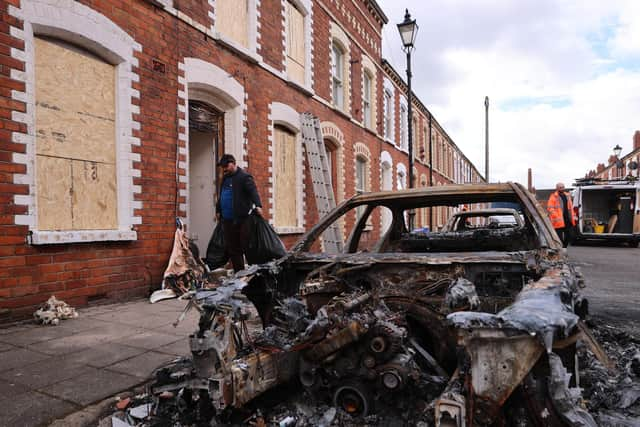

His comments came after two consecutive nights of violent anti-immigration riots following a knife attack on a local man, Stephen Ogilvie, who was seriously injured, losing an eye.
On Wednesday last week, Hadi Alodid, 30, a Sudanese refugee, appeared in Belfast magistrates court charged with attempted murder.
Sir Keir Starmer’s government might be lurching from crisis to crisis, but it can no longer assume that Northern Ireland - twin-governed through the devolved powers of the Northern Ireland Assembly at Stormont - can be left out in the cold.
An ongoing delicate brokering of powers and often uneasy truce-making has coloured Westminster-Stormont politics since the Good Friday Agreement was signed in 1998, which brought to an end the 30-year conflict known as ‘the Troubles’. The agreement established a power-sharing government, secured civil rights, and defined Northern Ireland’s constitutional status.
It’s fair to say that Northern Ireland politics is complicated; I’m no expert on the intricacies and nuances, rooted as they are in long and complex history.
However, I can claim some understanding of how the majority of people in Northern Ireland want to move forward, respecting the past perhaps but not allowing it to define the future.
I think of my friend in the leafy suburb of Dunmurray, South Belfast. Descended from an old Anglo-Irish line, she single-handedly rescued the family house from dereliction and now welcomes people for yoga classes, floristry workshops, music events and celebrations.
I think too of an English friend who had enough of the daily grind living here in South Yorkshire and upped sticks a decade ago to live on the stunning northwest ‘Causeway Coast’. He doesn’t mind the tourist buses taking fans of the HBO series Games of Thrones to see famous filming locations such as The King’s Road aka the eerie intertwining beech trees of The Dark Hedges in County Antrim.
GoT spin-offs are still being made, but at the peak of filming between 2010 and 2018, it’s reported that HBO spent over £251m directly on local goods, services, cast, and crew - such inward investment proved NI had much to offer.
As Brendan Ciarán Browne, Associate Professor, Conflict Resolution at Trinity College, Dublin, wrote last week for the online academic/journalism pub The Conversation, “as Northern Ireland has transitioned away from its legacy of conflict and moved beyond the 1998 Good Friday agreement, it has attempted to open up and become more cosmopolitan, pluralist and diverse.”
And I also think of the young woman I spoke to the other week working late in the marketing department of Belfast Harbour, which will benefit from a £1.3bn project, bringing 3,000 new homes, plus expansion of the port and a new marina. She was so proud and positive for the future of her city.
I thought of her and her optimism when I saw the horrific footage of the knife attack and then the subsequent riots, families being burnt out of their homes, water cannons fired on black-clad balaclava-wearing protestors, community leaders calling for calm.
For all the forward trajectory, Northern Irish cities such as Belfast suffer from serious social problems; poverty, substandard housing, unemployment, poor health. Around 40 per cent of Belfast’s population lives in areas that are consistently classified among the most deprived in Northern Ireland, according to the city council.
Add to this a dangerous cocktail of racism and long memories of sectarian violence, now fuelled for the younger generations by social media ‘bad actors’ who “couldn’t find Belfast on a map” as one commentator put it, and we witness a city on the brink of implosion.