
Robert Jenrick made the schoolboy error of not knowing his audience - David Behrens
There is little point in accusing the Tory attack-dog Robert Jenrick of naked opportunism or of aping Donald Trump’s slash-and-burn style of political debate – both are clear beyond doubt. But what was surprising about his performance at his party conference was how badly he misunderstands his core audience.

Jenrick was an unhelpful distraction when the remaining Conservative faithful gathered in Manchester last week. Next to the reasoned and rational presence of his boss, he came off as a prig with a Neil Hamilton air about him.
He had taken the opportunity to go on one of his confront-the-people escapades, following his self-proclaimed success on an earlier outing in which he shouted at fare dodgers on the London underground and moaned about the surfeit of Turkish barber shops.
This time he was in the Birmingham suburb of Handsworth, where he said that after an hour and a half he had not seen “another white face”. He then rowed back by adding that “it’s not about the colour of your skin” – although it plainly was, otherwise why mention it?

His point was that Handsworth was one of the worst integrated places he had seen, and he is right that integration is preferable to ghettoisation, no matter where you are in the world.
But beyond that single observation he hadn’t thought it through – because integration requires social mobility, and not necessarily the sort his intended supporters would want.
In fact, previous attempts at enforced desegregation provoked exactly the kind of response in white communities that is being weaponised against asylum seekers today.
Let me take you back to Bradford in the 1960s and 70s, where children from Asian families were taken every day by bus to schools in far-flung parts of the district so that they might better integrate with the white children who lived there.
It was a scheme conceived with good intentions but, far from desegregating the kids, it created an experimental apartheid around them. “Can all the immigrants form a line, please,” someone would ask half an hour before the final bell, so that they could leave early for the long journey home.
An entire generation of children climbed aboard with no say in the matter. The writer Shabina Aslam was among them and has created a travelling exhibition of memories from others involved. She remembers that she “didn’t really have any friends in the classroom”.
It left a lasting impression. “Nobody ever spoke to me. I was always looking at the others thinking, ‘How do I become like them?’”
In 1977 I went to Bradford as a journalist and I remember the whispers about recently-arrived Brits moving into new areas and the so-called ‘white flight’ of indigenous families to suburbs further afield. Those families, or their modern-day equivalents, are the ones Robert Jenrick thinks he’s talking to – but let the record show that they approve of social mobility only very selectively. It’s fine so long as they are the ones being upwardly mobile.
Even half a century ago this was not a new phenomenon. Communities in big cities worldwide have always adapted to the needs of their inhabitants. Robert Jenrick must know that; he’s not a complete idiot.
But then again, who is he exactly? If you asked his previous boss, Rishi Sunak might have described him as a moderate Conservative and professional lawyer who was a counterweight to the then Home Secretary, Suella Braverman. Sunak was closely allied to Jenrick and installed him as Immigration Minister with a brief to stop the small boats.
He ascribes his obvious failure to do so to the indolence of his civil servants, some of whom he considered (with justification, I’ve no doubt) were actively working against him. That – and Sunak’s supposed betrayal by failing to appoint him as Braverman’s replacement – prompted an embittered epiphany on Jenrick’s part that swung him opportunistically to the right. The question is, how much of its rhetoric does he actually believe?
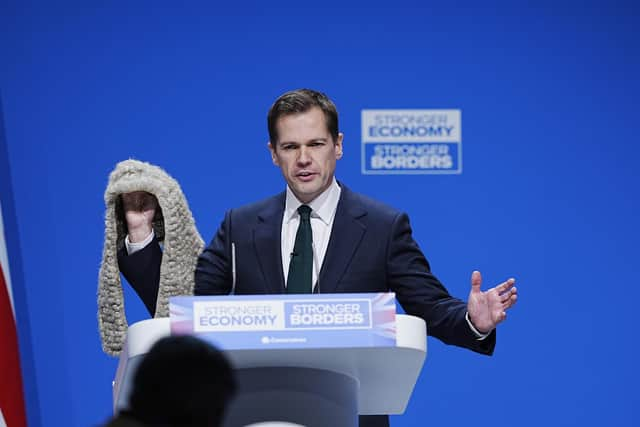
He ended his rant at the Tory conference by holding aloft a judge’s wig – coiffured by one of those Turkish barbers, no doubt – and threatening his old legal colleagues with a US-style politically-appointed judiciary. That was another own goal; judges are not known for their enmity towards the Conservative Party but they soon would be if that happened.
Not knowing your audience is a schoolboy error for any public speaker, especially one like Jenrick who actually looks like a schoolboy. It doesn’t take much to fool the Tory membership; they were the ones who anointed Liz Truss, after all. The rest of us aren’t so gullible.