
Sarah Mullally has the opportunity to become a voice of sense - David Behrens
A sheet of A4 drops onto my doormat: a begging letter from our village church asking for £5 a month towards its upkeep. This from within an organisation that owns 100,000 acres of land and property and manages a £10bn endowment fund to support it. Shouldn’t we be sending them the begging letters?

We have a lovely church, sure enough, but it’s the architecture that makes it attractive, not the calling to prayer – which in any case takes place there only occasionally.
It is typical of thousands of small English churches and the cost of keeping them is one of the many problems that will occupy the time of the new Archbishop of Canterbury who is – praise be! – a woman.
That this last detail is still in any way surprising or controversial shows you just how far the Church has to travel before it reaches the 20th century, let alone the 21st.
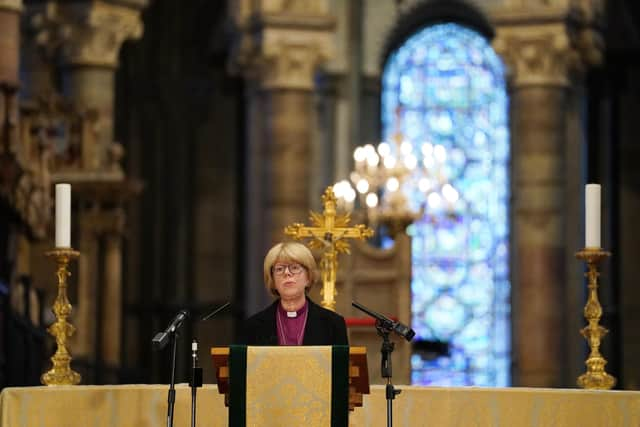

Parishes are the grass roots of its operation yet there are many volunteers at this level who are appalled at having to pass the collection plate outside their churches, as well as within. Readers of this newspaper have heard often from churchwardens in revolt at being made to find thousands of pounds for mandatory contributions to dioceses whose bishops can redistribute them with little or no transparency. If a government operated in that way there really would be a revolt – as indeed there was, in 1381.
It’s not a phenomenon unique to the Church of England. A century ago in Liverpool, the Catholic Archbishop Richard Downey shamed the poorest members of his community into contributing weekly to fund his castle in the air, a vast cathedral to rival the Lateran Basilica. It went unbuilt and they were never repaid.
It’s travesties like that – and at the other end of the scale, the parlous state of small churches like the one across the lane from me – that make you question the need for organised religion. Shouldn’t faith be a private matter for personal conscience?
As a nonbeliever, that’s easy for me to say. And it’s not my business to try to deconvert anyone. But if I believe anything it is that institutionalised worship is an anachronism; it’s tribal and it creates haters and victims of hate, sometimes within the same person. In the current climate of religiously fuelled terrorism, couldn’t we do with less of that?
If the state church still has a purpose it is surely to weigh principles against practicality – and that is the most difficult of all the challenges facing Archbishop Sarah Mullally.
She is, for instance, on record as saying that bishops must oppose the legalisation of assisted dying, on the grounds that terminally ill people who worry they are a burden to their families might feel pressured into ending their lives. The nation, she said, should invest in palliative care for them instead.
This is well-intentioned but unfeasible in a country whose health service struggles to care for even those with infinite life expectancies. And how many people with a terminal diagnosis would genuinely want to be kept alive for as long as possible, no matter how intense the pain or how great the emotional and financial distress to their families? For most, the option of dying with assistance and dignity will be a blessing, not a burden.
And that’s all it is: an option. No-one is mandating euthanasia. The role of the bishops should be to scrutinise the safeguards; to protect, not proscribe.
Mrs Mullally takes a more reasoned view than that of Stephen Cottrell, who as Archbishop of York would have been the natural choice for Canterbury but whose mishandling of various church abuse scandals mitigated against him.
Cottrell is ill-placed to claim the moral high ground and his fire-and-fury threat to vote down the End of Life Bill at the next opportunity bordered on caricature. Very few of us accept the absolute authority of the church, and dogmatic pronouncements like his further undermine our faith in it. Indeed just last month, a poll found that well over a quarter of us think the next Archbishop of Canterbury should talk less about politics and not at all about immigration and asylum.
That isn’t a surprising conclusion. The world right now is crying out for voices of reason; people who can dial down the rhetoric instead of ramping it up. Because for all the virtue signalling that goes on in social media, we have never been more hostile towards one another. There are ‘right’ causes and ‘wrong’ ones and their rightness is determined by volume, not common sense.
Sarah Mullally has the opportunity to become that voice of sense; the one that brings us together, not tears us further apart. And if there is any service the church can give that’s worth £5 a month, it’s that.