
Sir Chris Wormald’s departure could be the moment the civil service is made to realise it’s there to facilitate change, not prevent it - David Behrens
If they threw honours at writers the way they do at civil servants, I would be Baron Behrens by now. I wouldn’t have earned the title, you understand; it would have been my reward for sticking at it for so long.

Sir Chris Wormald got his knighthood for “distinguished service as a senior civil servant” or in other words, just doing his job. He had been doing it for 26 years at that point, which is half as long as I have now, and he’d had the benefit of not having to navigate a competitive jobs market. Such was his artlessness that he was once ridiculed in the Commons for letting his staff play with party hats in a meeting about funding cuts. He was head of the Department of Education at the time.
That being the case, one wonders why Sir Keir Starmer thought he was the whizzkid he could entrust with “nothing less than the complete rewiring of the British state”. I wouldn’t have let him rewire a Christmas tree.
Wormald fell from favour for not driving through civil service reforms. He lasted just 14 months as Cabinet Secretary. It’s the most senior post in Whitehall and no-one has served a shorter term than he. That makes him the Liz Truss of the civil service. Yet though he delivered next to nothing he will leave with a severance payment of £260,000.
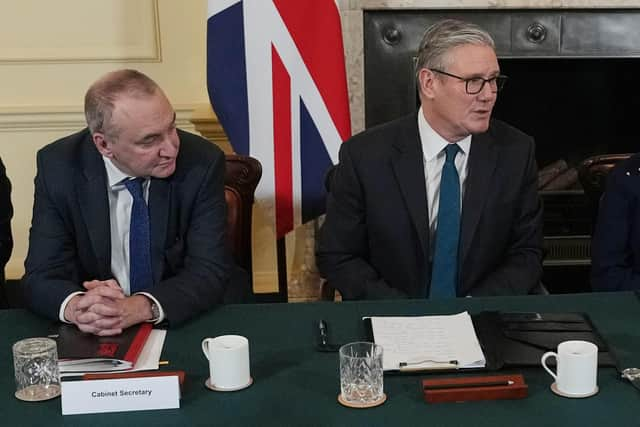

His union, the smugly self-congratulatory Association of First Division Civil Servants, said his sudden departure marked a new low in relations with ministers. But the ignominy of his ejection might actually raise the bar for those who follow. It could be the moment the civil service is made to realise it’s there to facilitate change, not prevent it.
Under Wormald, the civil service was the tail that wagged the ministerial dog. Politicians who thought they had signed off institutional changes found themselves upended by Whitehall departments and obscure quangos which, it turned out, wielded more power than they did. It was the boss’s job to remove these roadblocks; instead he was the one laying out the orange cones.
Nowhere was this inverted pyramid of power skewered more pointedly than in Leeds, when a new government ‘advisory unit’ called Nista, the National Infrastructure and Service Transformation Authority, threw a spanner under the wheels of the new tram system politicians had promised by the end of the next decade. It will now be delayed by perhaps a generation or maybe cancelled altogether because Nista, needing to justify its existence, demanded “a new approach”.
Its intervention was made worse by the excessive secrecy which surrounded it. We’re not even allowed to know what it didn’t like about the proposal because it is “normal” for its reviews to be kept commercially confidential, it says. But Nista is only 10 months old: it has had no time to set a precedent for what is normal and what is just a smokescreen.
And it doesn’t end there. This week the Treasury was accused of “excessive control” in holding back other transport spending that could deliver real change to the regions.
A more pragmatic Cabinet Secretary could have kept those controversies at bay by knocking heads together and finding a way forward. Wormald found only a dead end; he dealt in problems, not solutions, as the civil service always has. Keir Starmer thought he would break the mould but he was wrong.
And being wrong is, of course, the one thing Starmer does consistently well. Having performed more U-turns than someone trying to navigate the Leeds inner ring road, he now finds himself seeking as a successor to Wormald, someone who really can cut a swathe through the bureaucracy.
But his record in choosing people is poor. Under his premiership Number 10 has operated a revolving door of advisors and ‘enforcers’ like Sue Gray, Morgan McSweeney and Tim Allan, who have disappeared faster than a plate of civil service biscuits.
Starmer’s latest great hope is Dame Antonia Romeo, another one honoured just for doing her job, whose copybook is blotted by allegations of staff bullying – an investigation into which was allegedly hushed up. On paper that’s not a great look. Yet she might just be the one to tell her more indolent colleagues to get knighted.
Look, I don’t wish to trivialise bullying in the workplace or anywhere else, but in my experience a lot of institutionalised civil servants have a low threshold of what constitutes intimidation. People unused to being told to pull their socks up are apt to mistake criticism for coercion and dash off a petulant note to HR.
But you can’t instil cultural change without upsetting people, especially those people with ideas above their station. And if Chris Wormald couldn’t do it, maybe a bully is what it will take.