
Subtle shift in government transport policy is a real change in direction for Yorkshire - Lisa Littlefair
When the government published its Better Connected: a strategy for integrated transport earlier this month, it did something quietly significant. Instead of leading with roads, railways or headline grabbing infrastructure schemes, it put people and places at the heart of the story.
That may sound like a subtle shift, but in the world of transport policy it marks a real change in direction – and one that has important implications for towns, cities and regional economies across Yorkshire.
For decades, transport strategies in the UK have tended to focus on assets: new lines, new junctions, new capacity. Success was often measured by how many vehicles or passengers could be pushed through a network as efficiently as possible. The new strategy asks different questions. How does it feel to travel? Can people easily get to work, education or healthcare? Do different parts of the system actually connect in a way that works for everyday life?
That change of emphasis matters because transport, at its core, is not a technical system – it is a social one. Everyone uses it and everyone experiences its shortcomings differently. A timetable that works on paper can still feel fragmented in reality. A new road can increase capacity while making a place noisier, less safe or less attractive to invest in. Designing transport around lived experience rather than abstract efficiency is a recognition that the outcomes – economic inclusion, productivity, wellbeing – are just as important as the infrastructure itself.

The timing of the strategy is also important. It arrives as devolution gathers pace across Yorkshire with Hull and East Yorkshire set to follow South Yorkshire, West Yorkshire and York and North Yorkshire in taking responsibility for shaping their own transport futures. For years, local leaders have been asked to deliver better outcomes with limited tools and shifting national priorities. What has been missing is a clear, long term framework that gives local decisionmakers confidence that the ground will not move beneath their feet.
In that sense, the strategy functions less as a shopping list and more as a stabiliser. Its real value is in setting direction. By clearly backing integrated, place-based transport planning, it provides a reference point that devolved authorities in Yorkshire can use to justify difficult but necessary choices – whether that is reducing car dependency, rethinking street space, or prioritising investment where it delivers the greatest social return.
This is particularly relevant outside of cities like Leeds and Sheffield, where the multiple transport options of major urban areas simply don’t exist. Many towns and mid-sized cities, like Huddersfield and Wakefield, are grappling with transport challenges rooted in their history: dispersed development, high car reliance and networks that evolved in isolation from one another. Congestion, unreliable public transport and limited connectivity are not just inconveniences; they are constraints on growth, investment and access to opportunity.
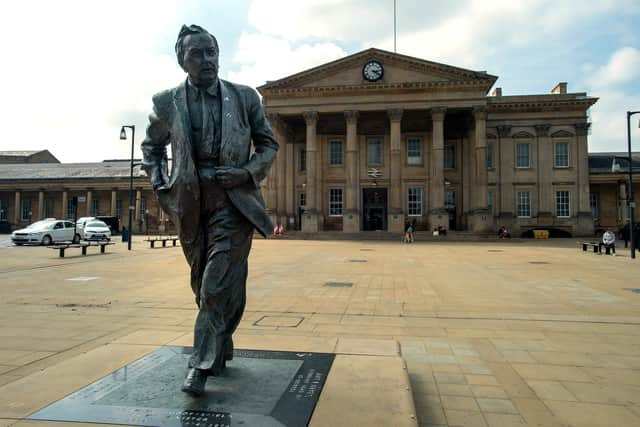
An example of this is Huddersfield which is dominated by car use with its location between major cities and close to the M1 and M62 corridors, making it popular with commuters and for logistics.
The ring road which circles the main town centre further reinforces private car use over public transport.
The integrated transport strategy’s people and place focused strategy reframes those challenges. Instead of asking how to accommodate ever more traffic, it asks how transport can support thriving town centres, widening labour markets and regeneration. In places experiencing high levels of deprivation, that can be transformative. Reliable, affordable, well-connected transport remains one of the most powerful enablers of economic participation not just in Yorkshire, but across the North and at a national scale too.
The strategy also reflects a growing recognition that integration is about the whole journey, not individual modes. It is about what happens before you board a bus or train: the walk to the stop, the quality of the street, the lighting, the sense of personal safety. It is about affordability, ticketing and information. These details rarely make headlines, but they shape whether people trust and use the system.
There is, of course, a gap between ambition and delivery. A strategy does not, by itself, fund maintenance backlogs or repair worn out assets. Local authorities are under intense financial pressure and many are struggling to maintain existing networks, let alone transform them. Without long term funding certainty, there is a risk that expectations run ahead of capacity.
But it would be wrong to dismiss the strategy on that basis alone. Transport policy is cumulative. What gets written into national frameworks shapes which schemes are developed, which business cases succeed and which outcomes are prioritised over time. Clear alignment between national direction and local plans makes delivery more likely, not less.
Lisa Littlefair is technical director for transport and mobility solutions and Leeds city lead at Mott MacDonald.