
The 250th anniversary of American independence is a reminder of the problem with gerrymandering - William Cooper and Edward Larson
The 250th anniversary of American independence should remind us what’s wrong with gerrymandering. Due to partisanship, however, it now not only persists but ratchets tighter in a tit-for-tat cycle that threatens to strangle representative rule. There is a solution to gerrymandering, however, if only politicians will act.
Inspired by revolutionary Enlightenment Era ideals, the Declaration of Independence and the new state constitutions of 1776 call for representative rule. The people would be sovereign, they proclaimed, with governments drawing their just powers from the consent of the governed. Nothing of the sort had ever been tried on a large scale and the founders struggled with how to implement it. Everything turned on establishing a truly representative governing assembly for each newly independent colony or state.
“The principal difficulty lies, and the greatest care should be employed in constituting this representative assembly,” John Adams wrote in his 1776 Thoughts on Government essay, which guided the drafting of most of the new state constitution and influenced Thomas Jefferson’s thinking for the Declaration of Independence.
During the early republic, although legislative and congressional districts failed to fulfill the ideal of fully representing all interests, they generally avoided the worst effects of modern gerrymandering by following existing political boundaries, such as town and county lines. This approach at least insured regional representation.
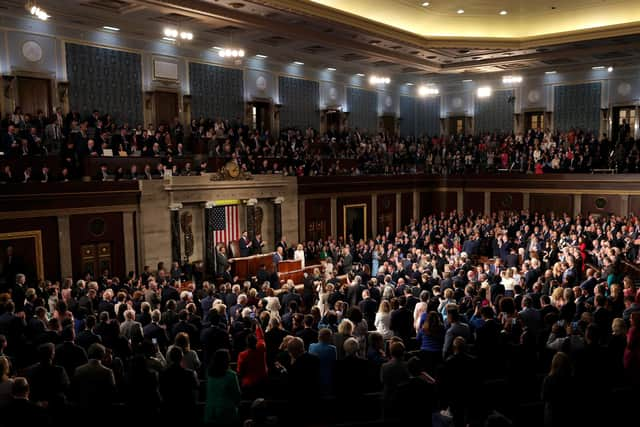

As a practical matter, 19th century partisan leaders lacked the precise voting records and detailed maps to crack and pack districts like their 21st century counterparts. They did have some sense of how neighborhoods and communities voted however and used it to affect a 19th century version of gerrymandering by selectively creating multi-member districts for state legislative and federal congressional offices. For example, if a clear majority of voters in a given city with four members of Congress typically voted for the same party, legislators could mandate that all four would be elected in one at-large district, with each voter casting four votes.
With the parties then picking candidates and many states using ballots that allowed voters to cast a single vote for all of a party’s candidates, at-large congressional and legislative districts virtually assured that the majority party’s candidates would sweep all the seats in a multi-member district even if they might lose in parts of it.
Five states carried this approach so far as to have all their congressional candidates run statewide, which assured that the majority party won every seat much as a winner-take-all approach for electing presidential electors gives all a state’s electoral votes to one candidate no matter how slim his majority. Both systems gained favor in the early 19th century as elections became more partisan. Pundits at the time calculated that under the winner-take-all system of congressional elections, one party could control the US House of Representatives with as little as 40 per cent of the nationwide vote.
The solution to this flaw in majority rule was obvious at the time. While assigning initial control over the manner of electing members of Congress to the various states, the Constitution empowers Congress to impose uniform rules.
In a populist reform enacted at the height of the Progressive Era, Congress passed the Apportionment Act of 1911 mandating single-member districts for congressional elections. As an added deterrent to partisan gerrymandering, the Act also provided that these districts be “composed of a contiguous and compact territory, and containing as nearly as practicable an equal number of inhabitants.” With this, gerrymandering subsided for a season.
Faced with the prospect of losing control of the US House in 1930 with the onset of the Great Depression, the Republican-controlled Congress passed the Reapportionment Act of 1929. In the hope of salvaging some Republican house seats, the new law repealed all of the anti-gerrymandering provisions imposed by the 1911 Act.
Multi-member districts returned in some states along with an increase in the number of less contiguous and compact single-member districts structured with a partisan edge. In 1967, a reform-minded Congress passed the Uniform Congressional District Act, which re-enacted the mandate for single-member house districts but without reinstating a requirement that they be contiguous or compact. By this time, the Supreme Court had applied the principle of equal population to legislative apportionment but the 1967 Act left open the door for gerrymandering those equally populated districts and advances in computer technology had transformed that process from a rough art to a precise science. Although the Supreme Court upheld partisan gerrymandering in 2019, under the Constitution, Congress can still limit it for House elections.
Only uniform, national rules can stop gerrymandering. Fortunately, the Constitution gives Congress the power to enact such rules but, having often been elected in gerrymandered districts, its members must be willing to act.
William Cooper is the author of How America Works … And Why It Doesn’t. Edward Larson is the Pulitzer Prize winning author of Declaring Independence: Why 1776 Matters.