
The AMRC is the model of regeneration and reindustrialisation - Andy Haldane & Koen Lamberts
More than 40 years have passed since the Miners’ Strike in 1984. The most visceral event during that strike took place at the Orgreave colliery and coking works in Rotherham on June 18, 1984. The Battle of Orgreave, a violent clash between picketing miners and the police, remains etched in our economic and social history, a historic low-point for industrial relations.
Yet visiting the site today, the landscape and the sentiment could hardly be more different. Where once miners stood, today stand hundreds of researchers, academics, engineers and industry professionals in a world-leading hub of innovation and industry – the University of Sheffield Advanced Manufacturing Research Centre (AMRC).
The AMRC turns 25 this year. Over the course of a quarter of a century, nothing short of an industrial renaissance has taken place. It is fitting that the AMRC was the brainchild and offspring of the University of Sheffield, which was founded as a civic institution rooted in local industry, local skill-building and practical problem-solving.
In 2000, Professor Keith Ridgway worked with local businessman Adrian Allen to establish the AMRC alongside Boeing and the University of Sheffield, persuading the manufacturing giant to build its first research site outside the US. From that acorn an industrial oak tree has grown, with more than 550 researchers and engineers now working across AMRC centres in South Yorkshire, Lancashire and north Wales.
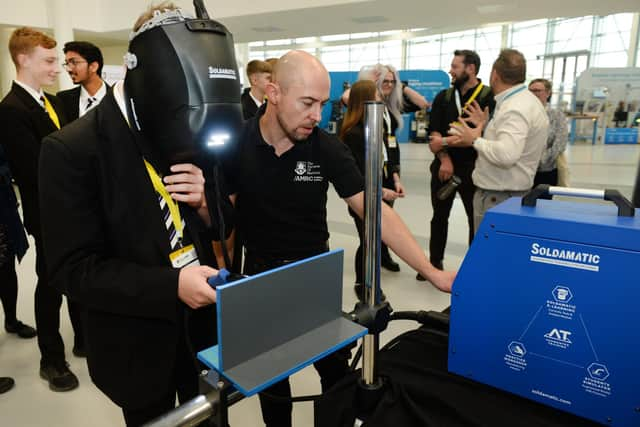

More than 100 industry partners, large and small, are now members of the AMRC. They include global titans such as Boeing, Rolls Royce, Airbus and BAE Systems, who use it as a testing site for their frontier technologies, transforming their advanced manufacturing practices. But the AMRC caters too for smaller firms, working with well over a thousand businesses each year, with almost half SMEs, which would otherwise have no route into advanced research.
No innovation eco-system can thrive without people and their skills. That is why the University of Sheffield and the AMRC have developed an onsite training centre for the region’s young people too. Since 2013, the AMRC Training Centre has supported more than 2,200 apprentices with more than 400 manufacturing firms. About 80 per cent of those apprentices have been from South Yorkshire and around half from low-income neighbouring communities. Like the University, the AMRC is a civic hub for jobs and skills.
Between 2013 and 2022, the manufacturing workforce in Yorkshire and The Humber grew by more than 50,000. The region’s pre-eminence in advanced manufacturing was the primary reason for this expansion, including through the AMRC. More striking still, courtesy of the AMRC, Rotherham has experienced one of the fastest rates of productivity growth in the UK – a modern-day miracle given subdued productivity growth at the national level.
So from the bleakest of beginnings, the AMRC has pioneered a model of innovation-led regeneration that has since been copied right around the world. This model’s origins lie in the university’s world-class engineering research which has then been scaled and commercialised to create high productivity firms, high-skilled jobs and high-value exports.
An anniversary is a time for looking forwards as well as backwards, celebrating a quarter-century of transformation but also asking what will shape the AMRC over the next 25 years. The good news is that, given its foundational strengths, the AMRC is enviably well-placed to surf the next wave of innovation in the sectors in which it has established clear strengths.
One example is clean aviation. With a new Government committed to ambitious net zero targets, researchers at the AMRC’s Composites at Speed and Scale (COMPASS) facility are working alongside Boeing to develop and test new technologies needed to meet future demand for lighter commercial aircrafts and help the aviation industry’s commitment to reach net zero by 2050. This complements work taking place next door, at the university’s Energy Innovation Centre, where researchers are supporting UK fuel producers in developing new sustainable aviation fuel to reduce the environmental impact of air travel.
The potential of the AMRC is not confined to South Yorkshire. For us, this is a model that can and should be applied right across the UK – a model rooted in place and propelled by what Prime Minister Andy Burnham calls the ‘triple helix’ of universities, businesses and local government.
Twenty-five years ago, a piece of land that was home to one of the most contentious industrial disputes of our modern history would have seemed an unlikely place to build the future of advanced manufacturing. Fortune has favoured the brave, the ambitious and the innovative. Today the AMRC is the model of regeneration and reindustrialisation – across all sectors and all regions – the UK needs. Taking it to the next frontier is a task for the next 25 years.
Andy Haldane is chancellor at the University of Sheffield and Professor Koen Lamberts is vice-chancellor and president at the University of Sheffield.