
The blame game won’t achieve anything in the current Israel-Gaza conflict - David Kibble
Voices are blaming Israel for the current state of Gaza, including the death of its inhabitants from famine. Israel is denying responsibility, pointing the finger instead at Hamas. It is my contention that trying to apportion blame in this situation is of limited value: we need to move beyond blame.
Speaking on BBC Breakfast, Foreign Secretary David Lammy called the situation in Gaza “grotesque”. The interview followed on from a joint statement by 28 Foreign Ministers condemning the situation regarding the distribution of food aid in Gaza.
It is assumed that the blame for much of what is going on in Gaza - the deaths of civilians from bombings by the Israel Defence Force, the poor distribution of food and aid and now the starvation of Palestinians – can be laid at the feet of the Israeli government.
The country’s Foreign Minister, Gideon Sa’ar, however, criticised the Foreign Ministers’ statement suggesting that it was ‘disconnected from reality’ and that it sent the wrong message to Hamas. He said that if countries wished to condemn what is going on in Gaza they should direct their criticisms to Hamas.
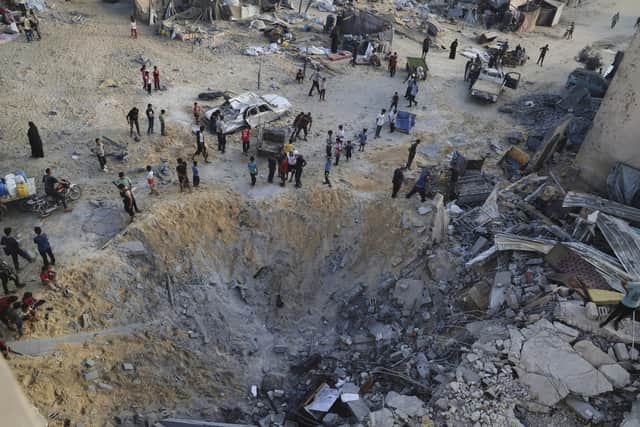

Israel has already been criticised for its bombings of hospitals and other humanitarian centres. However, it is known that Hamas uses such premises as cover. Video evidence, for example, showed clearly how armed members of Hamas brought Israelis who had been captured on October 7 to the al Shifa Hospital.
A manager of the Kamal Adwan hospital in Gaza, a Hamas Lieutenant Colonel, admitted that the hospital had been used as a Hamas command centre. In the following year an ambulance driver based at the hospital admitted that Hamas used the hospital for its own purposes.
In the Just War tradition, where armed conflict is necessary, it should be fought by proportionate means. In other words, combatants should ensure that harm caused to civilians and their property should not be excessive in relation to the military advantage that is anticipated. It is often argued that in the current conflict in Gaza, Israel is using disproportionate means. Their current actions are therefore judged to be unjust. Part of the problem in deciding what is proportionate is that Hamas has been using Palestinian citizens in Gaza as human shields.
In a book published just after the beginning of the current Gaza conflict Rabbi Schlomo Brody outlines what he regards as Jewish values in times of war. He notes that the concept of proportionality is a subjective concept, based on relative values such as ‘excessive’ or ‘military advantage.’
There is, he says, no such thing as a ‘proportionometer.’ He argues that where human shields are used ‘ultimately culpability lies with the defending party... An attacking party cannot be held liable for civilians working in the immediate area of a legitimate target or those placed there by the enemy to shield it from attack.’
Brody concludes that the number of noncombatant deaths proves nothing about the proportionality of an army’s actions.
His argument would suggest that bearing in mind the actions of Hamas, who began the conflict, who have refused to return all the hostages and who have failed to agree to suggested terms of peace, it is Hamas who are entirely responsible for the huge number of Palestinian deaths and destruction of property.
We must remember, too, that Israel’s response to Hamas October 7 incursion is designed to prevent much further bloodshed and the expulsion of Jews from Israel in accordance with the provisions of the Hamas charter. When that further possible conflict and bloodshed is added to the equation the matter becomes much more complex.
We can discuss endlessly whether Israel is to blame for the current situation in Gaza and whether it is using proportionate means. People will come to different conclusions depending on their perspective. It is my suggestion that simply to ask about blame is to ask the wrong question.
What both sides should be asking is ‘how might we bring Palestinian and Jewish communities together? How might we move together towards some form of agreed and peaceful conclusion?’ This is clearly a long term task but there cannot be any satisfactory solution for either side without it. Others with an interest in the conflict should ask how they can help promote this. Simply debating proportionality and trying to apportion blame will not get anyone anywhere other than repeating circular and entrenched arguments.
Whatever each side believes at this current juncture, both Jews and Palestinians will continue to be around as will the territorial and political aspirations of both. It is for the long term future of both communities that we should be planning. The primary aim should be to ensure that both Jews and Palestinians are able to live peacefully side by side in a settlement that is just. That will mean not simply dealing with the situation in Gaza but also with the increasing growth and militancy of settlers in the West Bank. That long term future is absent from much of the current debate and discussion.
David Kibble is a retired Deputy Headteacher from Huntington School, York, and a Licensed Lay Minister at St George’s Church, Leeds.