
The country is on a dangerous path with British Muslims being scapegoated - Qari Asim
This September, London witnessed one of the largest far-right mobilisations in recent memory. While not everyone concerned about large-scale immigration is motivated by racism, the ‘Unite the Kingdom’ rally employed a chilling vocabulary - “go back home,” “fight or die” - and cloaked its vitriol in a thin veil of religious justification.
The message was unmistakable: sow fear, isolate minorities, and spread anti-Muslim hatred.
Though the rally claimed to stand for “unity, boldness, and truth”, it was marred by far-right campaigners promoting the belief that Britain is under siege by Islam. This narrative is not only false - it is dangerous.
British Muslims are not invaders. Britain is our home; the Union Jack belongs to us all. The ancestors of many British Muslims fought in both World Wars to defend its freedoms. According to recent census data, 94 per cent of British-born Muslims strongly identify as British - higher than any other community. Our contributions are woven into the everyday story of this country. Yet, in recent weeks, many Muslims have felt less safe. Parents hesitate to let their children walk to school. Muslim women fear travelling alone at night.
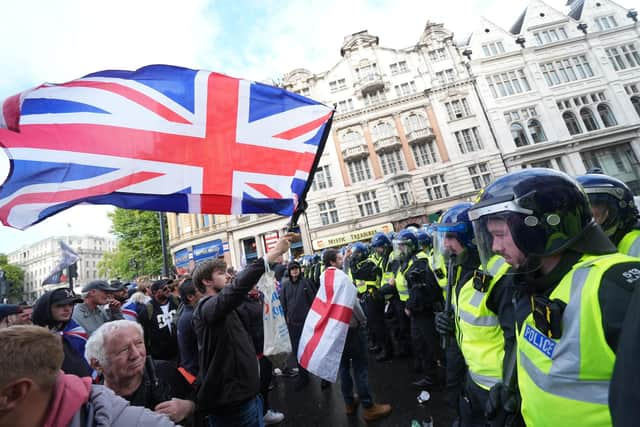

Hate does not become respectable simply because it borrows the language of heritage or faith. When bigotry wraps itself in the Cross or the Union Jack, it is not defending British values - it is desecrating them. The overtly Christian imagery and rhetoric used by extreme far-right groups at these demonstrations have only amplified fear and anxiety.
What deepens this unease is not just the bile from fringe microphones, but the silence from platforms that ought to know better. Too many political voices have equivocated instead of naming anti-Muslim and anti-migrant hatred for what it is.
What’s needed now is visible, courageous moral leadership - leadership that reassures all communities and counters the growing narratives of division. This is not about ‘taking sides’; it is about taking responsibility. If we believe in freedom of religion, freedom from fear, and the rule of law, then we must affirm those principles precisely when they are under threat.
The overwhelming majority of Britons reject hatred. It has been heartening to see civic voices rise in defence of inclusion. Christian leaders have condemned the language used at the Unite the Kingdom march, stating unequivocally that “any co-opting or corrupting of the Christian faith to exclude others is unacceptable”.
As Muslims, we know too well how religion can be caricatured by those who neither follow it nor seek to understand it. Hate-mongers who cloak themselves in patriotism or Christianity do not represent the teachings of Prophet Jesus (peace be upon him), just as ISIL and Boko Haram do not represent Islam. But unless we collectively and publicly disavow such ideologies, their reach and influence will grow.
Anti-Muslim hatred has reached alarming levels. Islamophobic assaults surged by 73 per cent last year. This is not about privileging one community’s pain - racism in all its forms corrodes the fabric of society. It is about recognising that when misinformation and disinformation go unchallenged, violence is never far behind. We saw this play out on our streets last summer. A society that shrugs at dehumanisation today will struggle to protect the vulnerable tomorrow - whoever they may be.
British Muslims understand the need for secure borders. But we also believe in upholding British values. We must not be scapegoated for the political or societal grievances that some hold. Instead, we want to work together to ensure that the legitimate concerns of fellow Britons are addressed through democratic and legal channels.
British Future’s recent report offers a constructive path forward. It proposes a scaled-up “routes and returns” approach, urging the government to expand the UK-France “one in, one out” deal by a factor of 10 or 20. This would return the vast majority of those arriving illegally in small boats to France, while welcoming a significant number of people with legitimate asylum claims through a regularised route.
A serious and constructive approach to immigration must begin by acknowledging that managing immigration well is a two-way street: successful integration is a shared responsibility. We owe it both to those who arrive and to the communities they join. Framing the debate as a binary choice - fairness to “them” or to “us” - not only fuels division but misses the deeper point: migration succeeds when newcomers and their children are embraced as part of the “us.” That’s not just a moral imperative - it’s a practical one.
Social cohesion cannot be carried by communities alone. It must be matched by political action. Successive governments have failed to prioritise inclusive growth or deliver affordable homes, good jobs, skills, and local investment. A credible housing programme, targeted skills and employment support, and an orderly, firm and fair migration system that commands public confidence will address the growing frustration and anger about immigration.
Imam Qari Asim MBE is co-chair of the British Muslim Network, trustee of Hope not Hate and British Future.