
The Government is taxing pubs out of existence with more and more jobs being lost - Andrew Vine
Think of a pub and a cosy scene of companionship springs to mind, of a local that is an institution, full of regulars chatting happily away, all presided over by a jovial landlord or landlady who is a friend to their customers.

It’s an image reinforced by countless films and television shows, like Yorkshire’s own Emmerdale, or Coronation Street, in which the pub is the heart of the community, beloved by all, where friendships are made and there is laughter in the air.
Sadly, the real picture of too many pubs across Yorkshire is anything but cosy. They stand shuttered and forlorn, last orders having been called for the final time and the doors firmly shut, never to reopen.
The licensees, or the companies that employ them, have been unable to make these pubs pay in the face of brutal economics, and with their loss something much more than a place to have a drink or a meal has vanished.
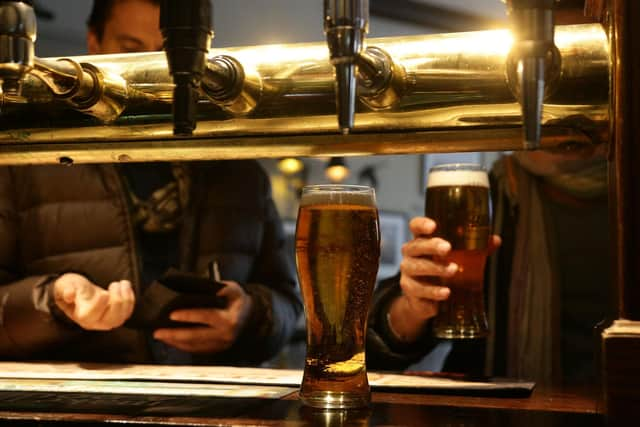

So has a focal point for their neighbourhoods, a meeting place for the people who live nearby, as well as a livelihood for those who worked in them. For smaller communities, such as villages, the loss of the pub is an especially hard blow.
And it’s a blow that just keeps on coming. An estimated 378 pubs across the country will close this year, with the loss of about 5,600 jobs, according to the British Beer and Pub Association. Last year, 350 shut.
Taxes are to blame, says the association. Of every £3 spent in a pub, £1 goes straight to the exchequer and matters are being made worse by the increase in national insurance costs for employers, which makes it more expensive to hire staff.
The closures aren’t only destroying the jobs of people who work in pubs. Farmers, brewers and others in the supply chain are losing out too.
But the most worrying aspect of the escalating numbers of pubs calling time because they can’t make the numbers add up is they are part of a much wider crisis in the hospitality industry that the government must bear responsibility for.
Since national insurance went up in October’s budget, a staggering 69,000 jobs have been lost in pubs, restaurants and hotels, according to the Office for National Statistics. During the previous year, before the tax hike, the industry had created 18,000 new jobs.
The trade body UK Hospitality says the losses could eventually reach 200,000 by the end of this year, nearly six per cent of the total workforce of 3.5m.
There has been no loss of jobs on this scale since the darkest days of the Covid lockdowns of five years ago, when businesses went bust overnight because of enforced closure.
In a sense, these job losses are hidden, because so many hospitality businesses run such tight ships and employ small staff. The public hardly notices when half a dozen jobs here, or a dozen there, disappear. They don’t have the impact of mass redundancies in industries like steel or car manufacturing, where the loss of hundreds at a time are on every front page and lead the television bulletins.
But taken together this is a catastrophic destruction of jobs, with terrible consequences for both the industry as a whole and those out of work who face little prospect of finding new roles in hospitality.
And they will have the most unwelcome of knock-on effects in Yorkshire, where the reinvention of town and city centres depends so heavily on hospitality.
As shops shut in the face of online competition, leaving streets and precincts with a dilapidated air, places large and small are rightly turning to the idea of turning retail areas into leisure destinations in order to attract the crowds back in.
The necessity of that strategy working was underlined by last week’s Centre for Cities report showing that Bradford, Hull, Huddersfield, Doncaster and Wakefield were among the places in Yorkshire where more than one in seven shops stand empty.
But if pubs and restaurants are shutting, how can these areas possibly become somewhere for an evening out if there are fewer places to meet over a drink or have something to eat?
Against the backdrop of potentially 200,000 jobs going, the government’s claims to have economic growth as its top priority and the interests of working people at heart ring very hollow indeed.
At least some of the people being put out of work are going to add to the ever-swelling welfare bill if the hospitality industry is shrinking.
Pubs have been sounding the alarm about their future for a very long time, and now the wider industry of which they are a part is doing likewise. The government cannot ignore their concerns.