
The modest project that could bring some HS2 benefits to Yorkshire - Jim Steer
The eastern side of England was promised significant benefits from the original HS2 scheme. For Yorkshire, HS2 was supposed to be a once-in-a-generation project to transform connectivity and rebalance investment between North and South.
Yet, when HS2 began to unravel, the eastern section was one of the first casualties – with the ‘Eastern Arm’ originally to run all the way north from the Midlands to Yorkshire dropped in 2021.
To be abundantly clear, the route for the original eastern arm is still set to be abandoned with property already acquired to be sold off as the Secretary of State for Transport, Heidi Alexander, has instructed HS2 Ltd.
But a part of her recent instruction to HS2 Ltd is that provision is still to be made for a junction pointing east on HS2 in the West Midlands.
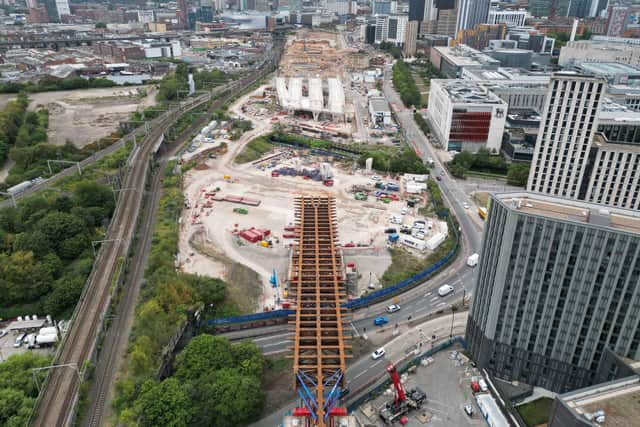

This is now envisaged to connect HS2 to the existing rail network. And this we believe is the key to delivering a connectivity benefit to Yorkshire at modest capital outlay.
We discuss how this might work in a new Greengauge 21 report ‘HS2’s Eastern Arm Version 3’.
Just five miles of new conventional speed track on a new alignment would be needed to link this junction on HS2 to the existing railway between Derby and Birmingham.
The opportunity created would be for a Leeds-Wakefield-Sheffield-Derby-London Euston HS2 service using existing stations in the four Yorkshire and East Midlands cities and using existing lines and a new connecting line of some five miles length to reach HS2.
Electrification all the way to Sheffield and Leeds would be needed to deliver two trains per hour at ‘conventional’ line speeds over existing lines and the connecting line.
Overall, economic gains would of course not be so great as those from the original HS2 plans, but then the capital outlay is massively reduced. However, the economic benefits are still significant.
Sheffield and Derby would both gain about a half-hour saving over today’s London journey times, helping shrink their connectivity to the capital and gain locational advantages.
Platform capacity would also be freed up at Sheffield Station by London services no longer terminating there as they do today.
There are benefits for West and North Yorkshire too. Leeds would gain resilience by being served twice an hour to Euston and twice an hour to Kings Cross in the event of incidents on one of the routes.
And with Wakefield served twice an hour to Euston, Kings Cross services could be speeded up by approaching Leeds from the faster route from the East Coast Main Line to the east and then run directly on to Bradford/Harrogate/Skipton rather than reverse back out of Leeds as they do today.
This would free up platform capacity in Leeds as well as the time-consuming crossing moves in and back out of Leeds - an inefficient and slow process to the frustration of passengers and rail service providers alike.
Other service opportunities could also be considered. Would a limited-stop Birmingham (Curzon Street)-Derby-Sheffield-Wakefield-Leeds-York-Newcastle-Edinburgh service be of value, for example, adding to the services that could use the new five mile link in the Midlands and the spare platforming available at HS2’s new Birmingham Curzon Street station?
The need to make provision for a five mile link between HS2 and the existing Sheffield-Birmingham line may not appear to many to be an immediate or obvious concern but a firm decision on its location is needed so the scope for its provision can be planned into HS2 construction.
There is a short window of opportunity to ensure the pros and cons and possible local impacts are examined, and an informed decision made about the location of the junction as well as the link.
This scheme, while modest in scale and adopting conventional - rather than high-speed - design standards, would itself be a project of national significance, and should be afforded priority status.
It would be hard to find elsewhere such a modestly-sized infrastructure project with equivalent economic growth potential – productivity gains from improved connectivity between two of the nation’s nine planning regions - Yorkshire and the East Midlands - and three others - West Midlands, South East and London.
So, we suggest that a study of the possible alignment choices for a short, five mile connection between HS2 and the existing Birmingham and Sheffield line should be instigated without delay.
This is a relatively modest project but certainly one of national significance that will benefit Yorkshire.
The choice is to seize this opportunity or let it slip. Hasn’t Yorkshire waited long enough already?
Jim Steer is a director of Greengauge 21.