
The Proms represent a Britain the recent flag wavers never will - David Behrens
It costs the BBC around £5m a year to stage the Proms at the Royal Albert Hall, after they’ve recouped what they can from selling tickets. But it’s not the money they’re sensitive about; it’s the elitism of the whole thing.

The Corporation bristles at charges of aloofness so it overcompensates by dumbing down. It installs commentators in a side room, as if on Match of the Day, to fill time during the interval by speculating on what The Merry Widow was so darned chuffed about.
Instead of Gabby Logan there is Katie Derham, or Richard Baker before her, and only the posh frocks and dinner jackets set them apart. The words are almost interchangeable as they cue up action replays of free kicks or bassoon solos.
“The atmosphere’s electric as the noise from the crowd subsides and Davis adjusts his waistcoat, waves his stick and bows his head in silent concentration.” Honestly, they could be describing the London Sinfonia or World Snooker at the Crucible.

They do that because they daren’t assume we are sufficiently cultured to work it out for ourselves. And they do it only with the classics, never rock or pop. If Zoe Ball at Glastonbury tried to explain rap music, she’d be ridiculed. “These Belfast boys called Kneecap are great favourites of the crowd although they do have a reputation for waving the flag of Palestine. And as they walk onstage… oh, my goodness, they’re chanting something. It sounds like ‘Gaza’. Didn’t he used to play for Tottenham, Gaby?”
Tonight is the Last Night of the Proms and a great many flags will be waved. It’s the one time of year you can still hold aloft a union jack without everyone assuming you’re racist – although in a sense you still are, because Land of Hope and Glory is the anthem of an imperial past for which we’re now supposed to feel guilt, not pride. But if you can put that to one side, the Promenade concerts are an example of, let’s call it Good Flag Waving: of showing togetherness. Football internationals are another; maybe a royal jubilee. But that’s about it.
Almost anything else is Bad Flag Waving; a mark of division, of laying down the line that it’s my country and not yours. That’s why it’s egged on by politicians who thrive on exploiting latent prejudice and legitimising it.
Intolerance isn’t new, goodness knows. But condoning it is a wholly new phenomenon, at least in this country. Not in Germany, of course. In the 1930s Oswald Mosley in Britain and Charles Lindbergh in the US tried but failed to inject it into the political mainstream, as Nigel Farage and Robert Jenrick are doing now. Farage is just Mosley in a Viyella shirt and Barbour jacket.
Yet many people are easily led. In some districts, flags in front gardens are as abundant as fuchsias once were. A family in Sheffield told a reporter this week that they were “proud” to put up union jacks and crosses of St George (though not proud enough to reveal their names). “It’s to show that I am English and British and I am loyal to the flag,” said one of them, the sort of man to whose level you could not descend if you dumbed down from now until Christmas.
What did he mean by loyalty, though? A willingness to take arms and fight for his homeland, perhaps even lay down his life? Don’t bank on it. Pinning a flag to a broom handle is one thing; a pointless virtue signal that requires no effort or even thought. Braving it out in the field of conflict is quite another.
This year two separate polls have found that the vast majority of males in every age bracket would be unwilling to fight for king and country if the chips were down.
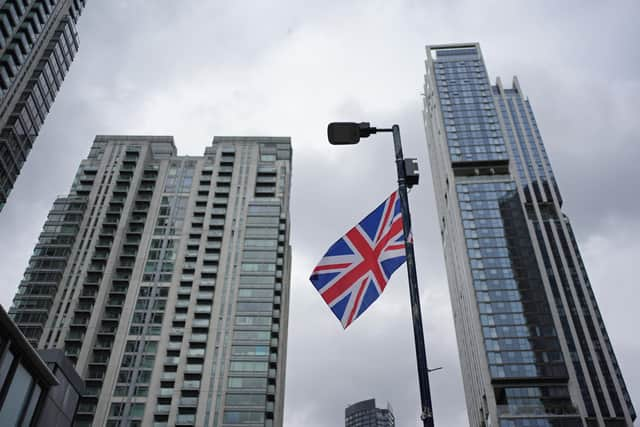
Do you seriously think those are not the same people who are right now planting flags in their gardens, on lamp posts, bridges and even this week on the chalk horse carved in the hills above Kilburn in the North York Moors? Oh, they’ll shoot their mouths off so long as they’re part of the herd – but when the recruiting posters go up, see if you can find them.
Polls can be misinterpreted, it’s true. Unwillingness to fight is not the same as refusing and even in the Second World War not all Britain’s two million conscripts would have been over the moon at getting their call-up papers. But they did at least know what it meant to be British and free. And they were selfless.
No poll is available to calculate how many broom-handle warriors will be singing along to Land of Hope and Glory this evening, nor whether they know the words or who wrote them. If they are as patriotic as they say, it ought to be the TV highlight of the year.
But the Proms represent a Britain they never will and you don’t need a commentator to explain why. If that makes them elitist, so be it.