
The US storm was a convenient crisis that kept America from making crucial decisions in the Ukraine war - Patrick Mercer
October’s Ramstein conference (more properly known as Ukraine Defence Contact Group) has been cancelled. That’s a real blow for President Zelensky because he intended to unveil his Victory Plan to the allies assembled there and the timing was crucial.
With all eyes on the Middle East and only a few weeks before the US election, Kiev had hoped to focus people on her plight. She needed to garner more funds, to receive permission to fire long range missiles at Russia and to win plaudits for the President’s strategy. But, none of that happened.
President Biden was the first to pull out citing a vast storm that was about to hit Florida. The boss would have to be on hand to deal with it and there might have been some sense in that, but why on earth did Antony Blinken, America’s Secretary of State, have to follow suit?
Even more ominously, why did all the other partners withdraw too? If the storm was so important (and there’s doubt about that) couldn’t other US officials be sent? Just as dubious, why couldn’t the other nations continue without America - it was Mr Zelensky’s big moment, after all?
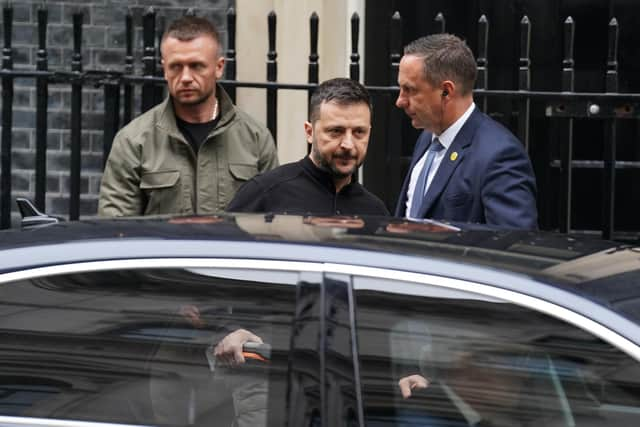

As Allied aircraft and US soldiers are going into action to protect Israel from her foes, Kiev must have been wondering why similar squadrons are not sent to help her. Even more frustrating was the fact that Mr Zelensky used the time when he might have been at Ramstein to tour the allies’ capitals, but at none of them did he receive concrete proposals.
All of his hosts were positive - with the exception of the US Speaker who said that he didn’t ‘have the appetite for further Ukraine funding’ - but no one seemed to back his demands for an early entry into NATO. Even the countries who have been clamouring to allow Ukraine to unleash the cruise missiles that they’ve supplied seemed to have lost their enthusiasm.
Well, whether you believe the US storm story or not, it was a hugely convenient crisis that kept the Americans out of an arena where crucial decisions were either going to have to be made or dodged just before their election.
Essentially, the new US president is going to be faced by some harsh realities and, within weeks of being elected she or he will be severely tested over their policy towards Ukraine.
Bearing in mind that the Pentagon already has its hands full with a shooting war in the Middle East, where is America and the rest of NATO going to get the materiel to keep propping up Kiev? The arsenals are almost empty; Britain, for instance, has already given all of her heavy artillery away and the other Allies can tell similar stories, overarched by the fact that ammunition production is simply not keeping up with demand.
And there’s the rub. NATO’s about to produce a new policy on how to deal with a Russia that is mightily well armed, numerous and battle hardened. We haven’t seen the details yet, but it’s not hard to imagine that a much more aggressive stance will be adopted. But where’s the kit to back that up?
If the West keeps giving all it can produce to Ukraine, we’ll never be able to replenish our warlike stocks. Similarly, all the NATO countries need time to raise larger armies, to build ships and aircraft and to harden their economies to cope with a confrontation that many expect with a predatory Russia.
But producing weapons and expanding armies takes time. The only way to buy that time against a country whose economy is now on a war footing is to keep Ukraine fighting whilst inflicting sufficient casualties to give the Kremlin pause for thought.
So, the problem that NATO faces is obvious: difficult choices have to be made, but only after a new incumbent is in the White House and his or her policy has been clearly stated. And that’s why the Ramstein conference was ‘postponed’, not to be rescheduled, I’d suggest, for several months.
Cynically, of course, the West is going to keep a very close eye upon developments on the front lines. If Russia’s has a spectacular success before the end of this year the new US administration is going to ask what the point is in providing more support for Kiev. Israel is already demanding much whilst, perhaps, replenishing and rebuilding its own forces would be more prudent.
Now, this amounts to ditching Ukraine and when it comes to ratting on friends, the Alliance has form. Think no further than the desertion of Afghanistan or the less well publicised withdrawal from Mali. But, even to talk about such a thing in the shadow of an election would be deeply unwise for either US candidate, although immediately after a victory the new President might safely expend some capital and do the dirty.
But will the catalyst of a strategic, Russian breakthrough happen? To assess that we must look beyond the lazy platitudes that much of our press peddles - the talk of stalemate and no Ukrainian compromise.
First, look at how Kiev’s Kursk adventure is about to be brought to a bloody halt. Then weigh up the recent fall of the vitally important Ughledar and the fortified towns and villages in the Donbas, a clutch of which are stormed almost every day.
Lastly, consider this report in Der Spiegel last Monday, when an unnamed Ukrainian officer said, “The government is now holding ‘serious discussions’ about relinquishing its aim of full territorial restoration”.
So far Ukraine has risen to every challenge thrown at her, but I wonder how much more death, hurt and failing allies she can endure?
Patrick Mercer is a former MP for Newark and Army colonel.