
Time for entertainment industry to act after Brand convictions and David Walliams accusations: Jayne Dowle
How many more powerful men in entertainment and media will be exposed as predatory sex pests?

And how much longer can such insalubrious individuals be allowed to get away with their lewd behaviour?
David Walliams is just the latest to be accused of using his star power to entice fans into questionable situations.
The TV star and children’s author, a judge on ITV1’s Britain’s Got Talent between 2012 and 2022, was last week accused of preying on women and girls as young as 15, through investigations carried out by The Guardian and ITV News.
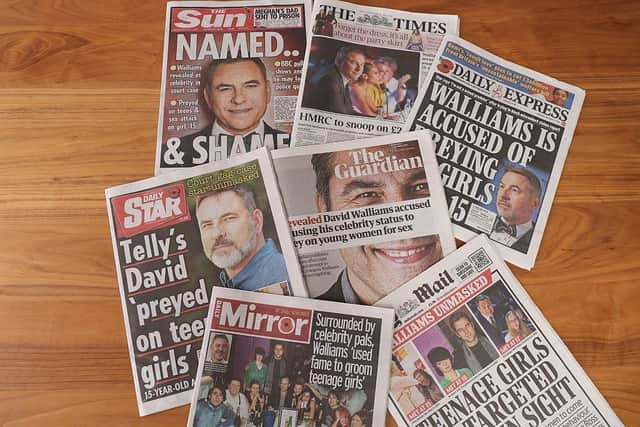

Walliams has denied all allegations of wrongdoing, grooming young women or abusing his position. He said he was “not a sexual predator” and had not “broken the law”.
We shall see where all this takes Walliams, who had attempted to legally suppress the reporting by claiming he was at risk of taking his own life. But it’s pretty safe to say that the 55-year-old’s career is in tatters, the BBC has deleted footage of his appearances in comedy shows from iPlayer, and libraries and schools have removed his books from their shelves.
The Walliams news broke only days after 51-year-old Russell Brand, his fellow TV star, comedian, author and self-styled spiritual guru, was jailed for his own wrongdoing.
Now serving 10 and a half years for committing rape and sexual assault, it’s reported that Brand will face claims of sexual misconduct from six further women. Their experiences could not be previously shared because it may have been prejudicial to the jury in his trial, which ended earlier this month.
There will be many others lurking in the wings, wondering if it’s their turn next to outed by fearless reporters. It is too late for their victims, but calls are growing for new entertainment industry standards to be put in place. These would relate to establishing legal obligations between relationships between celebrities, fans, audience members and colleagues, and put in place clear reporting mechanisms for misconduct.
Who knows what goes on behind the dressing room doors, or in Brand’s case, any toilet cubicle that happened to be empty? Lou Teasdale, a makeup artist who worked on Britain’s Got Talent during Walliams’ tenure, has told one newspaper that it was “standard protocol” in the entertainment industry for girls to “sign NDAs [non-disclosure agreements]” before being “left alone” with famous men.
Labour MPs, including Josh Fenton-Glynn, who represents Calder Valley, and York Central MP Rachael Maskell, are even calling for a change in the law to ban men over a certain age from having sex with 16 and 17-year olds under a staggered consent law.
They are joined in their quest by Hull-raised comedian Lucy Beaumont, who helped expose allegations against Walliams, and victims commissioner Claire Waxman.
We need “serious conversations” about changing the law to protect teenagers from exploitation when there is a significant age gap in a sexual relationship, Waxman argues. She too would like to see a staggered age of consent that would prevent adults from having sexual relationships with significantly younger teenagers.
These are serious contentions. But my fear is just like the #MeToo movement, this will be forgotten or submerged in accusation and counteraccusation.
Something even more horrific may come along. Or the rumblings we hear of a ‘mainstream media’ stitch-up, especially around support for Brand’s anti-establishment views - such as Covid vaccine scepticism - will grow to a deafening roar. And grubby individuals will simply carry on inviting impressionable girls to their dressing rooms or forcing young women into doing things they are deeply uncomfortable with.
Do you remember the #MeToo movement? It arrived in 2017 following sordid revelations about the American film producer Harvey Weinstein. More than 80 women, including fellow producers, actresses, models and employees came forward to accuse him of sexual misconduct, harassment, assault, or rape.
After a protracted legal process, the 74-year-old is now serving two prison sentences, the latest being 15 years handed down in September 2026 following a New York retrial for a criminal sexual act against former production assistant Miriam Haley.
Many other once-powerful men in the film and entertainment industry were exposed too. The movement spread to the UK and protective reforms were set in place, not just in this sphere, but across sports such as gymnastics and universities. For example, the ‘Everyone’s Invited’ initiative created an anonymous platform for school and university students to share testimonies of peer-on-peer abuse.
Yet inevitably, there was a backlash. Men cried out that none of them were now safe from accusation of sexual misconduct. And the growth of the hyper-masculine ‘manosphere’ in which certain commentators and contributors express hatred and suspicious of liberated and independent women, has turned back the clock.
However, in a 2019 interview with the Sunday Times magazine, one comedian declared themselves totally on board with the movement, calling #MeToo “a really positive change” and “a sign of real awakening”.
Can you guess who that comedian was? It was Russell Brand. Actions, as we have found out, speak louder than words. It is time for the entertainment industry to act certainly, but also for individual men to consider their own actions too.