
Trump is right, Starmer is no Winston Churchill but we live in a very different world - Jayne Dowle
Now we know that according to President Trump, Starmer is no Winston Churchill, can we finally put the Second World War behind us and accept we are living in a very different world?

Old certainties have exploded, shattering like so many missiles over the Middle East. We all need to wise up. For too long now we’ve laboured under the impression that we’re safe in the protective shadow of America.
As the war on Iran began, after Starmer hesitated for several days over whether US jets could carry out strikes from the “stupid island” (Trump’s words) of Diego Garcia, the US president said he was “not happy” with the UK and “this is not Winston Churchill that we’re dealing with”.
No it isn’t. And we’re not dealing with Franklin D. Roosevelt either. The so-called ‘special relationship’ between the UK and the US has to work both ways. After Trump’s initial Oval Office love-in, when Starmer turned up almost crucifying himself with politeness and bearing a letter from the King inviting the President on an unprecedented second State visit, things have gone downhill.
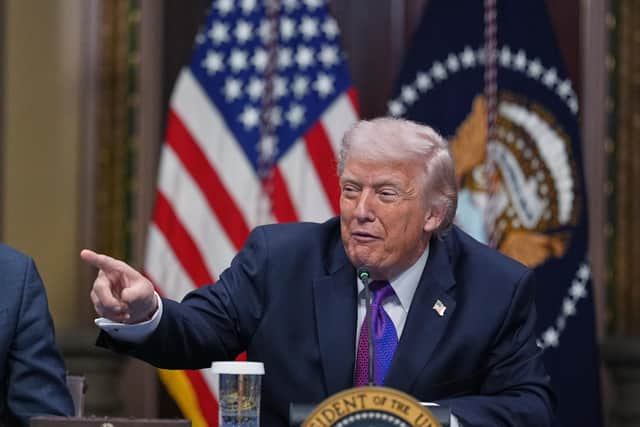

Clearly, there was only so much nonsense the former Director of Public Prosecutions could take; but his lawyerly, deeply-considered response to Trump’s obtuse bluster has been criticised by many.
Sure, Starmer has had his own reasons for holding back. The first US strikes hit Iran barely 24 hours after the blistering Gorton and Denton by-election pushed Labour into third place behind the Green Party and Reform UK.
He was still reeling from that blow and his instinct for self-preservation kicked in. Also, Labour has long been wary of marching to America’s tune, since Sir Tony Blair’s successive premierships were toppled ignominiously by his slavish support for President George W.Bush in 2003’s second Gulf War.
The special relationship has its roots in the genuine long-standing respect and friendship between the two Second World War leaders, Sir Winston Churchill and his US counterpart President Roosevelt. It’s well-documented; more than 1,700 letters and telegrams passed between them.
After the Second World War ended, the United Kingdom and America, although battered and with the former seeing its Empire fragment as countries such as India sought independence, stood shoulder to shoulder, having presided over conquering the evil Axis powers.
That was 80 years ago. Before the Cuban missile crisis. Before Vietnam. Before the Berlin Wall came down. Before the Gulf War and Afghanistan. Before Putin, before the rise of China and North Korea and before endless complex global crises which have chipped away at the certainty enjoyed by Churchill and Roosevelt.
It’s easier to accept the status quo than challenge it; in some ways we must thank Trump for his clumsy comments, because it forces a rapid reassessment.
And let’s be honest. The so-called ‘special relationship’ between the UK and the US was already struggling in the water before the President got petulant over Starmer’s obdurate stance over bringing British military forces directly into the war on Iran.
Trump has a short memory, but other leaders do not. Only in January, he was forced to backtrack after downplaying the role of NATO troops in the Afghanistan war; “We've never needed them. We have never really asked anything of them. They'll say they sent some troops to Afghanistan... and they did, they stayed a little back, a little off the front lines.”
Starmer called his words “insulting and frankly appalling”. Then Trump told our Prime Minister that if the UK refused to support the US seizing the Danish territory of Greenland, he would hit us with punitive goods tariffs.
And Trump also laid into the Diego Garcia settlement, painstakingly devised by the British government to secure the US military base on the Indian Ocean island, calling it “weakness”.
Trump has also made no secret of his lack of respect for NATO; the UK remains a leading NATO power and Starmer is right to have exercised caution. Whatever his faults maybe, his legally-informed sense of balance will have rightly made him question if it’s morally right to deride the NATO alliance one week, then turn around and demand its loyalty the next.
Importantly, Starmer has not been alone in refusing to immediately bow to Trump’s belligerence. Spain’s Prime Minister Pedro Sanchez, a true outlier, flatly refused to support the bombardment and to allow US troops to use Spanish military bases. “Twenty-three years ago, another US administration dragged us into a war with the Middle East. It triggered the largest wave of insecurity our continent has experienced since the fall of the Berlin Wall,” Mr Sanchez told reporters. Trump has hit him with tariffs. Inevitably.