
UAVs have changed the rules of war in Ukraine, could diplomatic traffic be the next target? - Patrick Mercer
What to believe in the Ukraine war? You can argue about ground taken, the respective number of casualties, whether both sides’ economies can survive and any number of other factors, but what’s certain is that drones - UAV’s, unmanned aerial vehicles, have changed the rules of war.
Their technicalities are less important than the way they are used. Certainly, the faster, jet powered models are much harder to knock down whilst increased range and the weight of explosive they carry means that attacks hundreds of miles behind enemy lines has given a new depth to the term ‘asymmetric warfare’. We’ve all become used to news of swarms of the things - increasingly teamed with ballistic missiles - hitting power stations, gas depots and railway infrastructure in order to sap Ukrainian energy and morale.
We’ve also seen the sheer, persuasive power of President Zelensky’s reply when his weapons wreck supermarkets and oil terminals deep in Russia. The engulfing flames and pyres of smoke are compulsively horrifying.
Of course, there’s nothing new about attacking ‘soft’ economic targets. Drones are just today’s equivalent of Napoleon’s campaign against Britain’s merchant ships or the fleets of bombers used to crush the Nazis’ factories, coal mines and food supply lines. But UAVs are far more flexible than any privateer or Lancaster.

With shells, aircraft and UAVs crowding the skies, vehicles on the ground are vulnerable, none more so than the usually unarmoured trucks, minibuses and ordinary cars which both sides use to ferry combat supplies to their troops. Now, though, provisions can be sent forward by drone - allowing everything a soldier needs to be delivered with a higher chance of success.
But, there’s a new, unconventional role emerging for UAVs which make them even more potent, but it depends on excellent intelligence.
Certainly, drone swarms are directed using information gained by reconnaissance aircraft and satellites. That’s good enough for large targets such as power stations, but UAVs are now being deployed against more precise targets such as assassinations and a number of other ‘dark’ tasks.
To be pinpoint accurate, though, human intelligence (HUMINT) is vital - an observer who not only knows the movements of high value targets but is also able to watch and pass realtime information to the UAV pilot. The work of spies and saboteurs - surely? Well, perhaps, but a civil war makes it easier to find people who can move easily amongst their enemies without arousing suspicion.
For instance, a gunfight erupted a few days ago on the streets of Kiev between a handful of officers from the GUR - Ukraine’s military intelligence agency - and others from the SBU - Kiev’s main, domestic counter-intelligence service. Then, shortly after the skirmish a very carefully targeted Russian made UAV crashed through the window of SBU chief Oleksandr Poklad’s office, exploded and injured 12, although not the man himself.
Predictably, Moscow denied any involvement leaving the world wondering if drones are ideal for settling internal feuds or whether Russia has moles in Ukraine’s intelligence agencies. I suspect both.
A Prosecutor General of Ukraine fled Kiev just a few days ago rather than face corruption charges and headed for Poland. He knew, though, that guards at the border crossing point he chose would need to be distracted - and they were by Russian UAVs. But the only vehicle speeding through the explosions was Kostin’s: anyone would think that this bigwig had friends in Red Square - and a very secure phone link to the drone pilots.
Murky stuff, but the flexibility of these weapons makes them perfect for muscular diplomacy as well. Now, both sides have always honoured a discrete agreement that ministers, diplomats and the like would not be attacked when they were calling on Kiev, Moscow and the like. That’s why the recent visit of the Head of the CIA to the Kremlin caused Ukraine to suspend attacks on Moscow for 48 hours.
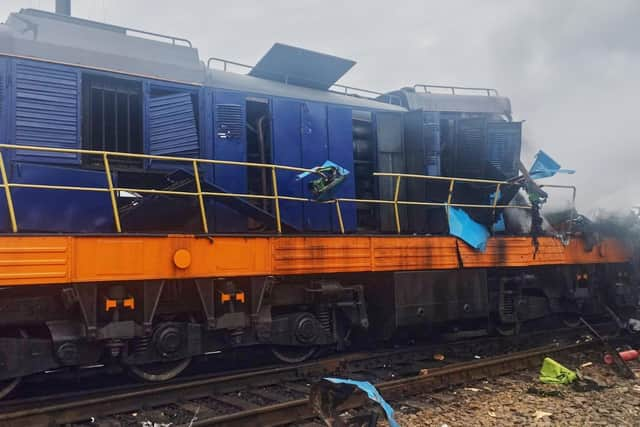
The system works well enough provided that both sides trust each other. But trust seems to have broken down from the Russian perspective as last Sunday Former Prime Minister Boris Johnson, Carl Bildt, the former Swedish PM, General Petraeus (the not so retired US spook) and a number of high ranking western officials were treated to the brutish spectacle of a Russian UAV destroying a locomotive close to their own trains and only about a mile from the Polish border.
This all took place in Yahodyn, a major rail hub in the far west of Ukraine. Soon after February 2022 it became too risky for VIPs to fly into Ukraine, so travelling by rail became the safest choice and Yahodyn now sees a great deal of sensitive political and diplomatic traffic. But these juicy targets were spared as part of an understanding between enemies - until now.
Patrick Mercer is a former Conservative MP for Newark and Army Colonel.