
Violence against Palestinian communities in the occupied West Bank must end - Qari Asim
The inhumane violence against Palestinian communities in the occupied West Bank must end. What is happening cannot be dismissed as a series of isolated confrontations or the actions of a handful of individuals.
It reflects a wider pattern of intimidation, physical attacks, shootings, displacement, land seizure and destruction that is making life increasingly unbearable for Palestinian families.
Recent events in Qusra should shock the conscience. Palestinian families have reportedly been surrounded in their homes by Israeli settlers, with water and electricity cut off and residents imprisoned in their homes. There have also been reports of repeated attacks, including stone-throwing and shootings, while people attempting to deliver food and essential supplies have reportedly faced obstruction.
It is difficult to comprehend how anyone can become so indifferent to the suffering of their neighbours that access to food, water and basic necessities becomes a means of pressure and punishment.
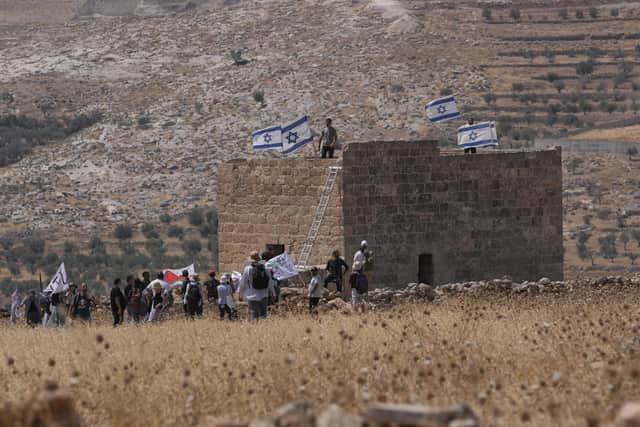

Qusra is not an isolated case. In Fasayil, Palestinian farmers have faced the diversion of a longstanding water source used for irrigation. The spring was reportedly redirected towards a tourist development, leaving farmers struggling to sustain their crops and livelihoods. For farming communities, control over water is not merely an economic issue. It can determine whether families can continue living and working on their own land at all.
So the question must be asked: how can anyone claim to be pursuing peace and security for their people while tolerating, enabling, or being complicit in the systematic actions that are making Palestinian life in that land increasingly impossible?
Even US Ambassador Mike Huckabee has described some settlers involved in violence as “Israeli terrorists”. Such recognition matters, but words alone are not enough. Palestinians and their supporters have described settler violence for years but there’s not been political will to protect them. What is required now is full protection under international law and perpetrators must face consequences.
The scale of displacement is deeply alarming. UN figures indicate that since January 2023, 127 Palestinian communities in the West Bank have suffered full or partial displacement, including 47 that have been entirely displaced, affecting more than 6,390 Palestinians. In 2026 alone, around 3,800 Palestinians, nearly half of them children, reportedly had to flee because of settler violence, demolitions and evictions. A community constantly forced to abandon the place where generations have lived should alarm us all and prompt the governments to protect these lives and homes.
The expansion of settlements and outposts, which are illegal under international law, is steadily reshaping realities on the ground in the Middle East. Some international organisations have concluded that patterns of displacement
amount to unlawful deportation and transfer and, in certain circumstances, crimes against humanity.
The international community must confront its failures. By focusing narrowly on a limited number of outposts, or portraying settler violence simply as the work of “extremists”, governments risk obscuring the wider system in which violence, settlement expansion, land occupation and displacement occur.
Violent settlers make peace and security for both communities more distant. They destroy trust and communicate to the world Palestinians, lives, rights and safety don’t matter.
But another form of dehumanisation also demands action: the growing use of anti-Muslim rhetoric in political discourse must be challenged at all levels.
When Israel’s Prime Minister describes Britain as an “Islamic Republic” or invokes the spectre of Britain becoming an Islamic nuclear power, this is not harmless rhetoric. It reinforces the dangerous idea that Muslims are somehow alien to Britain or incompatible with Western society. It should not be left to British Muslims alone to challenge such false and inflammatory anti-Muslim rhetoric; it is a responsibility for everyone who values truth, decency, and the kind of society Britain claims to be.
Rabbi Levy and Rabbi Baginsky, co-leads of the Movement for Progressive Judaism, rightly described Netanyahu’s comments as deeply offensive and warned against rhetoric that pushes communities apart. As they observed: “The more frightened we become of one another, the more powerful the extremists become.”
Muslims are not something Britain needs protection from. The threat comes from extremism, hatred and those who deliberately exploit fear to divide society, whether they come from within or outside Britain.
It is equally important to recognise Jewish voices condemning settler violence. Rabbi Wittenberg, Senior Rabbi of Masorti Judaism UK, described the recent actions of settlers as “an abomination”, warning that when such behaviour is “pursued purportedly in the name of Judaism and a greater Israel, it abases the name of Judaism.”
Dr Imam Qari Asim is chair of Mosques & Imams National Advisory Board and co-chair of UK Muslim Network.