
Volodymyr Zelenskyy is jeopardising his once indomitable image - Patrick Mercer
There’s a temptation when discussing Ukraine to over complicate things, to bandy unfamiliar Slavic names about and to assume that everyone follows the battle maps as minutely as you do.
Well, how’s this for simplicity: a great Ukrainian fortress city is about to fall to Russia. It’s taken Vladimir Putin’s troops over a year to get to this position and cost them dear in both blood and kit, but the fighting’s just about done.
It’s called Pokrovsk, but isn’t it just a further shell torn town blazing gently like so many others? Well, yes, it’s now a heap of bricks, slates and tattered bed sheets stinking of death, but it’s also a vital rail, road and logistics hub, a strongpoint in its own right and the southern key to the great, banana shaped belt of forts that guard Ukraine’s last line of defence in the Donbas region.
The fighting’s been bitter with both sides committing large numbers of troops and armoured vehicles, flying thousands of drones and firing hundreds of missiles in the skies above whilst drenching the soil with blood.
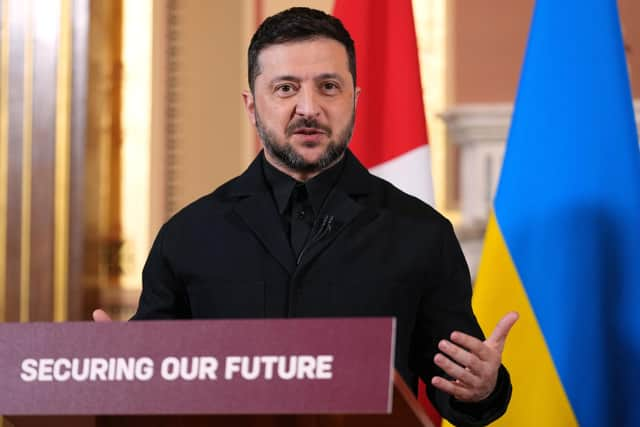

The propaganda duel has been just as ferocious. Russia has downplayed her losses and snail’s pace advance whilst Ukraine talked about how strongly they held the town - until its fall was imminent. Then, suddenly, Pokrovsk became strategically irrelevant and its costly defence just part of a devilishly clever plan to let the Russians exhaust themselves.
The trouble is, some Ukrainian troops on the ground and independent websites are saying that Pokrovsk has almost fallen whilst also pointing out that its capture will be a disaster. And it’s their analysis which is making the latest utterances by President Zelensky sound distinctly odd.
Despite all the evidence, Volodymyr Zelensky told reporters that Moscow has had “no success” in the town and that although the situation was “tough (and) difficult” Kiev’s forces “are destroying the invaders and all their equipment”.
Now, no one can suggest that Mr Zelensky has been faint hearted over the last three and a bit years, it’s certainly his job to bolster his people’s and soldiers’ hopes and morale, but his comments have got to be seen in the light of the tactics that he’s insisted be followed in the fight to save Pokrovsk.
Just like Marioupal, Bakhmut and many other places, Ukraine’s premier has demanded - despite the advice of his generals - that each and every major town is defended until the last man. In his words, “not an inch of land can be surrendered”.
Many of his generals disagree, arguing that turf, prestige and spin are far less important than the lives of their men. But, just like the US President, Zelensky is Commander in Chief, the army’s military as well as political head. Recently, grievous disagreements caused the removal of General Zalushny (he’s now kicking his heels in London as Kiev’s ambassador and is widely seen as Mr Zelensky’s most likely successor) which allowed the altogether more malleable General Syrskyi to be appointed.
But now, without a really strong general at his elbow, the focus has fallen even more intensely on the President. This was underlined in a Sunday Times leader a couple of weeks ago when the respected journalist Roger Boyes speculated that the coming winter could well be Zelensky’s last as president. This was probably the first, major, Western article which had dared to breathe the possibility that things might be looking terminal for Ukraine.
Then, almost at the same time, Kiev made a significant change to their demands for peace. Instead of insisting that no negotiations would start until every blade of Ukrainian grass was free of the invaders (including Crimea taken 11 years ago) Mr Zelensky suggested that the current battle lines should be the starting point for talks.
Hearing this Russia - of course - put their boot on the pedal and pressed ahead with uncharacteristic vigour to take as much ground as they could before Mr Trump and the Europeans put such pressure on them that they had to stop. And that’s why Pokrovsk and a number of other forts are in such peril.
Now these are tricky times. Russia is suffering, but she has the battlefield initiative and takes as a sign of victory the fact that Ukraine has mounted - for the first time - no offensives this year.
Yet, her resources are finite and she can’t maintain the current tempo of operations for very much longer. It’ll be a difficult balance for Moscow: how much territory can they seize versus the number of casualties they incur versus NATO’s strategic neuralgia.
With all of this in mind, an exclusive interview with the Guardian a few days ago proved to be very revealing about Mr Zelensky’s resolve and future plans. Strikingly, he talked about the need for the NATO nations - the Europeans in particular - to be ready to send troops to Ukraine not as a peacekeeping force, but as formed units poised to get involved in combat operations. Clearly, an unprepared, broke and trembling Europe cannot do this - and Mr Zelensky must know that.
It’s hard not to admire the pluck of Ukraine’s premier. He once provided an extraordinary, indomitable image, but now he jeopardises that by publicly denying the truth of what’s happening on the battlefields and embracing wild ideas about other nations’ troops coming to his rescue.
Patrick Mercer is a former MP for Newark and Army colonel.