
Wave of populism across Europe leaves questions for Britain and the wider continent - Patrick Mercer
When Sir Keir Starmer turned up in Kiev a couple of weeks ago in his ‘Tragic Dad’ tee shirt, few expected that President Zelensky would pay a flying visit to Whitehall just a few days later. Naturally, the Russian media was instantly full of theories suggesting that Ukraine’s leader was looking at the house he owns in London as a bolt hole once the wheels fell off in Kiev.
Then the swirling rumour was made worse by General Kiril Budanov, Ukraine’s head of military intelligence. He announced that, based on current indicators, his country could only resist Russia for about another six months.
Whether that’s true or not, there certainly seems to be a new urgency in trying to resolve the war and nowhere was this clearer than at an EU leaders’ ‘retreat’ earlier this week.
For the first time in five years a British PM attended the conference and a formal dinner with much of the business concentrating on Ukraine and European defence whilst playing host to Britain’s latest attempt to cosy up to a bloc that we’re meant to have left.
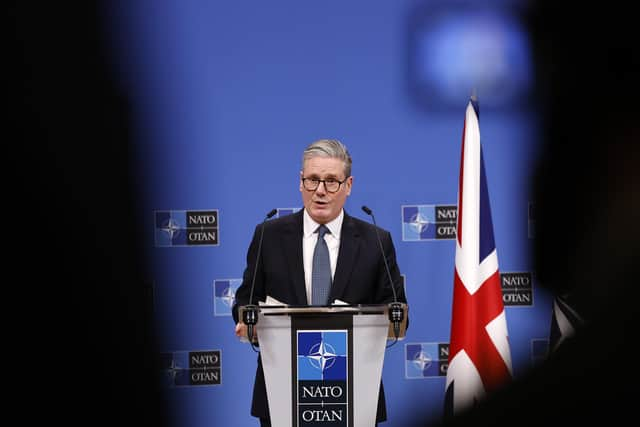

The PM’s energised overtures to our European allies have been stimulated, of course, by their speedy realignment once Mr Trump came to power. With America suddenly pivoting politically and throwing doubts on continued support for Ukraine, the Europeans have had to decide which side their bread is buttered: should they don the MAGA hat and swivel away from Kiev, or continue to prop it up in the name of defying Russia?
Well, the choice for Britain and the Europeans was a no-brainer under the old regimes, but all of a sudden populism has sprung up in the wake of what’s happening in America. The trend started in Italy, was followed in Holland and now influential Germany seems to be changing too.
Until a few days ago, Alice Weidel’s right wing Alternative For Germany (AfD) had been excluded from government by a firewall of the mainstream parties. Then Friedrich Merz, leader of the centre-right Christian Democratic Union (CDU) allied with the AfD over a vital immigration vote and the die was cast: as the Green Party said, “If you vote with the AfD on this very important issue, on what issue won’t you vote with the AfD?”
The AfD’s success signals a vital change in German attitudes: the former EU torch bearer seems to be heading towards Trumpism, undermining the alliance’s solidarity.
And what of France? After President Macron’s disastrous snap election last year, the pact between centrist and conservative parties in the cabinet is not enough to pass legislation by itself. Now the coalition depends on others such as Marine Le Pen's National Rally to stay in power and pass bills into law.
Yet, despite this political knife edge and chronic, internal disturbances which have made parts of France almost ungovernable, President Macron maintains a deeply hawkish stance on Ukraine. For instance, he was the first to suggest that Western troops should be deployed onto Ukrainian soil and was keen for his missiles to be used on mainland Russian targets.
In parallel, very little has been made of France’s decision to withdraw its garrisons from Niger and Chad, with experts assessing that they’re either needed to create sufficient muscle for an operation in Ukraine or, more worryingly, they’re being husbanded to deal with domestic problems in France. Neither will matter, though, if President Macron loses his grip on power.
There have long been suggestions that the European members of NATO will be asked to provide a peacekeeping force to monitor the front line between Russia and Ukraine should a ceasefire materialise. Mr Trump has stated that none of his men will be involved, but I strongly suggest that it’s Sir Keir’s dream to lead this force - hence his presence at the EU leaders’ ‘retreat’.
There are some practical problems with this, though. Mr Zelensky says that 200,000 troops will be needed (meaning a whacking 600,000 to allow for rotations etc); Germany’s already in turmoil, France is on the cusp and other for the Poles and the Baltic States, that leaves Britain by herself.
Well, newsflash, we haven’t got two rusty bayonets to rub together. We could send a whole, mounted regiment of 19th Century dragoons, a miscellany of goats, sheep and circus ponies - our regimental mascots - and battalions of bilious brigadiers, but not much else.
Now, although very few Western politicians and soldiers seem to take it into account, Russia has a view on all this too. President Putin has made it very clear that none of the plans being mooted by the US and NATO comes anywhere near being acceptable to Russia and that until they are modified, his forces will continue their bludgeoning attacks.
So, schisms within the EU and NATO, arguments with Trump’s America and a corporate failure of resolve in the West are beginning to look like a partial reward for all the blood and misery that the Kremlin has inflicted upon itself. Why would Russia lay down weapons, negotiate, or accept NATO troops on her border just as her enemies start fighting amongst themselves?
It was easy to understand Boris Johnson’s desire to thrust himself into the war in Ukraine: self aggrandisement whilst currying favour with Washington. Keir Starmer’s motives are less clear, though. Does he see Ukraine as a stepping stone towards reintegration with Europe; a useful way to resist Trumpism; or does he believe that a hotchpotch of empty cupboard European countries can ever supplant the USA’s support for Ukraine?
Whatever motivates him, it’s wrong. NATO must bind itself as closely as possible to the all powerful USA; anything less will do Mr Putin’s job for him.
Patrick Mercer is a former MP for Newark and Army colonel.