
West Yorkshire could have trams running within five years, if we were willing to learn from those who have already built them - Lord Kirkhope
Last summer the Chancellor confirmed billions of pounds for West Yorkshire's mass transit scheme. By the winter the timetable had quietly slipped once again, and we were told that the first trams would not carry a single passenger until the late 2030s. For a region that has been promised a modern network for the better part of my lifetime, this was wearily familiar.
When I was Member of Parliament for Leeds North East, I secured bus priority lanes along the Harrogate Road, a modest attempt to give public transport fairer access to our roads. Even then I argued that what we really needed was to bring trams back to the routes they once served, many of whose old track beds still lay beneath our streets. But the money was never quite there, or the question of which route should go where became so fraught that nothing moved at all.
Leeds remains the largest city in Western Europe without a mass transit system of any kind. Our trams were taken off the roads in 1959. A Supertram scheme was approved and then cancelled in 2005, the bill having alarmed the Treasury, after some £40m had already been spent.
A trolleybus network went the same way in 2016, by which time more than £70m of public money had gone on schemes that carried nobody at all. Dijon, a French city a fraction of our size, built a tram network of a dozen miles in around two years. Across the Channel such systems are routinely delivered in five to ten. We have managed 60, and we are still counting.
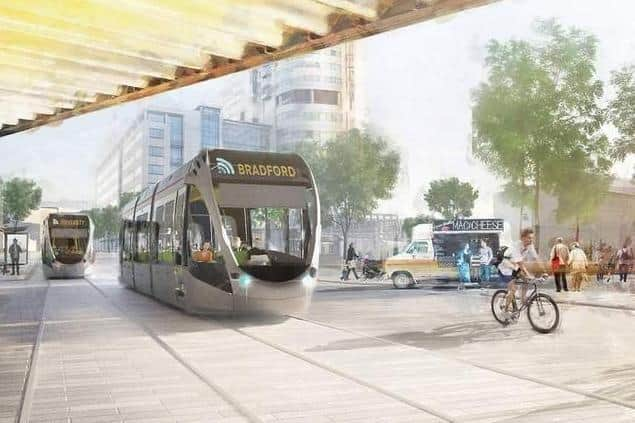

I therefore take the latest proposals with a generous pinch of salt. Even were every promise kept, the network would not be finished in my lifetime. And yet, amid all the earnest discussion of funding settlements and preferred routes, one thing is being missed altogether. It would be perfectly possible to have a network running in as little as five years, if those drawing up our plans were willing to look at how this ambition is being realised elsewhere.
As vice-chair of the China All-Party Parliamentary Group, I have watched with some interest the rapid arrival of a new kind of system in cities such as Zhuzhou, Yibin and Yancheng. It goes by the rather ungainly name of Autonomous Rapid Transit. It uses no rails, which are the chief source of the cost, the years of road closures and the constant diverting of pipes and cables that make the conventional approach so slow and so expensive.
Instead the vehicle follows a virtual track, its on-board computers reading markers set into the road surface. The vehicles are battery-powered and take their charge at each stop as passengers board, so there is no thicket of overhead wires to put up. They carry up to 300 people, run at up to 70 kilometres an hour (comfortably more than 40 miles an hour), and – crucially – can be installed in a matter of weeks rather than years, with very little lasting disruption. The saving is even more striking – by some estimates as little as a tenth of the cost of conventional light rail, and even on the most cautious figures no more than a fifth.
I can hear the objection already. Why should West Yorkshire take its lead from China? Simply, we should pursue what plainly works, wherever it happens to work, and we need not look only to the Far East to find it. In Coventry, engineers at the University of Warwick have developed a light rail system of our own. These trams are battery-powered, free of overhead wires, running on a shallow track set barely 30 millimetres into the road, at something like £10m a kilometre against the £25m projected for the current West Yorkshire proposals. Its first stretch of test track was laid in just eight weeks.
This country has nine light rail systems. Europe has some 250. The principle now being proved in Zhuzhou and in Coventry alike – lightweight vehicles, little or no track, no overhead wires, installed quickly and cheaply – could at a stroke bring rapid transit within reach of a dozen mid-sized towns and cities across the UK that the old model has always priced out. Australia, Malaysia, Israel and Dubai are all drawing up plans to adopt it.
There is a further prize. These vehicles are particularly well suited to the short trips between neighbouring towns – Leeds to Bradford, say, or Leeds to Rippon – at speeds that make them a competitive and cheaper alternative to the car, and across precisely the sort of county boundaries that a heavy, financially draining railway can rarely justify.
We have no shortage of Northern mayors, Northern bodies and Northern champions. What we need now is for regional leaders to embrace this innovation and for the good sense to send a delegation to those who have already done this and then to get on with it. The case for trams in West Yorkshire was settled long ago. The technology to deliver them exists, both here and abroad. All that is missing is political leadership. So what, precisely, are we all waiting for?
Lord Kirkhope of Harrogate is a Conservative peer, a former Member of Parliament for Leeds North East, and vice-chair of the China All-Party Parliamentary Group.