
What about farm land being lost due to climate change? - Yorkshire Post Letters

From: Dr Andrew Blewett, Matford Avenue, Exeter.
Peter Auty writes movingly about a farming family from Old Molton, whose acreage is destined to generate solar electricity (August 25). I agree that many if not all farmers are vulnerable in a fast moving complex environment, which is getting more complex with time, and no stability in sight. However, his argument that our big problem is taking land out of production for solar doesn’t stack up. Why?
Far more land is being taken out of production by climate disaster. The UK government Climate Change Committee scientific advice is that up to half of our best land will be under serious threat from flooding by mid-century.
Climate science also predicted increasingly severe summer droughts. The last three years saw an eighth of our cereals taken out of production by drought - this year perhaps worse.
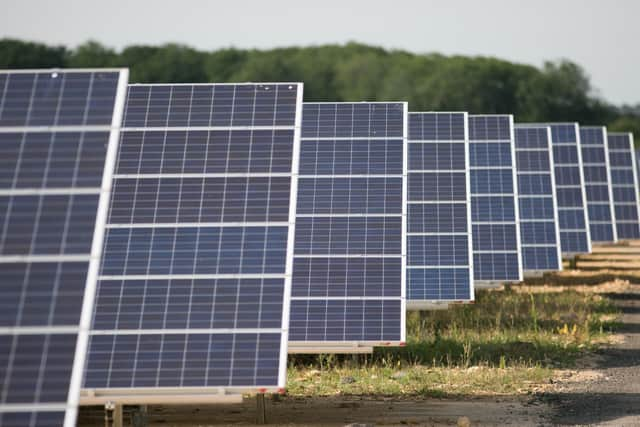

On the other hand, the government’s clean power targets envisage 0.4 per cent of UK land given over to solar, to generate up to a fifth of our net annual electricity needs - mostly in summer, complimenting wind - mostly in winter, leaving only a small part of our electricity dependant on fossil fuels for balancing purposes, and getting us of the gas price hook.
Further, why Peter’s focus on solar farms while we don’t seem to mind growing crops for bioethanol? 42, 000 Ha, 0.7 per cent of UK prime arable, is used to grow lorry fuel. Why isn’t Peter having a pop at this waste, easily worse than current solar farming. He needs to explain.
What all this tells us is that failure to join a sustainable global shift to clean energy will only make matters worse. A livable future depends on transition. Solar is one of the two quick fixes technically available to us, while the scope for Peter’s scheme to install much more expensive roof-top panels on barns and factories, laudable where possible, simply won’t measure up to the job.
The real issue for farmers is the need to move towards crop selections, livestock and regenerative management of land which are resilient to extreme weather. This means a lot of investment in learning, training, and physical re-invention of how we grow food and feed ourselves, including shifting the dial to less meat and more energy efficient plant-based food, with enormous potential impact on national food security.
Our domestic eating habits are already changing, but Peter seems unconcerned that we export meat which indeed is an earner, but very demanding in terms of prime arable supporting stocking elsewhere, which could be growing spuds for his dinner.
This is not primarily a case for ethical vegetarianism, it’s a case for efficient land-use under pressure from climate and our need for good, affordable food.
Perhaps Peter could move on from his nice but extremely costly roof-top argument. The arithmetic and practicalities don’t support him.