
What does it say about the Government if German supermarkets like Aldi and Lidl are coming out against its family farm tax? - Andrew Vine
Talk to any farmer about the relationship between agriculture and the big supermarkets and the chances are you’ll soon hear some trenchant criticism of prices.

Farmers have long been underpaid for what they produce, the consequence of the commercial clout of the supermarkets which screw prices down as low as they can.
Uneasy though it can be, the partnership between farmers and supermarkets keeps the overwhelming majority of people in Britain fed.
That fact seems to carry little weight with the government as it presses ahead with its ill-conceived and ruinous tractor tax, which will drive Yorkshire family farms out of business as surely as night follows day.
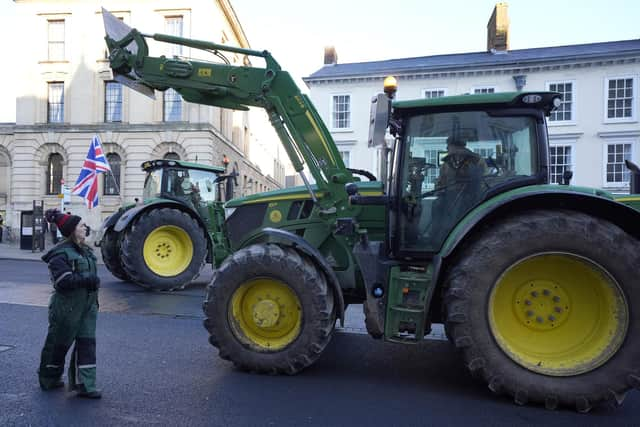

But if the government doesn’t care what happens to farmers, the supermarkets do. They have come out against changes to inheritance tax which will hit their suppliers, and in doing so deserve credit for supporting agriculture.
Almost every big chain has backed farmers in their fight against the tractor tax. Leeds-based Asda and Bradford-based Morrisons led the way. Sainsbury’s, Tesco, M&S and the Co-Op have joined them.
Both are based in Germany, and it is frankly extraordinary that overseas companies should be speaking up for British agriculture when Labour MPs are cravenly sitting on their hands and staying silent while farmers in their constituencies face seeing family businesses which have thrived for generations destroyed.
Despite the raw deals supermarkets force on farmers, they have a deep understanding of agriculture and how it impacts life for the entire country that appears to be lacking on the part of the government.
The statements from all of them make the same telling points – putting farms out of business will jeopardise food security, affect confidence in the agricultural sector and deter investment for the future.
They can foresee empty shelves or increased costs for imported food and are right to be concerned, just as farmers are right when they warn the tractor tax will decimate their industry and harm the countryside.
Everyone with any knowledge of farming and its crucial role not only in rural communities but in the wider economies of regions such as Yorkshire can see this tax is wrong at every level.
That was underlined last week by the letter from North Yorkshire Council to Chancellor Rachel Reeves urging her to think again. Its signatories included the leader of the Labour group.
All are people who know their patch, want it to prosper and realise only too well how badly it will be affected if farms go bust.
Maybe the intervention of the supermarkets, which make a massive contribution to the exchequer, will finally make the government take notice.
It should do so without delay, because it is currently set on a course to implement the most badly-judged policy since the introduction of the poll tax in 1990, which ultimately led to the downfall of Margaret Thatcher.
Proof of that is staring Sir Keir Starmer and Ms Reeves in the face, and their repeated insistence that inheritance tax changes will go ahead can only be interpreted as a stubborn refusal to accept facts.
This is a policy that was plucked from thin air, without consultation or proper consideration.
It has steadily unravelled since the day Ms Reeves announced it in her first budget, and that is hardly surprising because the whole thing is based on a false premise.
The Treasury’s assertion that 28 per cent of family farms would be affected was flatly contradicted by figures from Defra, which suggested 66 per cent being hit. The lower figure would be bad enough, but for two-thirds of farming families to be potentially driven out of business is appalling.
Plainly the Treasury had not done its homework, or talked to colleagues who spend their days working with agriculture, before coming up with a policy that is entirely destructive.
Then last week, the lack of thought that went into this dreadful measure was exposed yet again when the independent Office for Budget Responsibility concluded that it was “highly uncertain” to raise the £500m the Treasury claimed it would.
The OBR added that it would have a disproportionate effect on older farmers who would be unable to restructure their financial affairs before being taxed out of business.
This is a damning verdict. How is it even conceivable for a Prime Minister and Chancellor to defend a measure that will do next to nothing to plug the hole in the nation’s finances while at the same time victimising older people and undermining the British food supply?