
What is the West doing fanning the flames of war in Ukraine? - Patrick Mercer
You know what politicians say? If you’ve got a crisis at home, get a nice little war going somewhere to distract people. Well, I wonder if Sir Keir Starmer has been listening to that advice, because it looks as though Britain’s about to plunge headlong into a direct fight with Russia - a fight about which there’ll be nothing ‘nice’ or ‘little’.
The convoluted issue of whether Ukraine would be allowed to fire Western made missiles into Old Russia has been central to the whole debate for months now. The firing of these weapons was less important than Russia’s response, though, with the pundits divided over whether the Kremlin would do anything other than just sabre rattle or whether there would be a serious escalation.
In fact, both things happened, but with a thoroughly Slavic twist. First, when it seemed likely that Joe Biden would finally give his permission for ATACMS (long range rockets) and the British Storm Shadows to be used, the Russian sabre was indeed rattled. Vladimir Putin announced a change in doctrine which allowed his nuclear weapons to be fired at countries that provided long range missiles as well as those that actually pulled the trigger.
Then, when US and UK hardware was fired shortly afterwards, Russia retaliated with a sophisticated, ballistic missile that was designed to carry nuclear warheads and which had never been used before. Sticking to treaty rules, Moscow told the US and other nuclear armed countries that she was about to blast off and for a short time the Allies thought that Armageddon had been unleashed.
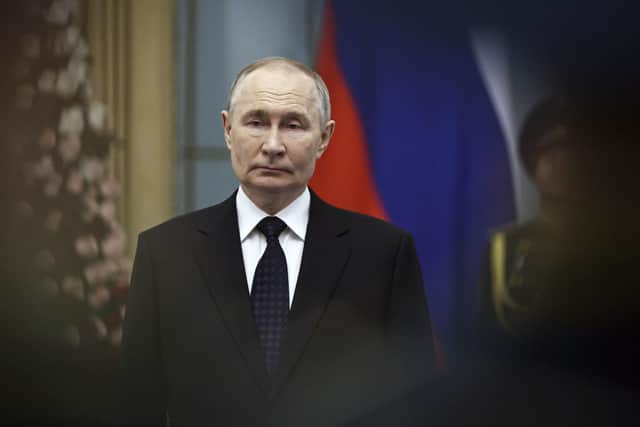

But no - and this was the twist - the Kremlin had deliberately fired a ‘blank’. The Oreshnik missile delivered 36 sub-munitions over Ukraine, but none of them had nuclear warheads: Russia simply wanted to demonstrate her ability to deliver a potentially devastating blow without being intercepted.
Extraordinarily, this counter-strike was mocked by much of the Western press with the Sunday Times even saying that it was ‘more of a whimper than a bang’. Really? The Oreshnik reached its target unscathed - and there’s plenty more where that came from.
Then there seemed to be a lull from the Allies whilst the implications of such a projectile being launched for the first time were digested. Would there be counter retaliation or had the West been overawed? Well, the answer came two days later when more ATACMS were fired into Kursk.
Now we wait for the next move; will Russia send nukes, chemical weapons or simply high explosives? Will Ukraine be the target again or somewhere in Germany or Poland? The British base in Cyprus has even been mentioned.
On top of this, France has given permission for her precision munitions to be used against Russian targets whilst Le Monde reports that Emmanuel Macron and Starmer are once more talking about an intervention by British and French forces. There had been a suggestion that specific areas such as the port of Odessa might be guarded by a limited number of soldiers, but there’s now a plan for our country and France to fill any gap left by the US should President Donald Trump decide to abandon Kiev.
The informed speculation goes further, hinting that Britain and the European nations must completely shoulder the burden of a continuing war with Russia on America’s withdrawal. In the light of Ukraine’s defences collapsing completely - the possibility of which is now being openly discussed in the West - British and European troops would have to be ready to trade shots with Russia.
Fine, except that Britain’s defence secretary has confessed that our Army ‘is not ready to fight’. Germany and France’s political turmoil, meanwhile, means that sending any troops would be deeply problematic whilst none of the ‘big three’ has the heavy guns or the ammunition for sustained fighting.
Poland is probably the only country with enough forces at a high enough level of readiness, but it’s madness to think that she and an alliance of small, European armies could hold the ring against Russia. No, the West’s ‘peace dividend’ of the last decades can now be seen for the dangerous nonsense that a few said it was: it’s baffling that Mr Starmer and others can’t grasp this reality.
What’s behind this crazed jingoism, though? Wartime pulls nations together and makes populations more dependent upon a government’s leadership (remember lockdown?); perhaps a dose of blood letting is exactly what Labour needs to overcome its tin-earned policies and plunging popularity?
And here’s another unbearably cynical explanation for all this bellicosity. The US election was an unequivocal victory for Mr Trump and he’s already making appointments and announcements that look certain to undo many of President Biden’s policies whilst redressing the ‘progressive’ direction of travel. Also, many Democrats fear that J D Vance (Trump’s Vice President) is being groomed to cement ‘Trumpism’ for two more terms once the Donald retires.
Now, one of the boldest declarations that Mr Trump has made is that he will end the fighting in Ukraine ‘within 24 hours’. That might be possible were Kiev’s troops on the front foot or even grittily holding the line, but they’re not. On current showing, the Kremlin’s troops will have overcome most resistance east of the Dneiper by the New Year and be in an even stronger position in any negotiations.
So, there’s only weeks for the hawks to kill, maim and fan the embers in Kursk and the Donbas into a blaze that will be impossible for President Trump to quench within months, let alone hours. Then the deaths of thousands more and an immediate policy failure will be a very dark stain for the incoming President to overcome as soon as he takes office.
Patrick Mercer is a former MP for Newark and Army colonel.