
What protesting farmers can learn from mistakes of the Miners Strike: Tony Lodge
“The miners united will never be defeated,” was the chant of Arthur Scargill’s striking colliers 40 years ago. The year-long 1984-85 coal strike was arguably the most divisive industrial dispute in Britain since World War 2, pitching the once all-powerful National Union of Mineworkers (NUM) against a triumphant Margaret Thatcher, fresh from victory in the Falklands and her 1983 election landslide.
The stakes were high; afterall NUM strikes and power cuts had undermined Edward Heath’s Tory government a decade earlier.
But 84/85 was to be different. Thatcher and her inner circle had seen Scargill coming. In opposition, in the late 1970s, they had war-gamed the likelihood of another clash with the NUM, especially after Labour’s Harold Wilson had satisfied their every demand with soaring subsidies and promises to double the size of the industry, despite the discovery of North Sea oil and gas. Another major battle was inevitable, but only when Scargill had made the early mistakes Thatcher and her team had anticipated and coal stocks were high.
So why should farmers, in their present bitter dispute with the government take any notice of an industrial conflict in a very different sector 40 years ago? Is it really very different? In many cases the farmers hold a stronger hand but their campaign already looks weak, predictable and divided with the National Farmers Union (NFU) proposing a traditional and restrained protest and others wanting Continental style resistance and even direct action.
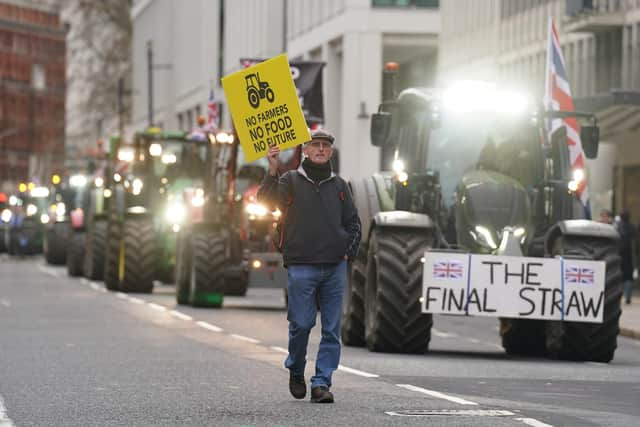

Jeremy Clarkson has called for a ‘provisional wing’ whilst wishing the NFU’s rather timid campaign well.
Unity is everything. This campaign row must end. In the case of the miners a bitter trade union split led to many drifting back to work. There was no going back and the NUM was broken. Any threats to power supplies, which was the whole point of the strike were banished for good.
So what are the lessons for farmers?
Devise, agree and commit to a robust plan of lobbying, protest and disruption. Unlike coal mining (in 1984), farming is privately managed and makes money. It doesn’t overproduce, if anything it is underproducing as food imports soar. Unlike coal most food cannot be stockpiled for months on end to withstand a stoppage; if farmers stop producing then a direct impact will be felt quickly in our daily lives and governments react to little else.
Choose and get behind a clever, prominent and media savvy leader. Though Scargill was undoubtedly the striking miners’ general, his media paranoia and poor strategy, ranging from letting coal bosses build up stocks and effectively choose the start date of the dispute sowed the early seeds of defeat. This was further exacerbated by the disastrous decision not to ballot union members on the walkout.
As things stand the farmers’ polite and very orderly recent protests in London and elsewhere have had little if any meaningful impact. Ministers will have concluded that there is little to fear so long as the NFU continues to be strung along with hollow promises from No 10 that they want dialogue, alongside a campaign of emails to MPs and tame protests with no real threat of escalation.
Crucially, Scargill’s strikers failed in their bid to blockade coal and coke supplies to key customers in power stations and steel plants. This was brutally exposed in the infamous pitched battle with police at Orgreave near Rotherham. Once they were split, working miners kept key pits working in some of the most productive areas.
Importantly, railway and power station workers were happy to move and burn stockpiled coal which fatally undermined the NUM’s dream of a tripartite strike across key sectors.
But solid action by farmers could have direct results almost instantly as food supply chains are much more instant and time sensitive. Shortages and price rises will quickly follow big reductions in supply. The loss of income for farmers is obviously a major issue but this is part of the battle; striking miners went without pay for 11 months but lost because they were split, badly led and couldn’t force power cuts.
Farmers must quickly decide and settle on a clear strategy. How far are they prepared to go? What does winning look like? If they decide the NFU-led campaign isn’t working they should take the decision now and set up a new, distinct movement and agree a clear strategy with different levels of escalation. Alternatively, their struggle will remain ineffective and fail.
They have a stronger political and strategic case than the miners. Unlike the NUM they aren’t asking for more taxpayers’ money to produce something they can’t sell.
People can even bear black-outs but not empty shelves. The farmers’ political, geographic and social footprint is more widespread but they must learn from their early tactical failures and get on the front foot. Anything less will mean their advantage is lost for good and with it their historic influence and leverage at Westminster.
“People will always need Coal” was the advertising slogan used to recruit new miners in the Seventies. But it wasn’t true. Given people will always need food then how can the farmers lose?
Tony Lodge is a political and energy analyst and Research Fellow at the Centre for Policy Studies.