
What the Government needs to do to win over farmers - Harriet Ranson
Recently, the Country Land and Business Association (CLA) welcomed news of a relaunched Sustainable Farming Incentive (SFI) this summer. Defra Secretary of State, Emma Reynolds made the announcement at the Oxford Farming Conference, in an attempt to re-set relations with the farming industry after a tumultuous 18-months since Labour came to power.
The original SFI scheme was abruptly closed in a poorly communicated decision last March, further undermining farmer confidence in the Government following the disastrous 2024 Budget, as well as decimating incomes and business investment. Upland farmers, who have always operated on narrow margins, were particularly stranded as many were never able to join the SFI due to a lack of suitable options for their land and businesses, had the promise of imminent suitable options erased.
In addition to the refreshed SFI, the CLA also welcomes the Secretary of State’s additional announcements of a new £30m Farmer Collaboration Fund, as well as a three-year extension to the popular Farming in Protected Landscapes (FiPL) programme.
The Farmer Collaboration Fund will aim to ‘support farmer groups in growing their businesses, building partnerships and sharing best practices’.
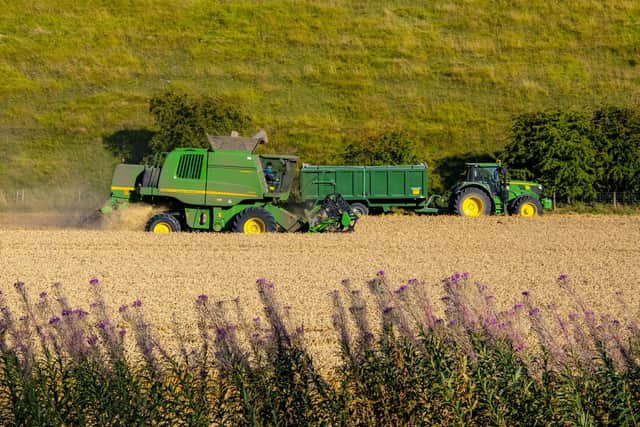

The FiPL programme benefits farmers and landowners within National Parks such as Yorkshire Dales and the North York Moors, and national landscapes such as the Howardian Hills. It specifically enables a wide range of projects that deliver for the environment and farm businesses across Yorkshire, and beyond.
The Environment Secretary also set out plans exploring a transformation of England's uplands. Building on research led by Dr Hilary Cottam in six upland areas during the past year, the government will work over the next two years – first in Dartmoor, then Cumbria. We await more detail and hope that the delicate relationship between the land, its owners and rural communities is reflected and boosted appropriately in these stunning if challenging landscapes.
The Government’s stated aim is to deliver ‘system-wide change, create farming clusters, explore new mutual funding models, and lay the foundations for new income streams, from nature-based enterprises to regenerative tourism and circular economy initiatives’.
With this slew of supportive announcements, Defra Secretary of State Emma Reynolds expressed a positive intent to work in partnership with the industry to boost farm profitability and long-term growth. The CLA is glad to be part of a small, trusted group of organisations working directly with Defra to ensure that SFI26 will work.
From our discussions with Defra it is clear that they remain committed to the SFI being a scheme designed to primarily help the government meet its legally binding environmental targets. The Government should recognise that only a profitable farming sector can afford the investment required to achieve environmental targets.
A finer balance is required between environmental and food security as inextricably linked public goods.
There will be two application windows for SFI in 2026, with the first from June prioritising smaller farms and those without an existing agreement, followed by a second round from September for wider applications.
However, with margins on food production steadily diminishing in the face of costly red tape and market challenges, it is essential that all farmers can access the Sustainable Farming Incentive scheme as soon as possible, regardless of farm type or size, to be able to finance delivering the greatest benefits to the environment alongside food production.
The CLA urges Defra to focus on rewarding environmental outcomes rather than imposing arbitrary caps based on farm size which will limit the extent to which nature benefits. Incentives should remain proportionate to the scale of delivery to ensure fairness, efficiency and maximum impact for the environment and food security.
There are many details still to be worked out and the CLA will be working closely with Defra over the next few months to clarify how a small farm is defined; how existing SFI schemes will transition and be given priority; payment rates and other details.
These announcements are all welcome. However, they fall short on the expectation of ‘clarity and stability’ promised at the CLA’s Rural Business Conference in November 2025.
Defra has had six months since the Agriculture Budget was set at £2.7bn per year for the three-year period of April 2026 to March 2029, and could reasonably have been expected to issue a more detailed plan by now.
In the short-term, what businesses need is a detailed plan of the proposed schemes and timing of application windows for the full three-year period, to support business planning.
For the long-term, there needs to be a focus on assimilating the recommendations of the Farming Profitability Review into the Farming Roadmap, and recognition of the social, environmental and economic value of the environmental land management schemes over the long term, beyond the current three-year spending review.
Harriet Ranson is CLA Director North.